Semana de Turismo: Uruguay’s Easter Week, Explained (2026)

The first time I tried to do anything practical in Uruguay during the week before Easter, I failed at all of it. The bank was shut. My usual lunch place had a handwritten sign in the window. The bus to Montevideo was standing-room only, packed with families and coolers and at least one inflatable kayak. A neighbour found me looking confused on the pavement and said, with the patience you’d use on a slow child, “It’s Semana de Turismo. Everyone’s left.” Then she got in her loaded car and left too.
That week taught me more about how Uruguay actually works than any guidebook had. So here is the thing nobody tells you before you book an autumn trip.
Semana de Turismo (Spanish for “Tourism Week”) is Uruguay’s secular name for Holy Week, the days around Easter. Uruguay renamed its religious holidays in 1919 under a hard separation of church and state. Today it is the year’s biggest domestic-travel week, when the cities empty for the coast. In 2026 it runs roughly Monday 30 March to Sunday 5 April.
What this guide covers
I want to explain the part that confuses almost every visitor, which is why a deeply Catholic-looking corner of Latin America calls Easter “Tourism Week” and mostly means it. Then I’ll get practical. You’ll find:
- The strange, genuinely interesting history of how Holy Week became Semana de Turismo in 1919.
- What the week actually looks like today, and where Uruguayans go.
- The Semana Criolla del Prado in Montevideo, the gaucho festival that runs the same week.
- The food traditions that survive even in a secular country.
- A clear-eyed take on the question of traveling during Semana de Turismo at all, plus the one honest drawback for each idea.
A quick note on words before we start. Semana de Turismo is Tourism Week. Semana Criolla means roughly “Creole Week” and refers to gaucho-tradition festivities. A gaucho is a South American cowboy of the grasslands. Jineteada is the rodeo-style event where a rider tries to stay on a bucking horse. Asado is the slow wood-fire barbecue that anchors most Uruguayan gatherings. The Prado is a leafy old neighbourhood in northern Montevideo. I’ll re-gloss them as they come up.
Semana de Turismo 2026 at a glance
Dates shift every year because Easter does. Here’s how the 2026 week lays out. The two days that genuinely stop the country are Holy Thursday and Good Friday, when banks, government offices and many shops close.
| Day | Date (2026) | What happens | What’s open |
|---|---|---|---|
| Monday–Wednesday | 30 Mar – 1 Apr | The getaway begins. Schools and many workplaces wind down; roads to the coast and the hot springs start filling. | Mostly normal. Banks and shops open, though emptying out by Wednesday afternoon. |
| Holy Thursday | 2 April | Official non-working holiday. The big travel push. Montevideo goes quiet; the coast and interior fill. | Banks and offices closed. Many restaurants and supermarkets open with reduced hours. |
| Good Friday | 3 April | Official non-working holiday. The quietest day in the cities, the busiest on the beaches and at the termas. | Banks, offices closed. Tourist businesses, estancias, beach towns fully working. |
| Saturday | 4 April | Peak crowds at the coast and hot springs. Semana Criolla in full swing at the Prado. | Shops reopen in cities; tourism running at full tilt. |
| Easter Sunday | 5 April | The week winds down. The long drive home begins; expect heavy return traffic on the main routes. | Normal Sunday. Markets and most attractions open. |
One caution on the calendar: Uruguayans treat the whole stretch as a holiday week, but only Thursday and Friday are the formal non-working public holidays. Monday through Wednesday are ordinary working days on paper, even if half the country has already mentally clocked off. If you need a bank, a notary or a government office, do it before Thursday or wait until the following week. For the full picture of how this fits the year, I keep a running reference on Uruguay’s public holidays.
How Holy Week became Semana de Turismo: Uruguay’s 1919 secular renaming
Most of Latin America does Easter with processions, palm fronds and packed churches. Uruguay does it with a road trip and a thermos of mate. The reason is a stretch of reforms a century ago that made this one of the most secular countries in the Americas, and it changed the calendar in ways you still feel today.
The shift didn’t start in 1919. By the 1880s, young liberals were already skipping religious observances. There’s a wonderful detail in the record: in 1886, a newspaper in Salto tut-tutted about local “young people in our society who care nothing for excommunication and other trifles,” because they’d rather go hunting in the countryside than sit through Holy Week. The state was pulling away from the Church well before it made it official.
Then came José Batlle y Ordóñez, the reformist president who dominated Uruguayan politics in the early twentieth century and built much of the modern country. Under his influence, religious instruction was removed from public schools in 1909. A full separation of church and state was written into the 1917 Constitution. And in 1919, the state finished the job by renaming the religious holidays themselves.
The instrument was Ley N° 6997, passed on 23 October 1919. It stripped the religious labels off the public calendar and gave the dates secular names:
- Holy Week became Semana de Turismo (Tourism Week).
- Christmas became the Day of the Family (Día de la Familia).
- Epiphany, the Day of the Kings on 6 January, became Children’s Day (Día de los Niños).
- Carnival, in the same secular spirit, is the season Uruguayans throw themselves into without a hint of Lenten restraint.
Two motives sat behind the renaming, according to historians who’ve studied it. One was principle: the new framework held that all religious worship is free in Uruguay and the state supports no religion. The other was practical and a little cheeky for 1919. The government wanted to grow tourism as an actual industry, so it labelled the spring-into-autumn break “Tourism Week” and effectively told citizens to go travel. The name was an economic nudge as much as an ideological statement.
Here’s what surprised me most, living here: it stuck completely. This isn’t official box-ticking that locals ignore. Everyone I know calls it “la Semana de Turismo,” in casual speech, on the news, in shop signs. Ask a Uruguayan when their Easter break is and they’ll correct you gently and tell you about Tourism Week. The 1919 rebrand won so thoroughly that the original name now sounds slightly foreign in everyday conversation.
None of which means Easter vanished. Catholic and Evangelical Uruguayans still mark Holy Week with services, and church attendance ticks up. The country didn’t ban the religion; it just declined to run the calendar on the religion’s behalf. You end up with a quietly unusual situation where the devout observe Semana Santa and everyone else observes Semana de Turismo, on the exact same dates, with no real friction. If the Uruguayan habit of doing things its own stubborn way interests you, it threads through the whole of Uruguayan culture.

What Semana de Turismo looks like today
Strip away the history and you’re left with a simple modern fact: this is the single biggest week of domestic travel in the Uruguayan year. More than 100,000 Uruguayans typically leave the country altogether for the week, and far more move around inside it. The cities hollow out. The coast and the interior fill up.
The timing is the whole appeal. Semana de Turismo lands in early autumn, late March or April, which in the Southern Hemisphere is the close of the warm season. It’s the last comfortable window before the cool, grey stretch of Uruguayan winter sets in. People treat it as the final getaway of the year, a last go at the beach, the river, the outdoors, before everyone hunkers down. If you want to understand the seasonal logic, it sits squarely in the rhythm I describe in Uruguay in autumn, and the day-to-day feel matches the patterns in the Uruguay weather guide.
There’s also a long camping-and-fishing tradition baked into the week. For a certain kind of Uruguayan, Semana de Turismo means loading a tent and a rod and disappearing to a riverbank, alternating fishing with controlled hunting and a lot of doing nothing. It’s the rural counterpart to the beach exodus, and it’s why so many small interior campsites fill up.
Semana Criolla del Prado: the gaucho festival at the heart of the week
If Semana de Turismo has a cultural centre of gravity, it’s the Semana Criolla del Prado in Montevideo. Semana Criolla translates loosely as “Creole Week,” and “criollo” here means the homegrown rural culture of the gaucho, the cowboy of the South American grasslands. While much of the country heads for the beach, this is the one big event that pulls people toward the capital instead.
It’s not a tourist invention. The city of Montevideo has organised it since 1925, which makes it almost exactly as old as the secular holiday itself. It runs at the Rural del Prado, the city’s main agricultural showground, in the green old Prado neighbourhood in the north of Montevideo. Plan on a 10-to-15-minute taxi ride from the centre, or about 30 minutes by bus. Any taxi driver will know exactly where you mean.
The festival opens daily, roughly midday until late, for the full stretch from the Sunday before Easter to the Sunday after. The thing to come for, the thing that draws the crowds, is the jineteada.
The jineteada, explained
A jineteada is gaucho bronco riding. A rider mounts a horse that has been bred and reserved to buck hard, and the whole point is to stay on while it does everything it can to throw him. The good ones hang on for somewhere between 6 and 15 seconds, which does not sound long until you watch a half-tonne animal try to fold itself in half underneath a man in a flat hat and baggy trousers. Riders come from across the region; gauchos from Argentina, Chile and Brazil compete too, but the Uruguayan crowd is unmistakably home.
Around the riding, the Prado turns into a full immersion in country life. There’s live music from late afternoon, usually starting around 6pm: folclore, the traditional folk style, plus rock and whatever else pulls a crowd. You’ll catch some of Uruguay’s well-known artists across the evening hours. There’s traditional dance. There’s a daily kids’ show, listed as “espectáculo infantil,” usually around 5pm.
And there are the stalls. This is where you eat your way through gaucho cooking, all of it meaty, and browse handmade crafts, riding gear, and proper gaucho clothing. If you’ve ever wanted a pair of bombachas, the loose pleated trousers gauchos actually wear, this is where you buy them from people who actually wear them.
Tickets go on sale at the gate, priced by seating area, with the Palco Oficial and Tribuna sections giving the best views. The top seats usually run about 10 to 15 US dollars. Children under twelve get in free unless they take a seat.
The honest drawback: the jineteada is a hard tradition and it doesn’t pretend otherwise. These are animals bred to buck and the spectacle is rough by design. If rodeo-style events sit badly with you, you’ll have a better time at the food and music stalls, or skipping the Prado for the coast entirely. I’d rather tell you straight than have you walk in unprepared.
One more thing worth saying. This festival is not staged for foreigners. Like Montevideo’s carnival, the Semana Criolla is by and for locals, which is exactly what makes it worth your evening. It links directly to the living gaucho world you can visit out in the country at an estancia, the working ranches where this culture isn’t a show but a job. The Prado is the city’s once-a-year window onto it.

Where Uruguayans actually go
Ask around before the week and you’ll hear the same handful of destinations. Here’s where the country scatters to, and what each is good for.
The hot springs of the northwest
This might be the single most popular Semana de Turismo move. Up in the departments of Salto and Paysandú, on the Río Uruguay in the country’s northwest, sit a cluster of thermal-spring resorts: Termas del Daymán, Termas de Arapey, Termas de Guaviyú. The geothermal water is drawn from the Guaraní Aquifer, one of South America’s great freshwater reserves, and in early-autumn weather the contrast of cool air and hot water is the whole point. These complexes fill to the brim during the week.
The honest drawback: the termas are the most over-subscribed destination of the entire week. Daymán in particular can feel less like a serene soak and more like a very warm public pool at peak. Book your accommodation weeks out, and if you want quiet, go for the smaller Guaviyú over the busy Daymán.
The Atlantic coast
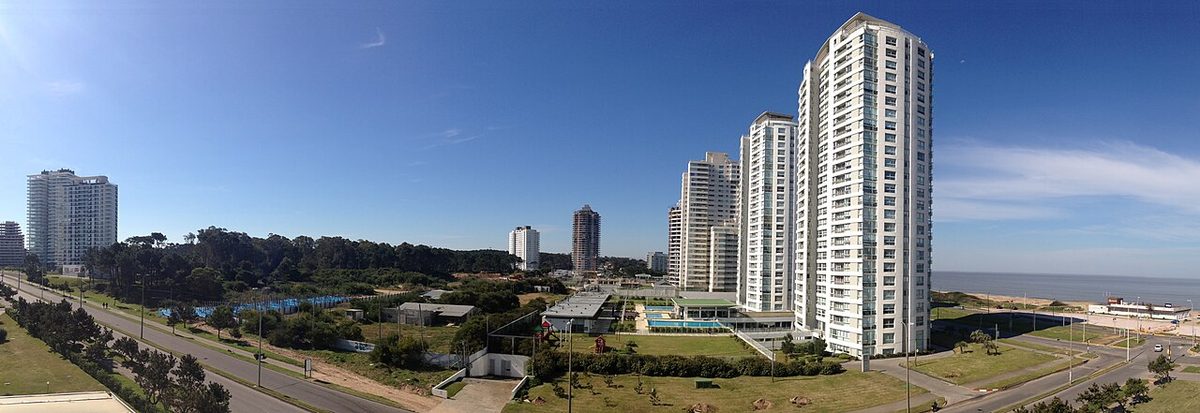
Beaches still pull the biggest numbers. Punta del Este is the marquee name and runs at full capacity, but plenty of families head for the calmer towns east toward Rocha, like La Paloma. The water has cooled from its January peak, so this is more about long beach days, seafood and the last warm light of the year than swimming. The coast is busy but it’s working, with restaurants and hotels fully open.
Colonia, Lavalleja and the interior
For something slower, Uruguayans peel off to Colonia del Sacramento, the cobbled UNESCO-listed river town founded in 1680, or into the low hills of Lavalleja for hiking and natural viewpoints. The interior is where the camping-and-fishing crowd vanishes to, and where the estancias do steady business hosting people who want horses, asado and silence.
Paysandú’s Beer Week
Worth a mention for the sheer incongruity: while half the country is fishing and the other half is at a gaucho rodeo, the city of Paysandú throws Semana de la Cerveza, Beer Week, a sort of riverside autumn answer to Oktoberfest. It’s a long-running fixture and one of the bigger draws in the litoral region.
If you’re trying to decide where any of this fits in your own trip, it all ladders up to the bigger question I tackle in my guide to the best time to visit Uruguay.
What people eat during Semana de Turismo
A secular calendar didn’t erase the food traditions, which I find quietly telling. Even Uruguayans who’d never set foot in a church still eat the Holy Week way out of habit, family rhythm and the simple fact that it tastes good.
The big one is fish. The old Catholic custom of skipping red meat on the holy days lives on at the table, so this is the rare week when a country obsessed with beef leans into pescado. Empanadas, the baked stuffed pastries, get filled with fish, seafood or cheese instead of the usual mince. Coastal towns push their seafood. For a population that treats asado as a near-religion in its own right, a week of fish is a genuine seasonal marker.
Then there are tortas fritas: flat discs of fried dough, faintly salty, best eaten warm. They’re the classic rainy-day food, and because autumn brings grey afternoons, Semana de Turismo and tortas fritas go together. You buy them from street carts or fry them at home, and they’re the natural companion to a round of mate, the bitter herbal tea passed hand to hand that is less a drink than a social operating system here.
At the Semana Criolla, none of this restraint applies. The Prado stalls are aggressively meaty, all grilled cuts and gaucho cooking, which is its own kind of tradition pulling in the opposite direction. The country contains both impulses in the same week and sees no contradiction.

Should you travel to Uruguay during Semana de Turismo?
Now the question you actually came for. Is it a good week to be here, or one to dodge? My honest answer: it depends entirely on what you want, and the trade-offs are sharper than for any other week of the year.
The case for going
You get to see Uruguay being thoroughly itself. The Semana Criolla is a real, century-old festival you can’t catch any other week. The weather is usually mild and pleasant, the last decent warmth of the year. And there’s an energy to a whole country on the move that’s genuinely good to be inside of, if crowds don’t drain you.
The smart play is to do what Uruguayans do. The cities empty, so the estancias and beaches stay busy but workable while Montevideo goes still. Spend the holiday days at a ranch or on the coast, where the infrastructure is built for exactly this, rather than expecting normal city life.
The case against, and the honest drawback
This is the busiest domestic travel week of the year, full stop. The main routes to the coast clog up, especially the Thursday outbound and the Sunday return. Ferries and buses sell out. The popular spots, the termas above all, hit capacity. And prices climb across accommodation in the in-demand areas. If your idea of a good trip is empty roads and easy last-minute bookings, this is the wrong week.
The single biggest drawback: if you don’t book ahead, you can get genuinely stuck. The good places in the popular areas fill weeks out. Show up without a reservation during Semana de Turismo and you may find yourself driving town to town at dusk with no room anywhere. Book early or build flexibility into your dates.
How to plan around it
A few hard-won rules:
- Handle all admin before Holy Thursday. Banks, government offices and many services shut Thursday and Friday (2–3 April in 2026). Change money, sort paperwork and stock up by Wednesday.
- Don’t try to do city errands on Thursday or Friday. Montevideo and the interior cities go quiet. If you need a working city, that’s the wrong moment.
- Reverse the crowd where you can. The cities are eerily calm and pleasant during the week. If you actually like a quiet Montevideo, this is a surprisingly nice time to walk the old city, as long as you accept some shops will be closed.
- Avoid driving the main coastal routes on the peak days. Thursday out and Sunday back are the heavy ones. Travel a day off-peak and you’ll skip the worst of it.
- Book accommodation as early as you reasonably can, especially for the hot springs and Punta del Este.
Semana de Turismo: your questions answered
When is Semana de Turismo in 2026?
The week runs roughly Monday 30 March to Sunday 5 April 2026, tracking Holy Week. The two official non-working public holidays are Holy Thursday, 2 April, and Good Friday, 3 April. Easter Sunday falls on 5 April. Because the dates follow Easter, they move every year, so always check the specific dates for the year you’re travelling.
Why does Uruguay call Easter “Tourism Week”?
In 1919, under President Batlle y Ordóñez’s drive to separate church and state, Uruguay passed Ley N° 6997 and renamed its religious holidays. Holy Week officially became Semana de Turismo. The same law turned Christmas into the Day of the Family and Epiphany into Children’s Day. It was both an ideological statement and a deliberate push to grow tourism as an industry.
Is everything closed during Semana de Turismo?
No, but the key days are limited. Banks, government offices and many shops close on Holy Thursday and Good Friday. Supermarkets and restaurants often open with reduced hours. Crucially, the tourism machinery stays fully open: estancias, beach towns, hot springs and the Semana Criolla all run at full capacity. The cities slow down; the holiday destinations speed up.
What is the Semana Criolla del Prado?
It’s Montevideo’s gaucho festival, held every Tourism Week at the Rural del Prado showground since 1925. The main draw is the jineteada, gaucho bronco riding, alongside folk music, traditional dance, crafts stalls and a lot of grilled meat. Tickets sell at the gate, with the best seats around 10 to 15 US dollars. It’s a genuinely local event, not a tourist production.
Where do Uruguayans go during Tourism Week?
Three main directions. The hot springs of Salto and Paysandú in the northwest (Daymán, Arapey, Guaviyú) are hugely popular. The Atlantic coast, from Punta del Este east toward Rocha, pulls beach crowds. And the interior, places like Colonia del Sacramento, the hills of Lavalleja, and the estancias, draws those after something slower, plus the camping-and-fishing set.
Is Semana de Turismo a good time to visit Uruguay?
It can be excellent if you book ahead and go where the locals go, the estancias, coast and hot springs, where everything is open and the autumn weather is mild. It’s a poor choice if you want empty roads, easy last-minute bookings or a fully functioning city, since it’s the busiest domestic travel week of the year and prices in popular areas climb.
Final thoughts
I’ve come to love Semana de Turismo precisely because it’s so Uruguayan. A country looked at its inherited religious calendar a hundred years ago, decided it would rather travel than pray, and made it official, then kept the fish dinners and the family rituals anyway because those were never really the point of the argument. You get the secular name and the sacred habits living side by side, plus a gaucho rodeo in the capital and a nationwide stampede to the coast, all in the same week.
If you come, come on purpose. Book early, do your city business by Wednesday, then follow the Uruguayans out to a ranch, a beach or a steaming thermal pool and let the cities empty behind you. Done right, it is one of the most revealing weeks you can spend in this small, stubborn, surprising country, and it deserves a spot in your thinking about the best time to visit Uruguay.
Credits & sources
Sources & further reading
- Tourism Week (Wikipedia) — overview of the 1919 secularization and Ley N° 6997.
- Guru’Guay: Why Uruguay celebrates Tourism Week, not Easter — first-hand context on the church-and-state history.
- Guru’Guay: Gaucho week in Montevideo — practical detail on the Semana Criolla del Prado.
- Intendencia de Montevideo: Qué es la Semana Criolla — the official municipal source on the festival.
Photo credits
All images via Wikimedia Commons: Jineteada Semana Criolla Uruguay by Carohv91 (CC BY-SA 4.0); Montevideo Prado Park Autumn by Eduardo Ruggieri (CC BY-SA 3.0); Gauchos Horses Uruguay Countryside by Bicentenario Uruguay (CC BY-SA 2.0); Punta Del Este Beach Uruguay by Zulmabm (CC BY-SA 4.0); Tortas Fritas Uruguay Fried Dough by adrian, https://www.flickr.com/photos/acanti/ (CC BY 2.0).