Desfile de Llamadas: Montevideo’s Great Drum Parade (2026)
The first thing you feel is the floor. I was standing on a kerb in Barrio Sur — one of Montevideo’s old downtown neighborhoods (a barrio is simply a city district) — when a wall of bass came rolling up Isla de María street about two blocks before I could see anyone. By the time the first comparsa rounded the corner, the sound had climbed into my chest and stayed there. That is the moment everyone talks about, and it is the reason I keep coming back.
That desfile de llamadas is Montevideo’s great drum parade: two consecutive February nights when roughly forty comparsas — neighborhood candombe troupes of drummers, dancers and costumed characters — march down a single narrow street in the Barrio Sur and Palermo districts. Around 3,000 drums and more than 6,000 performers compete for the year’s title in front of packed grandstands. It is the loudest, most concentrated expression of Afro-Uruguayan culture you will ever stand next to.
I have watched it from a cheap plastic chair, from a rented balcony, and from the free standing room where you get shoved and grinned at in equal measure. This guide is the version I wish someone had handed me the first time: what the parade actually is, who all those characters are, how the judging works, the exact route, where to sit, and the honest catch nobody mentions until you are three hours deep on a hard bench at midnight.
Locals just call it Las Llamadas, and if you search “las llamadas montevideo” you will find the same parade. It sits inside the wider Montevideo Carnival, the longest carnival season in the world, and it runs on the rhythm called candombe. I will point you to those two guides rather than re-explain the drums and the whole festival from scratch — here, the parade is the whole story. It is also one of the clearest windows into Uruguayan culture you can find on a single night.
What this guide covers
I have organized this around the way the night actually unfolds. First, what the parade is and where it came from — because the history explains almost everything you see. Then the comparsas and their cuerdas de tambores (the drum lines), followed by the cast of characters and what each one represents. After that, how the competition is judged, the precise route and the best places to stand or sit, and the practical layer: tickets, timing, crowds and photography. I close with the questions people actually ask me, and one honest drawback.
Here is the parade at a glance before we get into it.
| Detail | What to know |
|---|---|
| What it is | A judged candombe parade of neighborhood comparsas (drum-and-dance troupes) |
| When | Two nights in early February, both starting around 7:00 p.m. and running past midnight |
| Where | Isla de María / Isla de Flores street, through Barrio Sur and Palermo, central Montevideo |
| Route length | Roughly 1.5 km, from Zelmar Michelini to Minas street |
| Scale | About 40 comparsas, ~3,000 drums, 6,000+ performers across the two nights |
| Official since | 1956 (rooted in neighborhood llamadas going back to the 1800s) |
| How to watch | Paid grandstand seats (tribunas) or chairs (sillas) via the Abitab network, or free standing room |
| Honest catch | It starts late, ends very late, and gets extremely packed |
Where the llamadas come from
The word “llamada” means a call, and that is exactly what it once was. In the 1800s, Afro-Uruguayan drummers in Montevideo’s poorest neighborhoods would sling a tambor over one shoulder and walk the streets playing — and the sound itself was the summons. A drummer would stop outside a friend’s door, play, and the friend would grab his own drum and fall in behind. Block by block the group grew. They were “calling” each other out to play. That is the literal root of the name, and you can still feel it in the way a comparsa swells as it moves down the street.
These were the descendants of enslaved Africans brought to the Río de la Plata during the colonial period. After abolition, freed families clustered in two downtown districts — Barrio Sur and Palermo — and in crowded tenement buildings called conventillos, the most famous being Mediomundo in Barrio Sur and Ansina in Palermo. Those buildings, demolished in the 1970s, were the cradle of candombe’s rhythmic variations: the Cuareim beat of Barrio Sur, the Ansina beat of Palermo, and the Cordón beat from a third neighborhood. Drummers still argue about which “side” a cuerda plays.
The first organized black carnival group, Raza Africana, appeared in 1865. By 1876 the so-called “negros lubolos” had emerged — a tradition that grew into today’s Sociedades de Negros y Lubolos, the umbrella for the candombe troupes. For decades the llamadas were spontaneous: groups simply set out from their conventillos and paraded where they liked. Then, in 1956, the Intendencia de Montevideo (the city government) folded them into an official, judged event on a fixed date. That is the parade you buy a ticket for today. Unofficial llamadas still break out in various neighborhoods throughout the season, but the big one is the official desfile.
One detail I love: the ceremony has always begun with fire. Before a comparsa can play, the drummers crouch around a bonfire to heat the goatskin heads of their drums — heat tightens the skin and tunes the pitch. If you arrive early near the staging area, you can sometimes catch the cuerdas warming their drums over the flames, faces lit orange, before they ever reach the crowd.
Comparsas and the cuerda de tambores
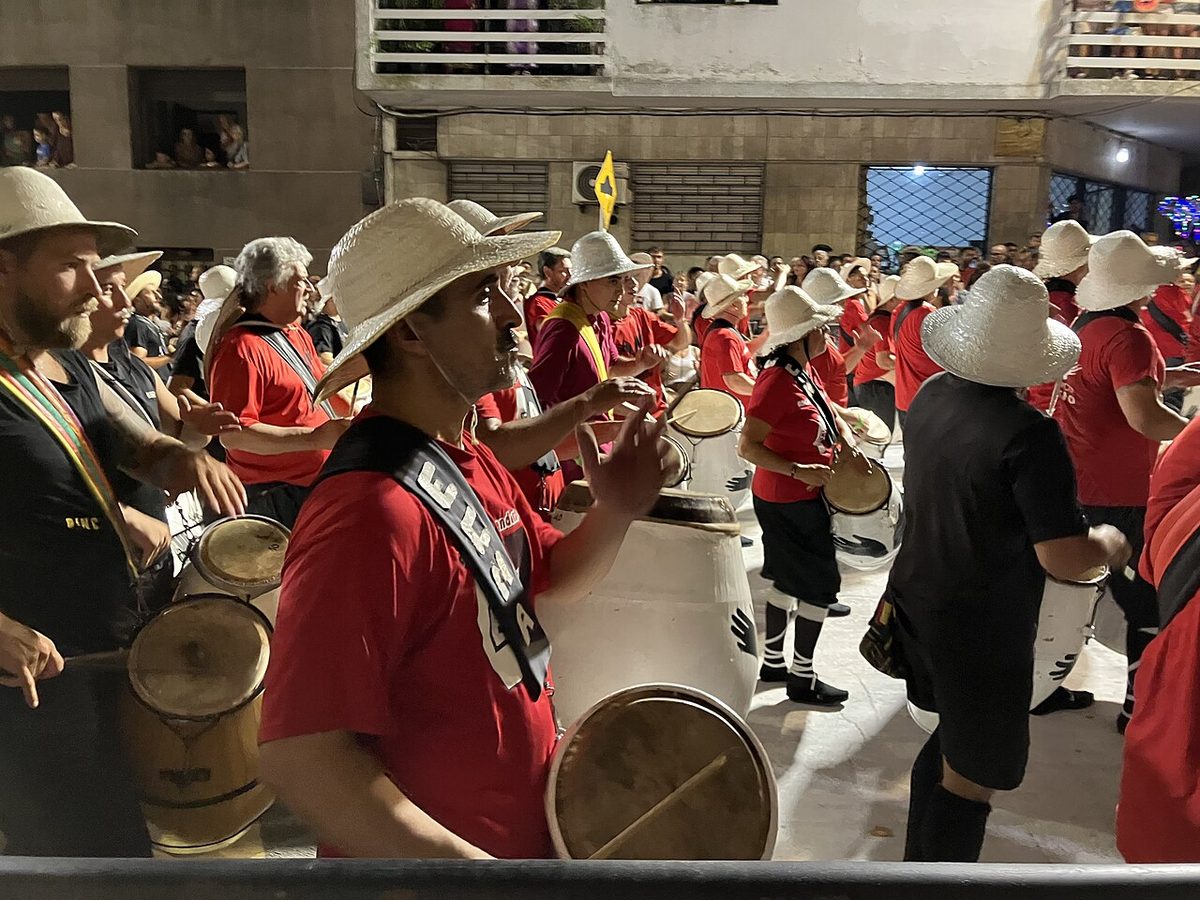
A comparsa is the whole troupe — drummers, dancers, flag-bearers and characters — that represents a neighborhood or a club. The beating heart of each one is the cuerda de tambores, the drum line, and it is worth understanding what you are hearing, because the rest of candombe’s musical background I will leave to the dedicated candombe guide.
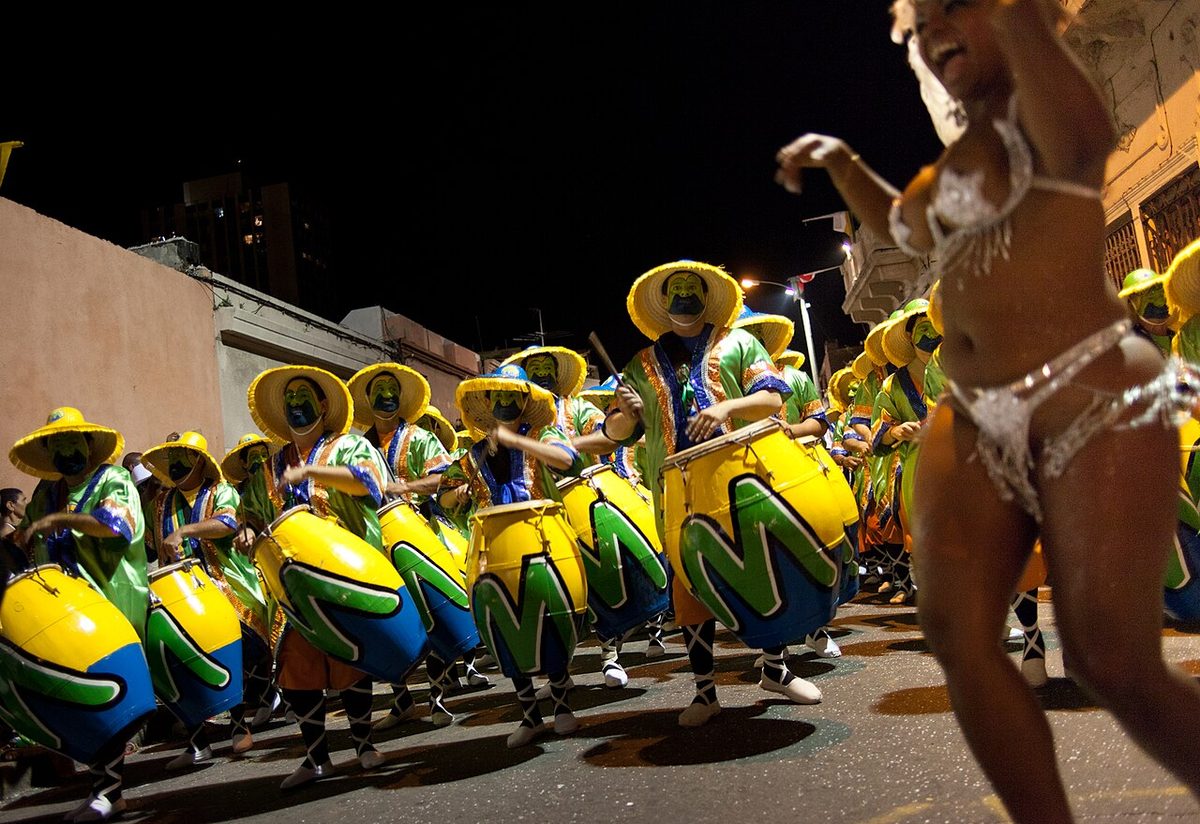
Candombe uses a single kind of barrel drum in three sizes, and the interplay between them is the entire sound. The chico is the smallest and highest, and it keeps the fast, steady pulse. The piano is the largest and lowest, laying down the deep melodic phrase that you feel in your sternum. The repique sits in the middle and improvises — the chattering, syncopated voice that dances over the top. Some cuerdas add a bombo (a bass drum) for extra weight. When forty or fifty of these play in lockstep, the effect is less like a band and more like weather.
The official rules set a real minimum. Every competing comparsa must field at least 36 drummers — at minimum 12 chicos, 12 pianos and 12 repiques — plus a fixed roster of characters and dancers, and the whole troupe can run up to 150 people. The big-name cuerdas like Cuareim 1080 (often written C1080), Yambo Kenia, Tronar de Tambores, Cenceribó and Valores de Ansina field the maximum and have followings the way football clubs do. Drummers wear costumes thick with meaning, which I will come back to.
The cast of characters, and what each one means
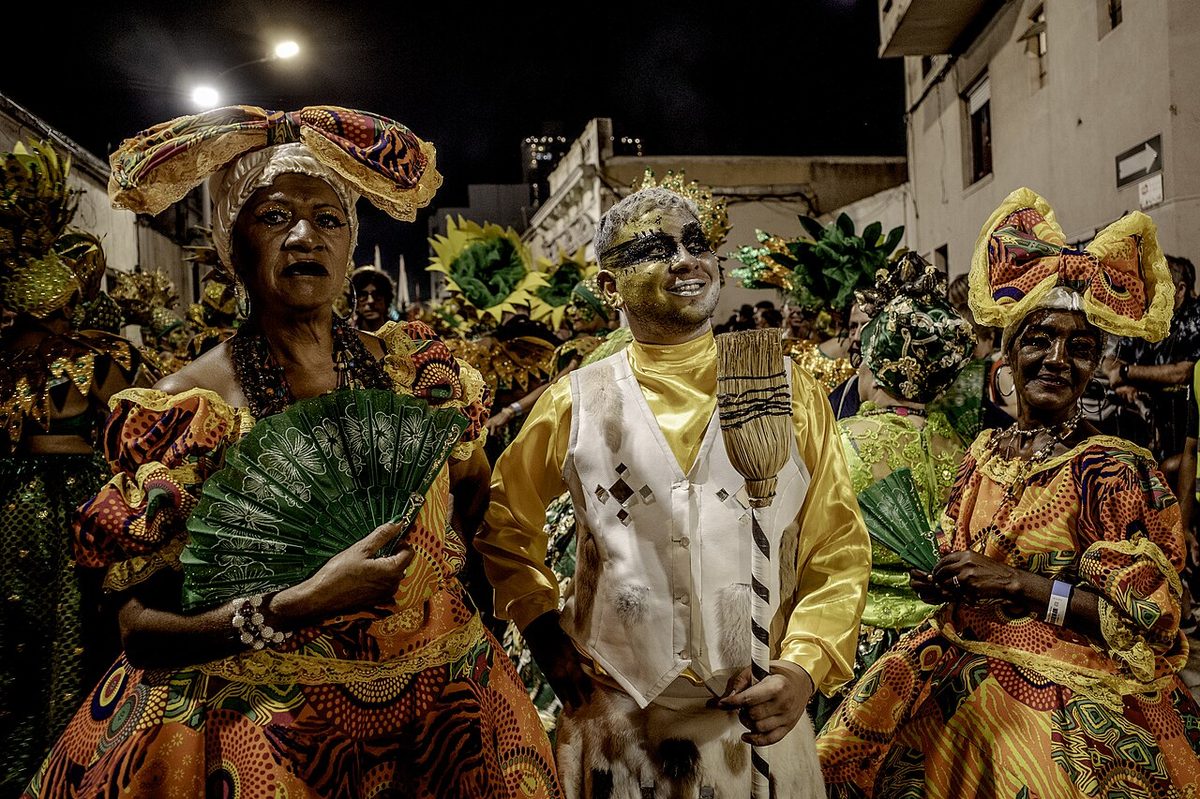
This is the part that turns the parade from a spectacle into a story. A comparsa marches in a fixed order, and every figure carries a meaning rooted in colonial Montevideo and in Africa. Once you can read them, you stop watching a crowd and start watching a procession with a plot. Here is the order they pass you, more or less, and what each represents.
| Character / element | What it is | What it represents |
|---|---|---|
| Portaestandarte | The standard-bearer carrying the comparsa’s banner first | The troupe’s name and identity, announcing who is coming |
| Banderas, estrellas, medialunas | Large flags, stars and half-moons on poles, often lit | Islamic symbols recalling the faith many enslaved Africans held before the Río de la Plata |
| Cuerpo de baile | The body of male and female dancers | The joy and energy of the comparsa; pure performance |
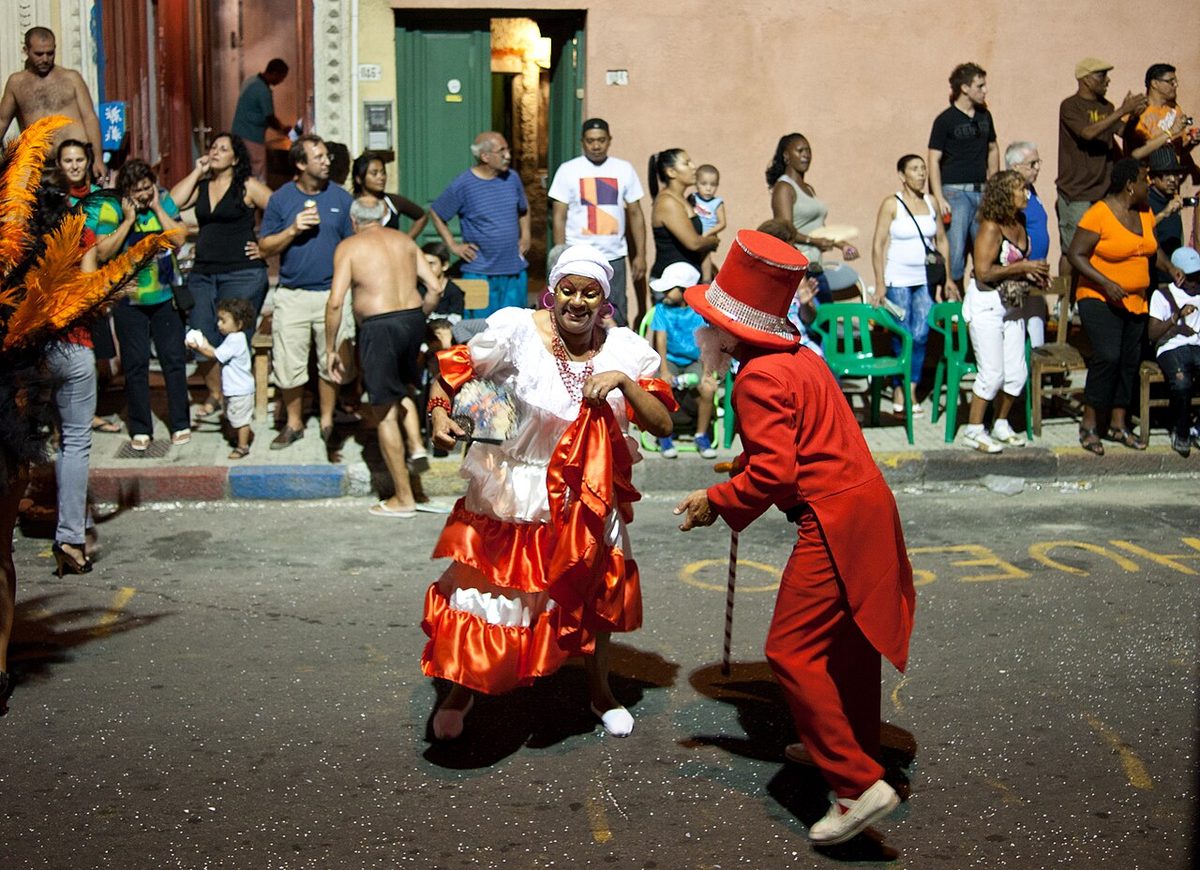
| Gramillero | An “old man” with cotton beard, top hat, frock coat, cane and a doctor’s bag | The tribal healer or witch-doctor who cured with herbs (gramillas); also a parody of the colonial “doctor” |
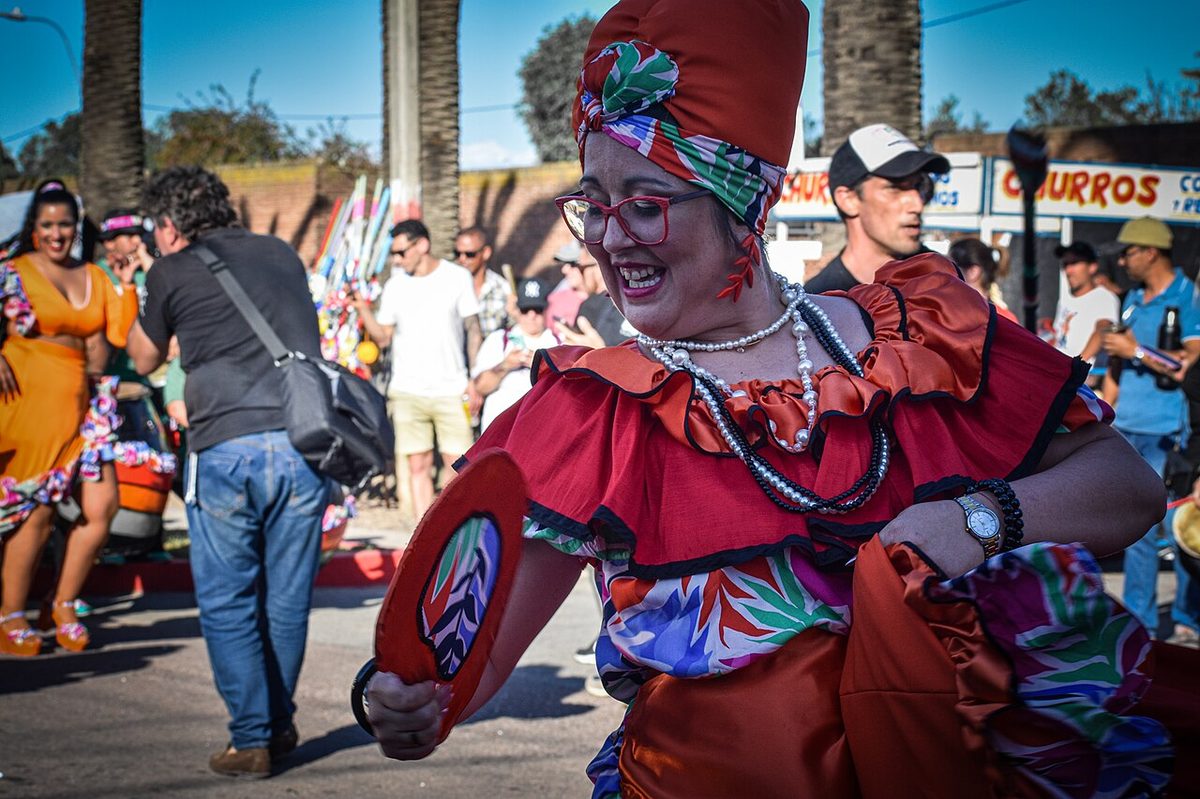
| Mama vieja | An older woman with parasol, fan and a basket | The colonial housekeeper; the matriarch who dances with dignity beside the gramillero |
| Escobero | A dancer wielding a small broom or decorated staff | Sweeps away bad energy and curses ahead of the drums; protector of the troupe |
| Vedette | A star female dancer in a feathered, often minimal costume | Glamour and showmanship; a 20th-century addition borrowed from cabaret |
| Cuerda de tambores | The drum line at the rear — chico, piano, repique | The pulse of the whole parade; everything marches to it |
Let me give a few of them a little more room, because they reward it.
The gramillero and the mama vieja
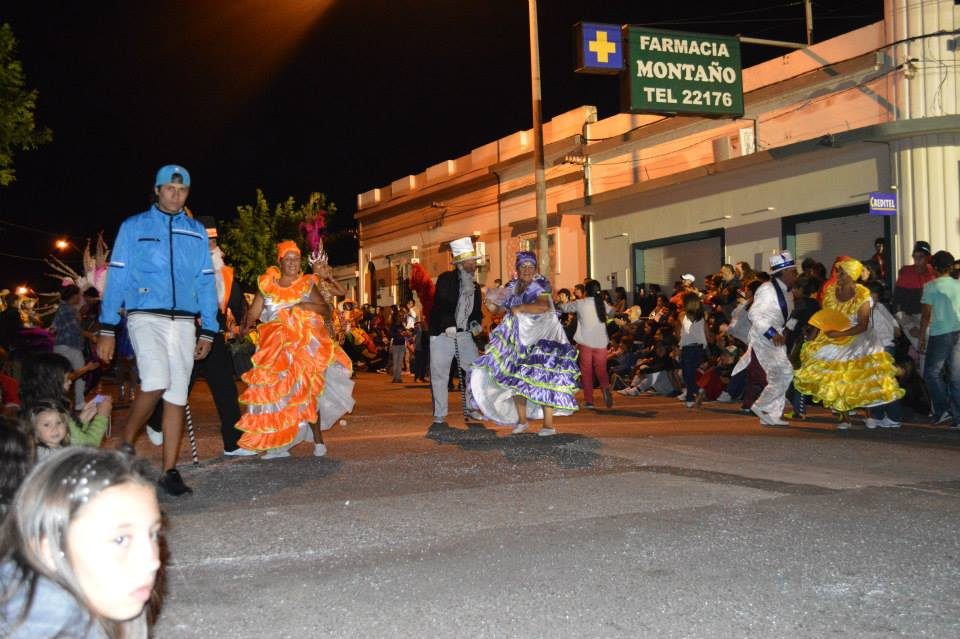
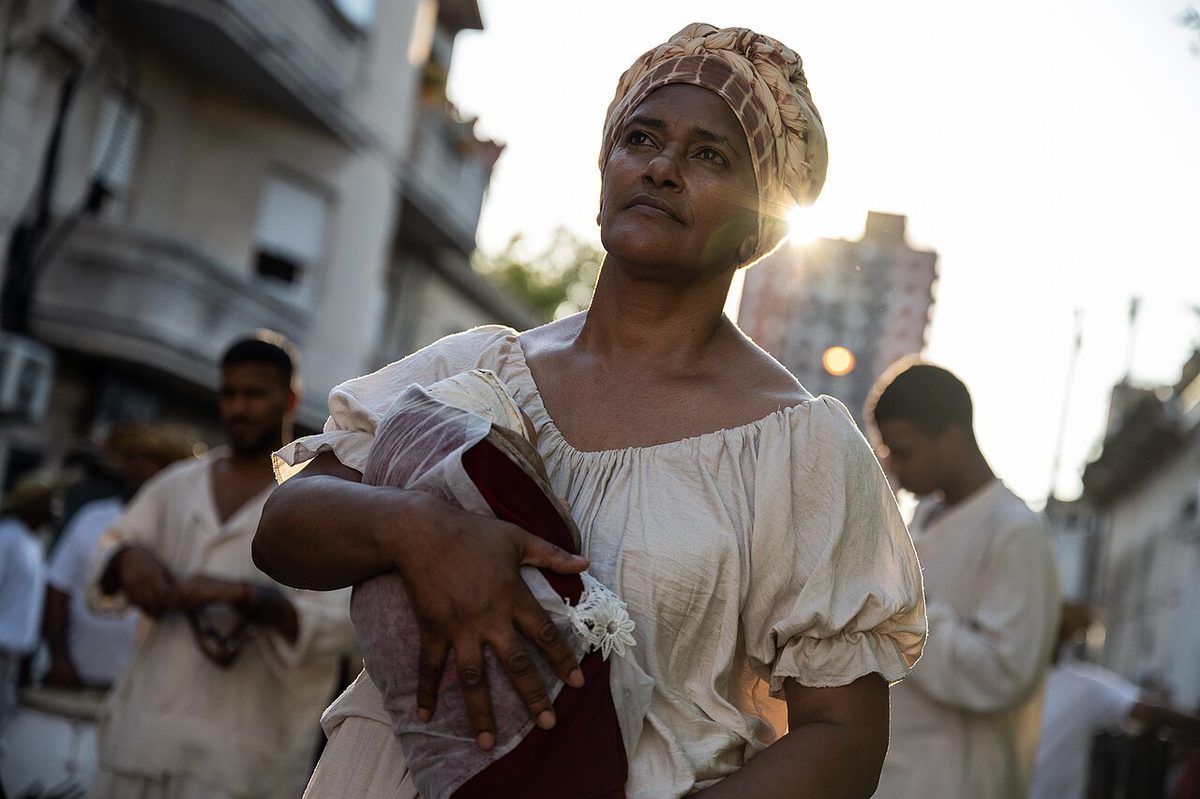
These two move together, and they are my favorites. The gramillero is the eldest figure of the comparsa — a stooped old man in a frock coat and top hat, with a cotton beard, round spectacles, a cane and a little doctor’s bag. He represents the tribal healer who cured with herbs, and at the same time he gently mocks the pompous “dotor” of colonial Montevideo. He shakes and trembles as he dances, all his years on his back, and yet he keeps trying to court the mama vieja beside him. She is the old matriarch, modeled on the housekeeper of a colonial household, parading with a parasol, a fan and sometimes a basket of warm pastries. She moves with a slow, swaying dignity. Their flirtation is comic, tender, and decades old.
The escobero and the vedette
Ahead of the dancers comes the escobero, swinging a small broom or a ribboned staff. His job is symbolic: he sweeps the street clean of bad spirits and “yerba mala” before the comparsa passes, and from his waist hang little mirrors, beads and bells used as amulets. Watch closely and you will see real skill — the good ones twirl and toss the staff like a baton.
The vedette is the newcomer to all this. She arrived in the late 1940s, borrowed from cabaret and Cuban carnival, and she dances just in front of the drummers in a feathered, often barely-there costume. The first vedette in Montevideo, the Afro-Venezuelan dancer known as “La Negra Johnson,” appeared in 1948; Martha Gularte followed a year later and became a legend. There is now a separate prize for best vedette, and the rivalry between them is its own storyline.
The costumes are a coded history
Look at the drummers’ clothes and you are reading a history of slavery written in fabric. The long black stockings imitate dark skin; the white ribbons crossed around the calves stand for the lash marks of the whip. The short, swaying step of the drummers echoes the shuffle of people who walked in ankle chains. The loose bright jacket, the domino, parodies the coats of Spanish colonial soldiers, and the strap the drum hangs from — the talí — copies the belt those soldiers used to carry a sword. None of it is decoration for its own sake. Every piece remembers something.
How the competition is judged
It is easy to miss, in all the noise, that this is a contest. A jury sits at a fixed point along the route and scores every comparsa across several categories. The exact rubric shifts year to year, but it broadly covers the cuerda de tambores (the drumming itself), the dances and movement of the body of dancers, the typical characters and “ancestrality” — how well the gramillero, mama vieja and escobero embody the tradition — and an overall vision of the whole presentation.
The stakes are concrete. The judges crown an overall winner plus separate prizes for best cuerda de tambores, best cuerpo de baile, best vedette and best bailarín. And the scores carry forward: only the top-placed comparsas each year keep their automatic slot in the following year’s desfile, while others have to qualify through admission rounds. That is why the order of march matters — the previous year’s strongest groups parade in privileged positions, and the running order is published and dissected in the press beforehand like a sports draw.
A handful of names dominate the modern era. Cuareim 1080 has won repeatedly; Yambo Kenia, Tronar de Tambores, Elumbé, Cenceribó and Valores de Ansina trade places at the top year after year. If you want to pick a “team” before you go, those are the ones whose arrival makes the grandstand stand up.
How to watch it: route, seats, tickets and timing
This is the section to read twice. As far as a Llamadas parade Uruguay travelers can actually plan around goes, the desfile is gloriously chaotic, and a little planning is the difference between a magical night and a sore, frustrated one.
The route
The whole parade runs down a single street — historically called Isla de Flores, now signposted in stretches as Isla de María — for about 1.5 kilometers through Barrio Sur and Palermo. Comparsas stage near Zelmar Michelini and set off from there, marching the length of the street to Minas, passing the famous Carlos Gardel street corner along the way. Because it is linear, you do not chase the parade; you pick a spot and let all forty comparsas come to you, one after another, for hours.
Where along the route should you be? The early blocks near the start are freshest — the drummers are at full strength and the energy is raw. The middle stretch, around the judges’ stand, is where comparsas perform hardest because they are being scored, so the dancing is sharpest there. The later blocks thin out a little and can be easier for first-timers who want room to breathe. There is no bad seat, only different flavors of the same night.
Grandstands (tribunas) and chairs (sillas)
The city and organizers build temporary grandstand seating — tribunas, tiered stands — and rows of numbered chairs, sillas, along both sides of the street. These are sold to the public and they are the comfortable, reliable way to watch. You get a guaranteed view, a place to put your bag, and you are slightly elevated above the crush. Prices vary by night and by how close you sit to the prime sections; in recent years chair tickets have run roughly in the few-hundred-pesos range per seat, with premium positions costing more.
You buy them through the Abitab network — Uruguay’s ubiquitous payment-and-lottery agency, with branches all over the country and an online portal. Tickets go on sale a few weeks before carnival and the good seats sell out fast, so this is not a buy-on-the-night situation. If you want a seat, buy it the moment they are released.
Free standing room
And you do not have to pay. Behind and between the paid sections there is free standing room along the route, and plenty of locals watch this way — leaning on barriers, perched on kerbs, packed three and four deep. It is free, it is electric, and it puts you right in the sweat and spray of the thing. It is also where you will be standing for hours with no guaranteed sightline, getting gently jostled the whole time. I have done both and loved both; just know which one you are choosing.
Timing and the rhythm of the two nights
Both nights start around 7:00 p.m. — but “start” is relative. The first comparsa steps off then, and with forty groups to come, the parade runs well past midnight; the last cuerdas can still be drumming in the small hours. The crowd builds through the evening and peaks late. The two nights split the field: the higher-placed and headline comparsas are spread across both, so neither night is a throwaway, but if you only go once, ask which night your favorite cuerda parades and which has the marquee names that year.
Practical rhythm I have settled into: arrive by early evening, eat first, claim your spot before the crowd thickens, and pace yourself. There are hydration points along the route and a small army of cleaning crews works the street during and after, but food and bathroom options thin out as the night goes on. Bring water, bring cash, and do not plan anything for early the next morning.
One honest drawback
Here it is, plainly: the desfile starts late, ends very late, and gets seriously packed. If you are in free standing room you may be on your feet in a dense crowd from before 7:00 p.m. until past midnight, often without a clear view when the tallest comparsa elements pass. The streets are narrow, the crowd is huge, and there is no leaving early without missing what you came for. My advice is simple — either commit to standing for the long haul, or spend the money on a grandstand seat and treat your backside kindly. Going in expecting a quick, comfortable hour will only disappoint you.
Tips for photographers
It is dark, it is fast, and it is crowded — a hard combination. A few things that helped me. Shoot at a high ISO and embrace a little grain; the light is warm streetlight and torch-glow, not daylight. A fast prime lens beats a slow zoom. Frame the gramillero and mama vieja for character, the vedette for color, and the drum line head-on for sheer mass. The medialunas and stars are lit, so they pop against the night. From a grandstand you get clean, elevated frames; from the street you get the intimacy but a forest of arms and phones in front of you. And keep your gear close — this is a packed crowd at night.
Desfile de Llamadas: your questions answered
When is the Desfile de Llamadas held?
The parade takes place over two consecutive nights in early February, during Montevideo’s carnival season. Both nights begin around 7:00 p.m. and run past midnight. Exact dates shift each year — in 2026 it fell on Friday 6 and Saturday 7 February — so check the Intendencia de Montevideo’s carnival listings before you book travel, as the rest of the carnival season stretches around it for weeks.
Where exactly does the parade go?
Everything runs down a single street — historically Isla de Flores, signposted in parts as Isla de María — for about 1.5 kilometers through the Barrio Sur and Palermo neighborhoods of central Montevideo. Comparsas set off near Zelmar Michelini and march to Minas street, passing the Carlos Gardel corner. Because the route is a straight line, you pick one spot and let every comparsa pass you.
How do I get tickets, and do I need them?
You do not strictly need a ticket — there is free standing room along the route. But for a guaranteed view and a seat, buy a grandstand (tribuna) or chair (silla) ticket through the Abitab network, online or at its branches across Uruguay. Tickets are released a few weeks before carnival and the best seats sell out quickly, so buy early rather than on the night.
What is the difference between Las Llamadas and Montevideo Carnival?
Las Llamadas is one event inside the much larger Montevideo Carnival, which is the longest carnival season in the world and includes murga, the tablados (neighborhood stages) and more. The desfile de llamadas specifically is the two-night candombe drum parade. For the full festival picture, see the dedicated Montevideo Carnival guide.
Is the Desfile de Llamadas suitable for families and kids?
Plenty of Uruguayan families attend, often in the earlier hours, and children love the drums and costumes. That said, it runs very late, the crowds are dense, and the vedettes’ costumes are revealing. If you are bringing kids, a grandstand seat near the start of the route, arriving early and leaving before the small hours, is far more comfortable than the standing crush. See our Uruguay with kids guide for more.
Where should I stay to be near the parade?
Anywhere central in Montevideo works, since the route is downtown and walkable from Ciudad Vieja and the Centro. Staying close means you can walk home afterward rather than hunting for a taxi at 1:00 a.m. with thousands of other people. Our guide to where to stay in Montevideo breaks the neighborhoods down.
Final thoughts
I have seen a lot of parades. None of them lands in the body the way the desfile de llamadas does. It is not polished in the theme-park sense — it is loud, late, crowded and gloriously sincere, a neighborhood tradition that grew out of real history and still belongs to the people who make it. Stand near the front, learn the characters, pick a cuerda to root for, and let the chico, piano and repique do their work.
Plan the boring parts — a seat or a firm decision to stand, water, cash, and no early alarm the next day — and the night takes care of the rest. If you are timing a wider trip, it pairs naturally with everything else in Montevideo and the broader sweep of things to do in Uruguay, and February is firmly within the best time to visit Uruguay for warm-weather travel. Go once and the drums will call you back.
Credits & sources
Sources & further reading
- Intendencia de Montevideo — Desfile de Llamadas (official)
- Wikipedia — Desfile de llamadas (history, characters and regulations)
- Museo del Carnaval — Candombe
Photo credits
All images via Wikimedia Commons: Desfile De Llamadas Montevideo Isla De Flores by Jimmy Baikovicius from Montevideo, Uruguay (CC BY-SA 2.0); Llamadas Barrio Sur Cuerda De Tambores by Jimmy Baikovicius from Montevideo, Uruguay (CC BY-SA 2.0); Gramillero Mama Vieja Llamadas Montevideo by Candomberomercedes (CC BY-SA 3.0); Vedette Llamadas Montevideo Candombe by Jimmy Baikovicius (CC BY-SA 2.0); Llamadas Montevideo Grandstand Crowd Palermo by Santiago Mazzarovich / IM (CC BY-SA 4.0).