Uruguay’s UNESCO World Heritage Sites: A Complete Guide (2026)
Two stamps on Uruguay’s UNESCO World Heritage List sit at opposite ends of the country’s southwest — one a town that changed flags seventeen times, the other a factory that fed both World Wars. Between them they tell the full arc of how this small republic shaped itself: through colonial stubbornness on the Río de la Plata and industrial ambition on the Río Uruguay. Add two intangible-heritage traditions that pulse through Montevideo every week and a third remarkable building inscribed in 2021, and you have a UNESCO story richer than most countries three times Uruguay’s size.
Uruguay has three UNESCO World Heritage Sites — the Historic Quarter of Colonia del Sacramento (inscribed 1995), the Fray Bentos Industrial Landscape (2015), and the Church of Atlántida, the structural masterpiece of engineer Eladio Dieste (2021) — plus two Intangible Cultural Heritage entries: Candombe and Tango, both inscribed in 2009. This guide focuses on the two major “uruguay unesco world heritage sites” that anchor a southwest road trip, with the church, the intangible heritage and the tentative list all covered below.
Who is this article for? Travelers already drawn to Uruguay who want to understand what makes these places genuinely significant — not just tick a box, but stand in them knowing the history. And anyone planning a southwest loop who wonders whether Fray Bentos is worth the drive (yes) and whether Colonia deserves more than a day trip (also yes, though one night will do it).
| Site | Type | Inscribed | Where | Time needed |
|---|---|---|---|---|
| Historic Quarter of Colonia del Sacramento | Cultural (criteria iv, v) | 1995 | Colonia del Sacramento, 180 km west of Montevideo | Half-day minimum; one night ideal |
| Fray Bentos Industrial Landscape | Cultural (criteria ii, iv) | 2015 | Fray Bentos, Río Negro department, 300 km NW of Montevideo | 3–4 hours for the guided tour |
| Church of Atlántida (Eladio Dieste) | Cultural (criterion iv) | 2021 | Estación Atlántida, 45 km east of Montevideo | 1 hour |
| Candombe and its socio-cultural space | Intangible Cultural Heritage | 2009 | Montevideo (Barrio Sur, Palermo) | Sunday evening, free |
| Tango (joint with Argentina) | Intangible Cultural Heritage | 2009 | Montevideo milongas and public plazas | An evening |
Historic Quarter of Colonia del Sacramento
Why it’s on the list
UNESCO did not inscribe Colonia because it looks pretty — though it does. The citation points to criteria iv and v: the barrio histórico (historic quarter) is an exceptional example of an urban plan that refused to follow Spain’s rigid checkerboard grid imposed across its colonial empire under the Laws of the Indies. Colonia was founded by the Portuguese in 1680 on a small peninsula jutting into the Río de la Plata, and its irregular, topography-following street layout reflects that founding identity. The town then spent more than a century as a contested prize — Portuguese, then Spanish, then briefly British, back to Spanish — before Uruguay emerged as an independent republic in the 1820s. Every occupier left something in the brickwork.
The result is the only urban colonial landscape in the Río de la Plata basin that blends Portuguese, Spanish and post-colonial styles without one erasing the other. Thick-walled single-story houses with Portuguese-tiled facades stand alongside Spanish colonial mansions and early 19th-century civic buildings. The street grid literally bends around a 1745 fortified gate rather than bulldozing it. That fusion, and its remarkable state of preservation, is what makes Colonia genuinely unusual in South America.
The history in slightly more detail
Manuel Lobo, governor of Rio de Janeiro, founded Nova Colônia do Sacramento in January 1680 as a direct provocation — a Portuguese foothold staring across the Plata at Spanish Buenos Aires, set up to funnel contraband trade and challenge Spanish control of the river. Spain took it within months. Then Portugal got it back. Then Spain. Then Portugal. Then Britain held it briefly. Then Spain again, definitively, in 1777 under the Treaty of San Ildefonso. Through all of this, the town was built, demolished, rebuilt and patched — each power leaving fragments. Spanish engineers added the Portón de Campo gate and the city walls. The Portuguese put their characteristic tiled facades on the old quarter houses. Later residents added Victorian verandahs. Nobody quite erased what came before.
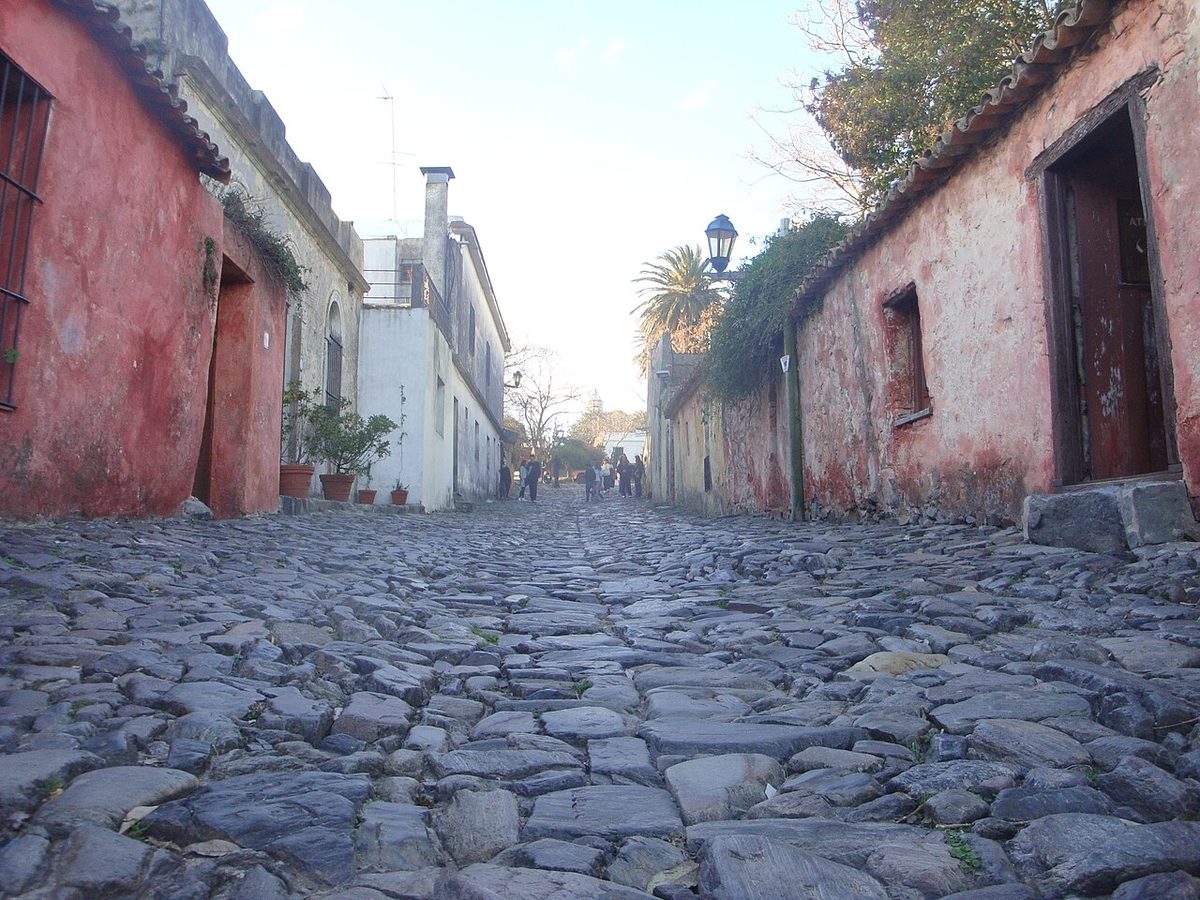
The most famous street, Calle de los Suspiros (“Street of Sighs”), runs a single block between the old gate and the river. No one agrees on the origin of the name — theories range from colonial-era love affairs to the last sighs of condemned prisoners — which is perhaps appropriate for a street whose stones have heard so many languages. Our full guide to Colonia del Sacramento has the complete visiting logistics; here I’ll focus on what the UNESCO status adds to the experience.
What to see in the historic quarter
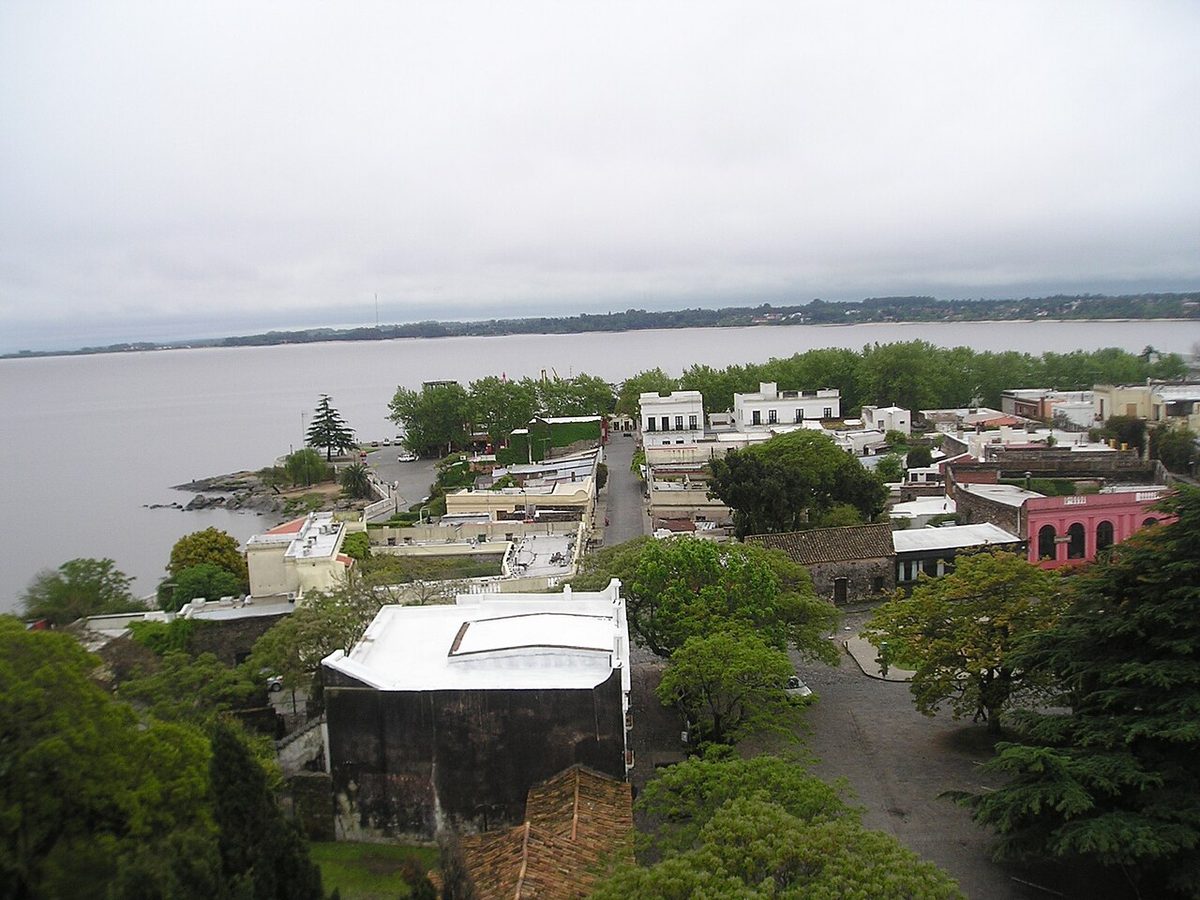
The barrio histórico is small enough to walk end-to-end in fifteen minutes, which means an afternoon here is not rushed — it’s leisurely. The 1857 lighthouse (actually built over the ruins of a convent) gives the best orientation: climb the spiral stairs, pay the small fee, and you can see the whole quarter’s irregular street plan from above, plus the brown-silver expanse of the river. From the lighthouse, walk the Calle de los Suspiros toward the Portón de Campo, dip into the ruins of the Convent of San Francisco, and look in at the free-entry Museo Portugués, which holds the colonial-era tiles, maps and navigational instruments that explain why this dot on a river mouth mattered so much to two empires. Most of the quarter costs nothing to wander — it anchors the free things to do in Uruguay list for a reason.
The honest caveat: Colonia at peak times (summer weekends, long Argentine holiday weekends) can feel crowded for a place this compact. On a Tuesday in low season, you’ll have the Suspiros mostly to yourself. On a Saturday in January, you’ll be sharing the cobbles with a significant slice of Buenos Aires.
Visiting Colonia
Colonia is 180 km west of Montevideo, reached by bus from Tres Cruces terminal (around 2.5 hours, very comfortable) or — far more dramatically — by ferry from Buenos Aires, a 1-hour crossing with Buquebus. If you’re using it as a stop on the southwest UNESCO circuit, arriving by boat from Buenos Aires and departing by bus toward Fray Bentos is the logical direction. The barrio histórico entry is free; the lighthouse, individual museums and the Portón de Campo charge small separate fees, all around UYU 50–100. If you’re planning the rest of Uruguay, our Uruguay itinerary guide maps out how to fold Colonia into a sensible loop. One night at any of the small hotels inside the historic quarter is worth it: by 8pm the day-trippers are gone and the lanes belong to the cats and the street lamps.
Fray Bentos Industrial Landscape
Why it’s on the list
Fray Bentos sits on a peninsula reaching into the Río Uruguay in the department of Río Negro, about 300 km northwest of Montevideo. The name may ring a bell in Britain as a supermarket brand — the corned beef, the pies — which is, in miniature, the whole point. UNESCO inscribed this industrial complex in July 2015 under criteria ii and iv: it is outstanding evidence of the interchange of human values between European society and South American population in the 19th and 20th centuries, specifically the development of technology that enabled canned and frozen meat to be produced and exported globally at scale.
In plain language: this factory changed how the world ate. And its ruins are magnificent.
A factory that fed two wars
The story begins in 1859, when the Liebig Extract of Meat Company — founded on the ideas of German chemist Justus von Liebig — established a plant here to extract concentrated beef into a product that could survive the Atlantic crossing without refrigeration. This became the OXO cube, and it was shipped by the ton to Europe throughout the late 19th century. In 1924 the British Anglo Meat Packing Plant took over, built cold-storage facilities, and scaled up to frozen and canned beef exports that reached the furthest corners of the British Empire and beyond.
Then the world wars arrived. By the First World War, Fray Bentos was supplying Allied troops with corned beef across multiple fronts. In 1943 alone, sixteen million cans of Fray Bentos corned beef were shipped to Europe. Soldiers on both sides of multiple conflicts ate this beef. The name “Fray Bentos” became so ubiquitous in Britain that it outlasted the factory itself, surviving as a brand decades after the plant closed in 1979.
At its peak the Anglo employed workers from more than 55 nations — Britons, Germans, Spanish, Italians, Lithuanians, each nationality settling into the Barrio Anglo neighborhood built around the factory, with its company-owned housing, church, hospital, casino, and even a golf course. This was effectively a company town transplanted to the Uruguayan riverbank, a globalized industrial village long before the term existed.
The Museo de la Revolución Industrial
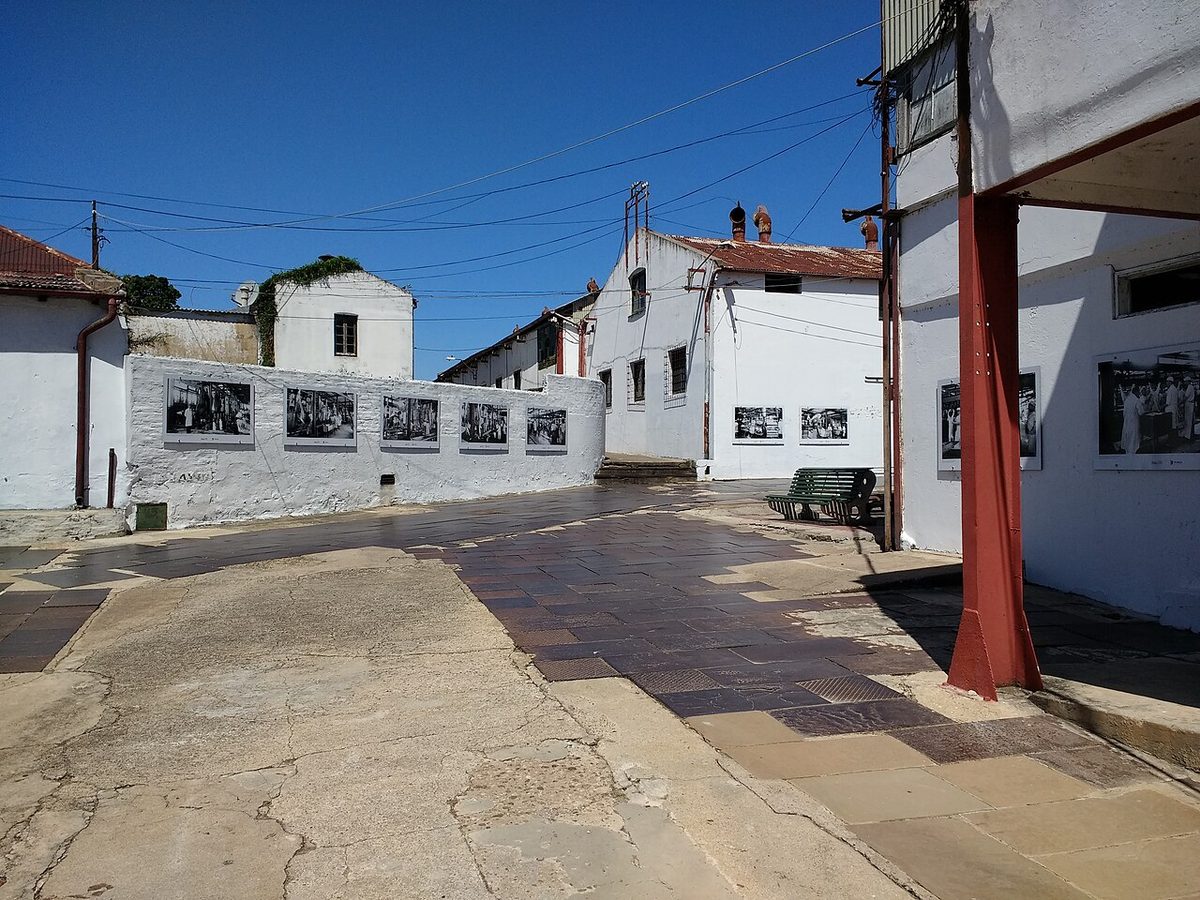
When the plant finally closed, the Uruguayan government preserved the machinery in place and opened the Museo de la Revolución Industrial — a name that does not undersell the experience. The guided tour (the only way in, for good reason: the machinery rooms require a guide to navigate safely) takes you through the cold-storage chambers, the stunning cavernous machine hall with its sawtooth rooftops, the original Liebig offices, and out onto the riverbank where the loading docks still jut into the Río Uruguay. The scale of the complex is arresting — 275 hectares of listed land — and the sense of organized industry frozen in 1979 is genuinely eerie.
The honest caveat: most guided tours run in Spanish, with English-language tours available only on certain days (confirm before going). Still, even without the language, the machinery speaks for itself — the overhead conveyor systems, the cold-storage corridors, the original administrative records. Allow 2–3 hours for the guided tour comfortably.
Opening hours: Tuesday–Sunday 9:30–17:00, with guided tours departing at 10am and 3pm. Entry is around 90 UYU (roughly US$2.50); Tuesdays are free. The museum contact is (+598) 4562 2918. Always confirm current hours with the museum before making the trip — these things shift seasonally. For more of the country’s less-obvious destinations, check our guide to Uruguay’s lesser-known stops.

How to visit both UNESCO World Heritage Sites: the Litoral route
These two sites are on opposite ends of Uruguay’s southwest, which is both the challenge and the opportunity. Done right, you can see both in a three-to-four day loop from Montevideo — or as a one-way southwest transit if you’re coming from Buenos Aires and heading north.
The logical route
From Montevideo, the most natural direction is to take Colonia first (180 km west, 2.5 hours by bus), spend a night in the historic quarter, then head north on Route 2 and Route 24 through the departments of Soriano and Río Negro to Fray Bentos (about 120 km north of Colonia, roughly 2 hours by bus). This is the Litoral — Uruguay’s western river corridor along the Río Uruguay, running all the way to Salto in the north. It’s not as visited as the east coast, but it’s the real Uruguay: cattle country, river towns, hot springs further north.
If you’re arriving from Buenos Aires, you can reverse the order: ferry to Colonia, then bus to Fray Bentos via Mercedes (the department capital of Soriano, worth a half-hour stop for the waterfront). Bus connections between Colonia and Fray Bentos run through Montevideo or with a connection in Mercedes — check current Turil or Nossar timetables from Tres Cruces. Journey time Colonia–Fray Bentos is around 2.5–3 hours depending on connection.
Does Fray Bentos warrant an overnight?
It depends on your schedule. Fray Bentos town itself — beyond the museum — is a quiet river city of around 25,000 people with a pleasant Rambla along the Uruguay and the 1912 Teatro Young worth a look. If you’re heading further into the Litoral (Paysandú, Salto, the hot springs), staying overnight makes obvious sense. If you’re completing a Colonia–Fray Bentos loop back to Montevideo, a long day trip is possible — but you’ll need to take the 10am tour, which means being in Fray Bentos by 9:30am. That’s tight from Colonia in a single morning. My call: if this circuit is the point of your trip, one night in each place. If it’s a detour within a larger Uruguay itinerary, an overnight in Fray Bentos and a day trip to the museum works well.
For the full picture on planning a Uruguay trip around both UNESCO sites and more, our best places to visit in Uruguay guide lays out the regional structure. And if you’re still deciding whether to come at all, is Uruguay worth visiting? addresses that head-on.
Extending north: the Litoral hot springs
One genuine advantage of making the Fray Bentos drive is that Paysandú (90 km north) and Salto (a further 120 km) are the gateway to Uruguay’s famous thermal-spring belt — geothermal water at 38–46°C that emerged from mid-century oil drilling and has been attracting Argentine grandmothers ever since. If the UNESCO circuit happens in winter (June–August), ending it at Termas del Daymán near Salto is not a bad plan at all. We cover this in detail in the Uruguay hot springs guide.
Uruguay’s intangible cultural heritage: candombe and tango
Not all UNESCO recognition comes attached to a building or a landscape. In October 2009 — the same year — Uruguay secured two entries on the Representative List of Intangible Cultural Heritage of Humanity, and both are still very much alive in Montevideo every week.

Candombe
Candombe is the drum tradition carried to Uruguay by enslaved Africans from the kingdoms of Kongo, Angola and Mozambique, and kept alive by their descendants in the conventillos (tenement houses) of Barrio Sur and Palermo. UNESCO’s inscription recognizes not just the music but its “socio-cultural space” — the whole ecosystem of the drumming: the drum-making traditions, the neighborhood comparsas, the role of the three drum sizes (chico, repique and piano), and the walking-procession format called the llamada.
The music is percussive, polyrhythmic, and immediate in a way no recording fully captures. The three drums lock into patterns that can only be heard properly at close range, walking alongside a comparsa as it moves down a street. Most Sunday evenings year-round, comparsas rehearse through the streets of Barrio Sur and Palermo in Montevideo — arrive near the intersection of Isla de Flores and follow your ears. It’s free, open to respectful observers, and the single best reason to be in Montevideo on a Sunday rather than a beach.
The Desfile de Llamadas in early February — the peak carnival event where dozens of comparsas compete through Barrio Sur — is the spectacular formal version. But the Sunday rehearsals are the living tradition, unperformed and genuinely communal. Understanding candombe changes how you hear Uruguay’s broader culture; it’s not separate from the country’s identity, it is central to it. For context on how candombe fits into the cultural picture, see our guide to Uruguay culture.
Tango
Buenos Aires gets most of the credit. Uruguay gets most of the arguments. “La Cumparsita” — composed in 1917 by Montevideo teenager Gerardo Matos Rodríguez, still the most recorded tango in history — premiered here, not across the river. UNESCO’s 2009 inscription recognizes tango as a joint Argentine–Uruguayan tradition: developed simultaneously in the working-class port neighborhoods of Montevideo and Buenos Aires, at a cultural crossroads of European immigrants, African descendants, and criollo populations, the dance and its music expressed something neither city could have produced alone.
Tango is still danced seriously in Montevideo. The milongas at venues like Joventango (in the Mercado de la Abundancia) run weekend nights with beginner-friendly floors and modest entry fees — dramatically less intimidating than their Buenos Aires equivalents. Free outdoor milongas appear on Plaza Independencia and elsewhere in summer. In Montevideo, by tradition, La Cumparsita is always the night’s last song.

A third site and the tentative list: what might be next
The Church of Atlántida (2021)
The most recent addition to Uruguay’s World Heritage List is not a city or a factory but a chapel. The Cristo Obrero church in Estación Atlántida, 45 km east of Montevideo on the Costa de Oro, was designed by engineer Eladio Dieste (1917–2000) and completed in 1960. It has undulating brick walls that support an equally undulating roof — a structural system Dieste invented, using reinforced ceramic in Gaussian vaults that required no steel and almost no formwork. UNESCO inscribed it in July 2021 under criterion iv: it represents an outstanding application of a new building technique that opened new structural and expressive possibilities for architecture worldwide.
Entry is free — walk in, look up, try to work out how the walls are holding up the roof. You won’t immediately succeed. If you’re traveling between Montevideo and the east coast, it’s an easy detour that takes ninety minutes including the drive from the motorway. It also makes a pleasingly odd complement to the industrial scale of Fray Bentos: Dieste and the Anglo plant engineers are, in their different ways, examples of what UNESCO criterion ii is about — the interchange of technical knowledge between European and South American contexts.
What’s on the tentative list
Uruguay has six sites on its UNESCO tentative list, nominated for future consideration. Several are Montevideo-focused: the Rambla (the world’s longest continuous urban promenade, at 22+ km), the city’s early 20th-century modern architecture, and the historic Barrio Peñarol with its railway industrial landscape. Chamangá, a rock paintings area in Flores department, represents pre-colonial heritage. The Insular area and bay around Colonia del Sacramento — essentially a maritime extension of the inscribed historic quarter — and Isla de Flores, a fort island in the Río de la Plata, round out the list. None are formally nominated yet, but a Montevideo Rambla inscription would be an interesting conversation: it is genuinely one of the great urban waterfronts on the continent, and one of the best things to do in Uruguay.
Uruguay’s UNESCO sites: your questions answered
How many UNESCO World Heritage Sites does Uruguay have?
Three, all cultural. The Historic Quarter of Colonia del Sacramento was inscribed in 1995; the Fray Bentos Industrial Landscape in 2015; and the work of engineer Eladio Dieste — the Church of Atlántida — in 2021. Uruguay also holds two UNESCO Intangible Cultural Heritage entries: Candombe (2009) and Tango (the latter jointly with Argentina, also 2009).
Is Fray Bentos worth visiting for a tourist?
Yes — emphatically, but with caveats. The Museo de la Revolución Industrial at the Frigorífico Anglo is one of the best industrial-heritage museums in South America: the machinery halls are enormous, the history is genuinely gripping, and the setting on the Río Uruguay is beautiful. The caveat is logistics: it’s a 300 km drive or bus ride from Montevideo, most tours run in Spanish only, and the town of Fray Bentos itself is quiet. Plan around it, not as an afterthought.
What were the UNESCO inscription criteria for Colonia del Sacramento?
Colonia was inscribed under criteria iv and v. Criterion iv: it is an outstanding example of a type of urban planning that fuses Portuguese, Spanish and post-colonial styles in a way unique in the Río de la Plata basin. Criterion v: the historic quarter represents an exceptional example of an Ibero-American colonial town adapted to topographic conditions and reflecting the layered occupation of a strategically contested site over more than 300 years.
Can you visit Colonia del Sacramento as a day trip from Buenos Aires?
Yes, and many people do. The Buquebus fast ferry takes about 1 hour across the Río de la Plata. The barrio histórico is compact enough to explore well in a few hours. That said, the town shifts personality after the day-trippers leave — a night in the historic quarter, with the evening lanes to yourself, is worth planning for if you can. Our detailed Colonia del Sacramento guide covers ferry times, hotels and what to see.
What is candombe and why does it have UNESCO status?
Candombe is the drum tradition of Afro-Uruguayan communities in Montevideo, rooted in the cultural practices of enslaved Africans brought primarily from Kongo, Angola and Mozambique. UNESCO inscribed it in 2009 as a living intangible heritage — not a historical curiosity but an active community practice, heard in Barrio Sur and Palermo every Sunday and reaching its peak in the Llamadas processions of February carnival. The inscription recognizes both the music and the social-cultural space around it: the comparsas, the neighborhood bonds, the drum-making craft.
Is there a good route that combines Colonia and Fray Bentos?
The Litoral route works well: Montevideo → Colonia (bus, 2.5 hours, one night) → Fray Bentos via Route 2 and Route 24 (2–2.5 hours north, one night) → back to Montevideo or continuing north to Paysandú and the hot springs near Salto. Travelers arriving from Buenos Aires can run it in reverse: ferry to Colonia, bus north to Fray Bentos. Allow a full three to four days for both sites without rushing. For help with getting here in the first place, see our guide to getting to Uruguay.
Final thoughts
Uruguay’s UNESCO sites refuse to be lumped together. Colonia is intimate: six cobbled blocks, a lighthouse, 340 years of contested history in stones that don’t match because the people who laid them didn’t either. Fray Bentos is the opposite — a vast industrial cathedral to the proposition that cattle on the pampas could feed London on a wet Tuesday. Both made it onto the World Heritage List because they’re genuinely irreplaceable records of how people organized the world in a particular moment.
The intangible entries, candombe and tango, are something else again: living traditions that don’t need a museum to survive. Drum lines still shake the street at Barrio Sur on Sunday evenings; milongas still close with La Cumparsita. That aliveness is its own kind of heritage — harder to protect, harder to quantify, and completely impossible to fake.
If I’m building a southwest Uruguay loop, I start in Colonia with a night in the old quarter, head north to Fray Bentos for the 10am tour, and end back in Montevideo in time for Sunday candombe. Three days. Three UNESCO designations, five if you count the intangible pair. Not bad for a country of three and a half million people at the wrong end of the continent — in the best possible sense of wrong.
Credits & sources
Sources & further reading
- UNESCO: Historic Quarter of the City of Colonia del Sacramento — official World Heritage listing and inscription criteria
- UNESCO: Fray Bentos Industrial Landscape — official World Heritage listing, inscribed 2015
- UNESCO: The work of engineer Eladio Dieste: Church of Atlántida — inscribed 2021
- Uruguay Ministry of Tourism (turismo.gub.uy) — official visitor information and event listings
- UNESCO: Tango — Intangible Cultural Heritage
Photo credits
All images via Wikimedia Commons: Colonia Del Sacramento Calle De Los Suspiros by Banfield (CC BY-SA 3.0); Colonia Del Sacramento Lighthouse by Heretiq (CC BY-SA 3.0); Frigorifico Anglo Fray Bentos by Mx. Granger (CC0); Fray Bentos Industrial Landscape by Eduardo Gonzalez (CC BY-SA 3.0); Candombe Drummers Montevideo by Manzanita2203 (CC BY-SA 4.0); Tango Rio De La Plata by virginiainnocenti (CC BY 2.0).

1 comment