Uruguay Hot Springs: The Complete Guide to the Termas of Salto and the Litoral

The Uruguay hot springs sit in the country’s northwest, strung along the Río Uruguay across the Salto and Paysandú departments. Five main thermal parks — Daymán, Salto Grande, Arapey, Guaviyú and Almirón — tap the vast Guaraní Aquifer, with water running anywhere from about 38 to 46°C. Most travellers base themselves in the city of Salto.
I’ll be honest about why I keep coming back to this corner of the country. The termas are not what most people picture when they hear “hot springs.” There are no steaming volcanic pools in a mountain canyon — Uruguay is too flat and too geologically quiet for that. What you get instead is hot mineral water pumped up from deep underground into well-kept municipal pools and resort complexes, surrounded by eucalyptus, citrus groves and the slow brown river. It is less dramatic and far more relaxing than the Instagram version of a hot spring, and on a cold July night, with your shoulders under 40-degree water and your breath fogging in the air, it is one of the most quietly pleasurable things you can do in this country. If you’re still mapping out the wider trip, our guide to things to do in Uruguay puts the termas in context alongside the coast and the capital.
This guide covers all five major springs, what each one is actually like, which one suits which kind of traveller, what it costs in 2026, when to go (the answer surprises people), and how to string the whole thing together into a road trip down the litoral. I’ve tried to be candid about the weak points too, because no guide that calls every pool “relaxing” is being straight with you.
Uruguay Hot Springs at a Glance
Here’s the quick comparison I wish I’d had on my first trip. Temperatures are approximate and vary pool to pool; prices are rough 2026 figures and move with Uruguay’s inflation, so treat them as a guide rather than a quote.
| Spring | Where | Water temp | The vibe | Rough day entry | Best for |
|---|---|---|---|---|---|
| Termas del Daymán | 9 km S of Salto | Up to ~45–46°C | Busy, social, lots of pools | ~250–350 pesos (≈US$6–9) | First-timers, families, no car |
| Termas de Salto Grande | ~12 km N of Salto | ~40–45°C | Resort & water park by the lake | Hotel-led; water park ~US$10–14 | Resort comfort, families |
| Termas del Arapey | ~80 km N of Salto | ~38–40°C | Quiet, green, oldest & most remote | Mostly resort/lodging-based | Couples, slow stays, golf |
| Termas de Guaviyú | N Paysandú dept | ~36–40°C | Shady campground, no frills | ~200 pesos (≈US$5) | Campers, budget, peace |
| Termas de Almirón | 5 km from Guichón | ~34–42°C | Saline water, tiny & medicinal | Stay-to-use; book ahead | Wellness, real quiet |
If you only have time for one and you’re arriving without a car, stop reading and go to Daymán — it’s the easiest, the hottest, and the one with a city bus running to the door. Everyone else, read on, because the right spring depends entirely on what you want out of the trip.
What the Uruguay Hot Springs Actually Are

The whole thing is an accident of oil exploration. In the 1940s and 1950s the Uruguayan government went drilling in the northwest, hoping for crude. It never found commercial oil. What the wells hit instead was the Guaraní Aquifer — one of the largest underground freshwater reservoirs on the planet, shared with Argentina, Brazil and Paraguay — and at those depths the water comes up hot. Over the following decades, towns and the state built thermal parks around the bore holes, and a modest domestic tourism industry grew up around soaking.
That history explains the character of the place. These are bore-fed springs: the hot mineral water is genuine, but it’s pumped into engineered pools rather than bubbling out of a rock. The mineral content is real and varies by site — Daymán’s water carries iodine, iron, calcium, magnesium and fluorine; Almirón near Guichón is saline, the only salt springs in the country. Uruguayans have long treated the termas as semi-medicinal, good for circulation, aching joints and stress, and you’ll see plenty of older regulars who come for a week every winter and take the waters with real seriousness.
Geographically, all the major springs line up along or near the Río Uruguay, the wide river that forms the border with Argentina. This strip — Salto, Paysandú, and the river towns south of them — is what Uruguayans call the litoral. It’s farm country: citrus orchards around Salto, wheat and cattle inland, blue herons on the riverbanks. It sees a fraction of the foreign visitors that the Atlantic coast does, which is exactly why I like it.
The Five Springs, One by One
There are smaller and private thermal spots scattered around, but these five are the ones worth planning a trip around. I’ve ordered them roughly by how many people they see, busiest first.
Termas del Daymán — the popular one
Daymán is the default, and for good reason. It sits about nine kilometres south of Salto on Route 3, an easy day trip or an overnight in the little village of Termas del Daymán, which has a permanent population of barely 350 and swells enormously in winter. The municipal park packs in something like a dozen pools at different temperatures, fed by the hottest water in the country — it leaves the ground at around 45–46°C, and the hottest pools genuinely sting at first. There are hydro-massage jets, shallow children’s pools, Scottish showers, the works.
What I like about Daymán is the social, slightly old-fashioned feel: multi-generational Uruguayan families staking out a pool for the afternoon, thermos flasks of mate everywhere, no pretension at all. Entry is cheap — last I checked somewhere around 250 to 350 pesos for an adult, well under ten US dollars, with discounts for hotel guests and retirees and free entry for young kids. The park keeps long hours, often from early morning until late at night, and you can come and go on a day ticket. Right next door is Acuamanía, a thermal water park with proper slides that bills itself as the first of its kind in South America.
The honest drawback: Daymán is a victim of its own popularity. On a July weekend or during the early-July school holidays it can be packed, and some of the infrastructure feels its age — tired changing rooms, a few pools that could use a refit. If your idea of a hot spring is serene and empty, this is not it. Go on a weekday, or go in the evening when the day-trippers have left.
Termas de Salto Grande — the resort by the lake
About twelve kilometres north of Salto, near the enormous Salto Grande hydroelectric dam, is a different proposition. This area, sometimes called Termas de Salto Grande, is built around resort hotels rather than a municipal park — the best known is the Hotel Horacio Quiroga, a lakefront place with indoor and outdoor thermal pools, hydro-massage, bikes, horses and tennis. There’s also a large public aquatic park here with wave pools and slides, free to hotel guests and open to day visitors for around ten to fourteen US dollars.
This is the spring to choose if you want the water without roughing it — proper rooms, a restaurant, transfers from the Salto bus terminal, the whole package. Couples and families who want to settle in one comfortable place for a few nights tend to be happiest here. It pairs naturally with a stay in the city; see our guide to where to stay in Uruguay for how the lodging tiers compare across the country.
The honest drawback: it’s a hotel experience first and a hot spring second. Day-trippers get less out of it than they would at Daymán, and the all-inclusive resort model means you’re somewhat captive to the property’s restaurant and rhythm. If you want to wander between a dozen public pools with a peso coin and a towel, look elsewhere.
Termas del Arapey — the oldest and most remote

Arapey is the oldest established spa in Uruguay and, to my mind, the prettiest. It sits on the Río Arapey Grande roughly 80 kilometres north of Salto — call it an hour and a half by car — out where the farms get bigger and the traffic disappears. The water here is gentler, averaging somewhere around 38–40°C, and the setting is genuinely lovely: a green, manicured resort village beside a slow river, with thermal pools, a spa, horseback riding and tennis. There’s a serious side too — the five-star Altos del Arapey has an eighteen-hole golf course, unusual for rural Uruguay.

The whole thermal zone can sleep around 3,000 people across hotels, bungalows and chalets, but it rarely feels crowded the way Daymán does, because people come to stay rather than to day-trip. This is where I’d send a couple wanting two or three slow days with a book, a river view and a long evening soak.
The honest drawback: the distance. Without a car, Arapey is awkward — bus connections from Salto are infrequent, and once you’re out there, there’s very little beyond the resort itself. That isolation is the appeal and the catch in one. Come for stillness, not for options.
Termas de Guaviyú — the quiet campground

Cross into Paysandú department and the mood shifts. Guaviyú, on Route 3 north of the city of Paysandú, is a municipal complex set inside an enormous shaded campground of mature eucalyptus. It’s the budget, low-key option — a handful of pools at different temperatures, a big grassy camping area with barbecue pits, and a refreshingly unpolished feel. Entry is cheap, on the order of 200 pesos for an adult last time I looked, with camping pitches not much more.
This is my pick for travellers who want quiet and don’t need a spa. Families pitch tents under the trees for a week; retirees park caravans and soak twice a day. It feels like a Uruguayan summer holiday from forty years ago, in the best way.
The honest drawback: facilities and opening days can be limited, and they change — at times the pools have run on a reduced Thursday-to-Sunday schedule, so it’s worth checking before you drive out. There’s not much in the way of restaurants or nightlife; bring supplies. If you want polish, Guaviyú will feel basic.
Termas de Almirón — the saline secret
Almirón, five kilometres from the small town of Guichón in Paysandú, is the odd one out — and the one most foreign visitors have never heard of. It’s the only saltwater hot spring in the country, drawn from water of ancient marine origin and unusually high in sulfates, chlorides, calcium and magnesium. That makes it the most overtly therapeutic of the lot; people come specifically for skin and joint complaints. There are a few hot saline pools running roughly 34–42°C, plus a cooler freshwater pool and a couple of enclosed indoor pools, all set in a quiet natural reserve with walking trails and a fishing spot.
It is tiny, peaceful and a little out of the way, which is precisely its charm. If your goal is genuine quiet and water that feels different from everywhere else, Almirón delivers.
The honest drawback: access can be restricted to people with accommodation booked at the on-site lodging, and day visits aren’t always possible — so this is somewhere to plan and reserve, not to drop in on. It’s also the least equipped for children. Treat it as a destination in itself, not a casual stop.
Which Hot Spring Is Right for You?
Five springs, five different trips. Here’s how I’d match them to what you actually want.
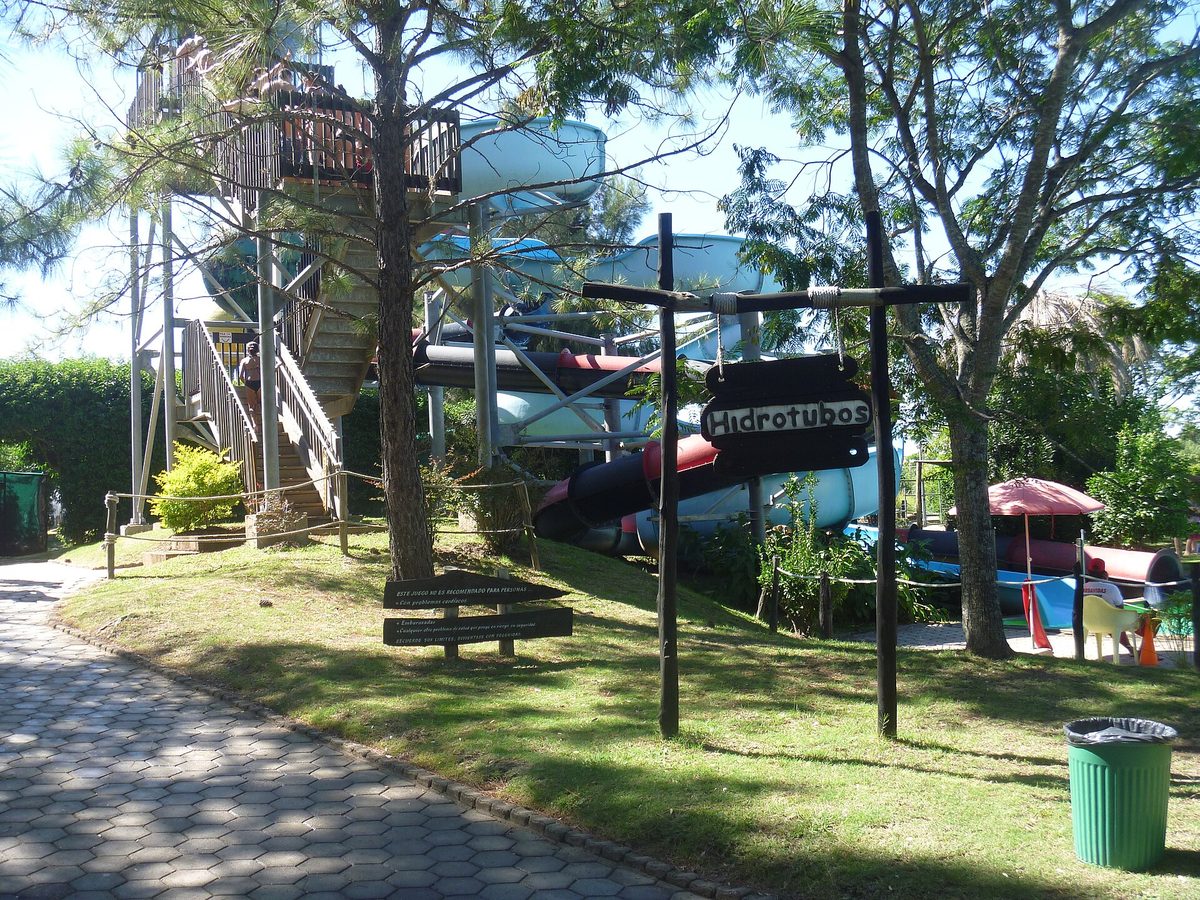
Families with kids: Daymán, hands down, with Acuamanía next door for the days when soaking quietly is never going to satisfy a nine-year-old. The Salto Grande aquatic park is the runner-up, with its wave pool and slides and the comfort of the Horacio Quiroga behind it. Both have shallow children’s pools and free or cheap entry for little ones.
Couples wanting a slow, romantic few days: Arapey. The riverside setting, the gentler water and the lack of day-trip crowds make it the most restful of the lot. Almirón is the wilder-feeling alternative if you’ll trade comfort for quiet.
Budget travellers and campers: Guaviyú first, for the shaded campground and rock-bottom prices, or the village of Termas del Daymán, where simple cabins and small hotels run cheap and you can walk to the pools.
Wellness and the genuinely creaky: Almirón for the saline, mineral-heavy water, or Arapey for a proper spa with massages and treatments. These are the two where “taking the waters” feels like more than a marketing line.
Comfort and resort polish: the Hotel Horacio Quiroga at Salto Grande, or the five-star Altos del Arapey if you want a golf course attached to your hot spring. Expect to pay resort prices, but you’ll never have to leave the property.
When to Go: The Counterintuitive Bit
Here’s the thing that trips up first-time visitors. The best time to visit Uruguay’s hot springs is winter — roughly June through August — which is the exact opposite of when everyone floods the Atlantic beaches. It sounds backwards until you’ve done it. The pleasure of a hot spring is the contrast between cold air and hot water, and on a crisp 8°C winter morning, steam rising off the pools, that contrast is perfect. In the height of summer, when Salto bakes at 35°C, lowering yourself into 42-degree water is a much harder sell.
Winter is high season here precisely for that reason, and it’s worth knowing the rhythm. The early-July school holidays are the single busiest stretch, when Uruguayan and Argentine families descend en masse — book ahead and expect Daymán to be full. The shoulder months either side, say May and September, are my favourite: the water still feels wonderful against cool air, but the crowds thin out and prices ease. This is the mirror image of the coast, where our guide to the best beaches in Uruguay comes into its own from December to February. The two halves of the country trade seasons.
Summer at the termas isn’t pointless — many pools are graded to cooler temperatures, the water parks are in full swing, and you’ll have the place comparatively to yourself — but you’d be going for the slides and the campground rather than the soak. For a full month-by-month breakdown of weather, crowds and prices across the whole country, our guide to the best time to visit Uruguay goes deeper than I can here. The short version: for the termas, pack a warm coat and come when everyone else has gone home from the beach.
How to Get to the Termas
Almost every termas trip runs through the city of Salto, the regional capital and the second-largest city in Uruguay. Get yourself to Salto and the springs open up from there. If you’re sorting out arrival into the country first, our guide on getting to Uruguay covers flights, ferries from Buenos Aires and the border crossings in detail.
From Montevideo
The standard approach is the bus. Long-distance coaches leave Montevideo’s Tres Cruces terminal for Salto throughout the day, run by companies like Agencia Central, Núñez and others. The trip takes around six hours and costs somewhere in the region of 30 to 45 US dollars depending on the operator and how far ahead you book. The buses are comfortable — reclining seats, air conditioning, a bathroom — and an overnight service lets you sleep through the journey and arrive ready to soak. If Montevideo is your starting point, it’s worth a day or two of its own; see our guide to things to do in Montevideo before you head north.
There are also flights between Montevideo and Salto’s small airport, which cut the journey to about an hour, but schedules are limited and come and go, and the fares are several times the bus price. Most travellers, myself included, just take the coach. Driving is the other option — it’s a straightforward four-to-five-hour run up Route 3 — and a rental car transforms what you can reach once you’re up there, which I’ll come back to.
From Argentina
The springs are right on the border, so coming from Argentina is genuinely easy and often overlooked. The Salto Grande dam carries an international bridge linking Salto with Concordia in Argentina, and further south another bridge joins Paysandú with Colón. Argentine visitors cross for the weekend in huge numbers — the Entre Ríos side has its own thermal scene — and a foreign traveller can do the same in reverse. If you’re touring northeast Argentina, the Uruguayan termas slot in neatly.
Getting between the springs
This is where it pays to think about a car. Daymán is the exception: a local city bus runs from Salto out to the village roughly every hour for about a dollar, so you can stay in Salto and visit Daymán with no car at all. That alone makes Daymán the obvious choice for car-free travellers. Arapey, Guaviyú and Almirón are a different story — public transport to them is sparse and slow, and to link several springs in one trip you really want your own wheels. Renting in Salto or driving up from Montevideo opens the whole litoral. If you’d rather not drive, hiring a local remise (a private car-and-driver service, easy to arrange through any Salto hotel) for a half-day run out to Arapey or Guaviyu is a common workaround, and splitting the fare between a few people keeps it reasonable. For how the termas fit into a longer national route, our Uruguay itinerary guide maps out the options.
What It Actually Costs
The termas are, by international hot-spring standards, absurdly cheap to get into — the money goes on where you sleep. Here’s a realistic breakdown for 2026. I’ll stress again that Uruguay runs a fair bit of inflation and the peso moves, so these are ballpark figures to plan around, not quotes.
| What | Rough cost (2026) | Notes |
|---|---|---|
| Daymán day entry (adult) | ~250–350 pesos (≈US$6–9) | Cheaper for hotel guests & retirees; young kids often free |
| Guaviyú day entry (adult) | ~200 pesos (≈US$5) | Camping pitch a little more per person |
| Acuamanía / Salto Grande water park | ~US$10–14 | Free for guests of the linked hotel |
| Budget cabin or small hotel | ~US$40–80 / night | In Daymán village or central Salto |
| Mid-range hotel with pools | ~US$90–160 / night | Horacio Quiroga and similar |
| All-inclusive resort (couple) | ~US$200–350 / night | Arapey resorts, Altos del Arapey |
| Bus Montevideo–Salto (one way) | ~US$30–45 | ~6 hours; overnight services run |
To put it together: a frugal traveller could base themselves in Salto or Daymán village, soak daily, eat at simple parrillas and run a three-day termas trip for well under a hundred dollars a day all in. A couple wanting an all-inclusive resort with spa treatments and golf could just as easily spend three or four times that. The water costs the same to everyone; the comfort is the variable. For wider money-saving tactics — tipping, paying with cards versus cash, the quirks of Uruguayan prices — our Uruguay travel tips are worth a read before you go.
A Word on the Water: Minerals, Health and Cautions
Uruguayans don’t soak purely for fun — there’s a long-standing belief in the medicinal value of the termas, and the practice even has a name, balneotherapy, that turns up on resort brochures. The science is genuinely mixed on how much hot mineral water cures versus simply relaxes, but the minerals themselves are real and they differ from spring to spring, which is part of what makes touring more than one of them interesting.
Daymán’s water is rich in iodine, iron, calcium, magnesium and fluorine, and locals swear by it for circulation and tired joints. Almirón is the genuine outlier: its saline, marine-origin water is unusually high in sulfates and chlorides, and it’s the one most often sought out for skin conditions and rheumatic complaints. Arapey’s gentler water is marketed more for general relaxation and stress than for any specific ailment. None of this is a substitute for medical treatment, but a few slow days in mineral water and country air does most people a quiet amount of good.
A few honest cautions, because the heat is no joke. If you’re pregnant, or you have heart trouble or blood-pressure issues, the hottest pools are not for you — stick to the cooler graded pools and keep your sessions short, and check with a doctor first. Small children overheat quickly, so keep them in the shallow, cooler pools and out of the water far sooner than you’d think. Everyone should get out at the first sign of light-headedness, cool down, and rehydrate before going back in. Soak sensibly and the termas are pure pleasure; treat them carelessly in the depths of a hot pool and you’ll cut your day short.
What a Soak Is Actually Like — and a Few Rules
If you’ve only ever been to a polished Japanese onsen or an Icelandic lagoon, set those expectations aside. A Uruguayan terma is closer to a municipal swimming complex that happens to be filled with hot mineral water — concrete pool decks, plastic loungers, a kiosk selling fizzy drinks and alfajores, families everywhere. That sounds unglamorous, and it is, but it’s also unpretentious and warm in every sense. The ritual is simple: you move slowly between pools of different temperatures, building up to the hottest, then cooling off, then back again, for as long as the afternoon lasts.
A handful of things I’ve learned the slightly hard way. Hydrate — it’s easy to forget you’re sweating when you’re sitting in water, and the hottest pools dehydrate you fast, so bring a water bottle and refill it. Don’t combine the hot pools with much alcohol; the heat amplifies everything and you’ll feel terrible. Respect the time limits posted on the hottest pools, which usually cap you at ten or fifteen minutes for good reason. Bring flip-flops for the walk between pools, a towel (not all places rent them), and something warm to throw on the moment you get out in winter, because the cold hits hard when you’re wet. Lockers aren’t a given at the cheaper parks, so leave anything valuable at your hotel and bring only what you’re happy to keep beside the pool; a cheap waterproof pouch for your phone earns its place if you’re drifting between pools all afternoon. And do as the locals do with mate — soaking and sipping is half the point, though you’ll want to keep the gourd well clear of the water.
Etiquette is relaxed but real. Shower before you get in, keep the noise down in the quieter resort pools even if the family complex next door is a happy racket, and don’t be the foreigner who tries to power-swim laps through a pool full of people soaking. For the broader cultural cues — greetings, mealtimes, the national devotion to mate — our guide to Uruguayan culture will save you a few puzzled looks.
Make It a Litoral Road Trip

The mistake is to treat the termas as a single stop. The richer trip is to drive the litoral — the river road down the western edge of the country — and let the springs be the spine of it. With a few days and a car, here’s the loop I’d point you to.
Start in Salto itself, which deserves more than a night. It’s a genuine working city with handsome plazas, a riverfront walk, a good food scene built on local beef and citrus, and the Salto Grande dam just north. Soak at Daymán in the evenings and use the days to explore. From there, drift south through Paysandú — Uruguay’s underrated second river city, with its own brewing history and the Almirón and Guaviyú springs in its hinterland — and on to Fray Bentos, where the old Anglo meatpacking plant is now a UNESCO World Heritage industrial site that’s genuinely fascinating to tour. Keep going and you reach Mercedes, a pretty riverside town, before the road bends toward Colonia del Sacramento and, eventually, Montevideo.
The litoral also happens to be ranch country, and one of my favourite ways to round out a termas trip is a night or two on a working estancia inland — long rides, an open-fire asado, total silence. Our guide to the estancia experience in Uruguay explains how to pick one. And wherever you stop along this route, eat well: the river towns take their parrilla seriously, and the citrus around Salto is the best in the country. Our rundown of Uruguayan food covers what to order. Done properly, the hot springs stop being a destination and become the reason to discover a whole side of Uruguay that most visitors drive straight past.
Uruguay Hot Springs FAQ
Are Uruguay’s hot springs natural?
Yes and no. The water is genuinely natural — hot mineral water drawn from the Guaraní Aquifer deep underground — but it’s pumped up through bore holes into built pools rather than bubbling out of the ground on its own. So the source is natural; the pools are engineered. There are no wild rock pools to find here.
Which is the best hot spring in Uruguay?
It depends what you want. Termas del Daymán is the best all-rounder and the easiest to reach, with the hottest water. Arapey is the prettiest and most restful, Guaviyú the cheapest and quietest, and Almirón the most therapeutic thanks to its unique saline water. For a first visit, Daymán is the safe, satisfying pick.
Can you visit the hot springs without a car?
Yes, if you stick to Daymán. A city bus runs from Salto out to Termas del Daymán roughly hourly for about a dollar, so you can base yourself in Salto with no car at all. The other springs — Arapey, Guaviyú, Almirón — are poorly served by public transport, so you’ll want to drive to reach them.
When is the best time of year to visit the termas?
Winter, from about June to August. The whole pleasure of a hot spring is hot water against cold air, and a crisp Uruguayan winter delivers that perfectly. Early July is busiest with school holidays; May and September are the sweet spot for warm water without the crowds. Summer is quietest but the soak is far less appealing.
Which Uruguay hot spring has the hottest water?
Termas del Daymán. Its water emerges from the ground at around 45 to 46°C, the hottest in the country, and the hottest pools there are properly hot. Other springs run cooler — Arapey averages around 38 to 40°C, and Almirón’s saline pools sit somewhere in the mid-30s to low-40s. Most parks grade pools across a range.
How much does it cost to visit Termas del Daymán?
Day entry is cheap — somewhere around 250 to 350 pesos for an adult in 2026, well under ten US dollars, with discounts for hotel guests and retirees and free entry for young children. Prices drift upward with inflation, so check current rates, but the entry fee will never be the expensive part of your trip. Lodging is where the money goes.
How many days do you need for the hot springs?
Two nights is the minimum to make the long trip from Montevideo worthwhile — enough for a couple of proper soaks and a look at Salto. Three or four nights lets you slow down, try more than one spring, and fold in the wider litoral. Day-tripping from the capital isn’t realistic given the six-hour bus each way. If you can spare a week, the springs and the wider litoral road trip fill it comfortably without ever feeling rushed.
Are Uruguay’s hot springs worth visiting?
If you want dramatic scenery, no. If you want to understand how Uruguayans actually relax — unhurried, social, family-centred, gloriously unpretentious — then absolutely. The termas are one of the few genuinely domestic tourism traditions here, almost untouched by foreign visitors, and a winter evening in the water is a small, real pleasure that stays with you.
Final Thoughts
The Uruguay hot springs won’t out-postcard the geysers of the Andes or the lagoons of Iceland, and they’re not trying to. What they offer is something the country does better than almost anywhere: a low-key, deeply unfussy kind of comfort, shared with three generations of a Uruguayan family and a thermos of mate, in warm water under a cold sky. Come in winter, base yourself in Salto, give it more than a day, and let the litoral pull you down the river afterwards. It’s the side of Uruguay that the beach crowds never see — and it might be the part you remember best.
Credits & sources
Sources & Further Reading
- Wikipedia: Termas del Daymán — location, pools and water data for the main spring
- Wikipedia: Termas del Arapey — background on the country’s oldest thermal spa
- Welcome Uruguay: Hot Springs — directory of the main termas and their facilities
- Intendencia de Salto — the Salto departmental government, which runs the Daymán municipal park
Photo Credits
Thermal pools at Termas del Daymán, Salto: photo by Góngora, CC BY 2.5, via Wikimedia Commons.
Salto Grande dam on the Río Uruguay: photo by Lenilucho, CC BY 3.0, via Wikimedia Commons.
Termas del Arapey resort village, Salto: photo by Alejgon, CC BY-SA 4.0, via Wikimedia Commons.
Río Arapey Grande at Termas del Arapey: photo by Alejgon, CC BY-SA 4.0, via Wikimedia Commons.
Termas de Guaviyú complex, Paysandú: photo by BiblioJu, CC BY-SA 4.0, via Wikimedia Commons.
The Río Uruguay at Salto: photo by ManuelaGB, CC BY-SA 3.0, via Wikimedia Commons.
Acuamanía thermal water park, Termas del Daymán: photo by Flavia232, CC BY-SA 4.0, via Wikimedia Commons.
About Uruguay Tourism Guide
We’re an independent travel guide to Uruguay, built on first-hand research, repeat visits and an unreasonable enthusiasm for this small country. We don’t sell tours, run resorts or take payment to appear here; recommendations and opinions reflect our honest experience. Thermal-park entry fees, opening days, transfers and resort rates change — always confirm directly before you travel. Last updated: June 2026.