Best Restaurants in Montevideo: Where Locals Actually Eat (2026)

My first real lesson about eating in Montevideo was that the best meal of my trip was not in a guidebook. It was a plate of grilled provolone and short ribs at a corner parrilla in Cordón, eaten at 10pm on a Tuesday, surrounded by Uruguayan families and not a single other tourist. The waiter never rushed me. The bill was gentle. And I understood, finally, why people here treat the grill the way other cultures treat religion.
The best restaurants in Montevideo are not the ones nearest the cruise port. For grilled meat, locals favor neighborhood parrillas (charcoal grill houses) in Cordón, Pocitos and Punta Carretas over the tourist market. For everything else, you eat where Montevideanos eat: Italian-heritage cantinas, modern bistros around Parque Rodó, old confiterías (pastry cafés), and the food hall at Mercado Ferrando. Come hungry, come late, and order beef.
Consider this guide for travelers who have already heard about the market hall and want to know where Montevideanos actually book a table on a Friday night. I cover the grill houses locals defend like football teams, the Italian pasta and pizza that quietly defines this city, the new-wave bistro scene in Cordón and Palermo, cafés worth a slow morning, two food markets, vegetarian options that go beyond a sad salad, and a neighborhood-by-neighborhood breakdown. I name specific places, hedge the prices, and flag the one drawback that catches every visitor off guard.
| Category | A pick I rate | Neighborhood | Price tier | Known for |
|---|---|---|---|---|
| Parrilla (grill) | La Pulpería | Punta Carretas | $$–$$$ | Sidewalk charcoal grill, cult following |
| Italian heritage | La Perdiz | Pocitos | $$–$$$ | Milanesas, pasta, Uruguayan-style pizza |
| Modern bistro | La Cocina de Pedro | Palermo | $$–$$$ | Comfort cooking, neighborhood crowd |
| Café / confitería | Café La Farmacia | Ciudad Vieja | $–$$ | Vintage pharmacy fit-out, good coffee |
| Vegetarian | La Madre | Cordón | $$ | Veg-forward plates, not an afterthought |
| Food market | Mercado Ferrando | Cordón | $–$$$ | Many stalls under one roof, all tastes |
Prices shift with the peso and with how much wine you order, so read those tiers as a rough guide rather than a promise. Roughly: $ is a counter snack or a coffee-and-pastry, $$ is a relaxed neighborhood dinner, and $$$ creeps toward a special-occasion bill once you add a bottle of Tannat. For the wider context on what these dishes are and where they come from, the national guide to Uruguayan food is the place to start; this article is about where to sit down and order them.
Parrillas: the grills locals actually defend
Beef is the foundation here, and the parrilla is its temple. A parrilla is a charcoal or wood grill, and by extension the restaurant built around one. Every Montevideano has a favorite they will argue for, and the good news is that the famous market hall is rarely the answer they give.
Mention Mercado del Puerto to a local and you will often get a polite shrug: it is a genuine institution and worth seeing once, but it has tilted toward visitors, and prices reflect it. I have covered that cathedral of beef in its own guide. For everyday grilling, locals go to the barrios.
La Pulpería and the Punta Carretas grills
La Pulpería, in Punta Carretas, is the one I send people to first. It is barely more than a charcoal grill, a chalkboard and a handful of tables that spill onto the sidewalk. You queue, you wait, and then you eat some of the best-value asado (barbecue) in the city. Order the entraña (skirt steak) and a provoleta to start. The drawback is real: there are no reservations, the wait on a Friday can hit an hour, and when it is full it is genuinely full.
Steps away you will find a cluster of other grills, because Punta Carretas eats well. This is a leafy, well-off neighborhood near the old lighthouse, and the standard is high even at unremarkable-looking corner spots. If La Pulpería has a line out the door, walk two blocks and trust the smoke.
Garcías, La Perdiz and the reliable middle
For a grill with actual tablecloths and a wine list, Garcías is the safe, very good choice. The story goes that the owner was frustrated that Uruguay’s best cuts get exported, so he built a place to serve them to locals at a fair price. The baby beef is the move. It is not cheap by Uruguayan standards, but you are paying for cuts that would cost triple back home.
La Perdiz, in Pocitos, has topped local ranking sites for years, and while that makes the cynic in me suspicious, the cooking holds up. It does the full Uruguayan repertoire well: grilled meats, milanesas and pasta under one roof. My honest caveat is that its reputation means it can feel a touch polished and busy compared with a scruffy barrio grill, so go for consistency rather than discovery.
How to order at a parrilla
Sharing is the default. A parrillada for two arrives as a procession of cuts: short ribs (asado de tira), sausages (chorizo), blood sausage (morcilla) and, if you are brave, sweetbreads (mollejas), which are rich, crisp-edged and worth trying once. Do not ask for your beef well done, and do not touch the grill. The parrillero (grill cook) runs that fire, and you defer to them the way you would a chef.
Pace yourself. Provoleta, the disc of grilled provolone that opens most meals, is a trap: it is so good that newcomers fill up before the meat arrives. Order one to share, not one each, and save room for what the fire is actually for.
Italian heritage: the pasta and pizza locals grew up on
Here is what surprises first-timers: Montevideo is, quietly, an Italian food city. Waves of Italian immigration left a mark as deep as the gaucho one, and on any given night plenty of locals are eating pasta, not asado. Ignore this side of the city and you miss half of how Montevideo actually eats.

The cantina is the classic format: a family-run Italian-Uruguayan restaurant, often with checkerboard floors, paper tablecloths and portions sized for farmhands. These are where you find ravioli, cannelloni, lasagna and the gnocchi ritual that the city takes seriously. Tucked through Cordón, Pocitos and the Centro, the older cantinas survive because locals never stopped going.
One thing to know before you order: pasta usually comes with the sauce priced separately. You pick your shape, then choose a sauce, and the menu does the maths. It feels odd the first time. By the second night it makes complete sense.
Ñoquis del 29 and the pasta calendar
On the 29th of every month, Uruguayans eat ñoquis (gnocchi). The tradition is half superstition, half budget cooking from the days when the 29th was the lean stretch before payday, and people would slip a coin under the plate for luck. Walk past any cantina on the 29th and you will see it written on the chalkboard and the tables full. If your trip overlaps with that date, plan a cantina dinner. It is one of the easiest ways to eat alongside locals doing something genuinely theirs.
Fainá deserves a mention too. It is a thin chickpea-flour flatbread, baked until the edges crisp, and the local move is to lay a slice on top of your pizza. That combination is called “pizza a caballo,” pizza on horseback. Order it once just to say you did, then keep ordering it because it works.
For pizza specifically, Montevideo runs to a thicker, cheese-heavy style closer to the Argentine tradition than the Neapolitan one, sold by the slice (porción) at counters all over the Centro. It is a cheap, satisfying lunch. The drawback is that the very cheapest slice joints can be greasy and forgettable, so follow the queue of office workers rather than the first neon sign you see.
Modern bistros: where Cordón and Palermo eat now
This is the part of Montevideo that English-language guides keep missing, and it is the most exciting thing happening in the city’s kitchens. In the last few years, a new-wave restaurant scene has taken root in Cordón, Parque Rodó and especially Palermo, the slightly bohemian barrio just inland from the southern Rambla. Young chefs are working out of converted houses and old warehouses, plating local produce in ways the cantinas never did.
Palermo is the heart of it. Wander its low streets after 9pm and you find small bistros with short, changing menus, natural wine on the list and a crowd that is almost entirely local. La Cocina de Pedro is the kind of place I mean: unfussy, warm, the sort of comfort cooking that makes you want to move in. It is not a tasting-menu temple, and that is the point.
Cordón, just east of the Centro around the avenue, has become the other pole of this scene, helped along by Mercado Ferrando anchoring the neighborhood. Around it you find corner bistros, specialty-coffee spots and the kind of casual-but-serious cooking that draws Montevideanos in their thirties. La Tira, a small corner bistro in this orbit, is a local favorite that on weekends puts on live music from Uruguayan musicians, which tells you who it is really for.
One genuinely upscale name worth knowing is Manzanar, which has appeared on Latin America’s best-restaurants lists and swings from sushi to refined pasta. It is the spot for a special dinner, and the bill matches. My one caution: at this level you are eating “international Montevideo” more than anything specifically Uruguayan, so save it for a night when you want polish rather than local character.
The honest drawback across this whole scene is hours and size. These places are small, they often do not open until 8:30 or 9pm, and the best of them fill fast with regulars. A few do not take reservations at all. If a Palermo bistro is on your list, message ahead on Instagram, the way locals do, or arrive right at opening.
Cafés, confiterías and the art of merienda
Montevideo runs on coffee and pastry, and the café culture is its own reward. The grand old confiterías, part café, part bakery, part time capsule, are where the city has met for a century. Marble counters, glass cases of pastries, waiters in waistcoats who have worked there for decades.

Build your day around the merienda, the late-afternoon coffee-and-pastry break around 5pm that bridges a 1pm lunch and a 9pm dinner. Skip it and you will be ravenous and cranky by 7pm with every kitchen still closed. Treat it as the locals do, a small ritual, and the late dinners suddenly make sense.
For atmosphere, Café La Farmacia in Ciudad Vieja is hard to beat: it keeps the fittings of the old pharmacy it used to be, down to the apothecary cabinets, and does proper coffee plus a coconut alfajor worth the detour. An alfajor, by the way, is two soft biscuits sandwiching dulce de leche, the caramelized-milk spread Uruguayans put on everything. The drawback at the prettiest cafés is that you pay a little extra for the room, but a morning by the window watching the old city wake up is money well spent.
Specialty coffee has landed too, mostly around Cordón and Pocitos, if you need a flat white that would pass muster in Melbourne. It sits a little apart from the traditional café world, and locals happily move between the two. For pastries, the medialuna (a small, often sweet croissant) is the default, and on weekend mornings families queue for them like clockwork.
Food markets and the chivito question
Beyond the famous port market, Montevideo’s most useful food hall for travelers is Mercado Ferrando, and it has become a local fixture rather than a tourist trap. Housed in a converted 19th-century furniture factory on Chaná in Cordón, it gathers a couple of dozen stalls under one roof: parrilla, pizza, sushi, burgers, craft beer, waffles and a vertical garden in the open-air section. It works brilliantly for groups who cannot agree, and for solo travelers who want a good meal without committing to a full sit-down dinner.
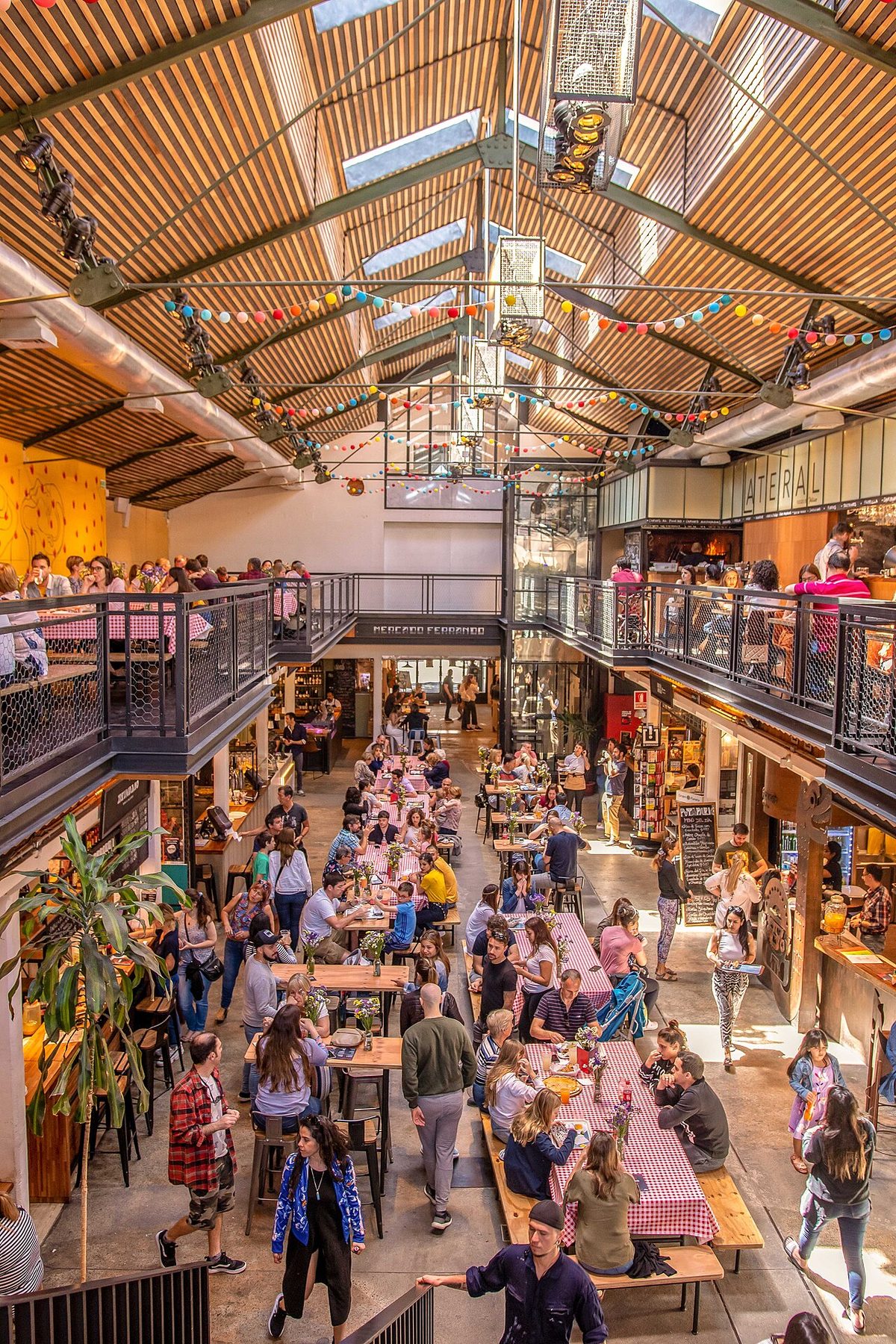
Go for lunch or early evening on a weekday if you want it calm; weekend nights it heaves, which is fun but loud. The trade-off with any food hall is that nothing is as singular as a dedicated restaurant doing one thing well, so I treat Ferrando as a sampler rather than a destination meal. The Mostrador Parrilla counter is a reliable way to get your grilled-meat fix inside it.
Then there is the chivito, which deserves its own paragraph because it is the sandwich Montevideo is built on. A chivito is a tower of thin steak, ham, melted cheese, lettuce, tomato, a fried egg, olives and mayonnaise on a soft bun, usually buried under fries. The “chivito al plato” swaps the bun for a plated version with sides. It is enormous; one feeds two cautious eaters.

Expreso Pocitos is the chivito address locals name most often, and ordering it “a la canadiense” (the Canadian way, with bacon and olives piled on) is the move, however odd it is that Uruguay’s signature sandwich has a Canadian deluxe version. The drawback is simply the aftermath: a full chivito is a commitment, and you should plan a slow afternoon, not a museum, for what follows.
Vegetarian and lighter eating
Let me be straight: this is a beef city, and a strict vegetarian will work a little harder here than in, say, Buenos Aires’ more cosmopolitan corners. That said, it is far from hopeless, and the situation has improved sharply in the last few years, especially in Cordón and Palermo.
La Madre, in Cordón, is the kind of veg-forward kitchen I point plant-based travelers to: vegetables treated as the main event rather than a garnish, with grains, legumes and good produce. Around Mercado Ferrando and the Palermo bistros you will also find salads, pasta and vegetable plates that go well beyond the obligatory lettuce-and-tomato. The cantinas help too, because Italian menus mean meat-free pasta is always an option, fainá is vegetarian by default, and a caprese-style starter is everywhere.
The phrase to memorize is “soy vegetariano” or “soy vegano,” and most kitchens will sort you out with pasta, rice or a salad even if the menu looks meat-heavy. The honest drawback is that hidden meat stock and ham turn up in unexpected places, so it is worth asking specifically rather than assuming a vegetable dish is automatically clean. For reliable meat-free dishes beyond the capital, and how to order them, see our vegetarian and vegan guide to Uruguay.
Where to eat in Montevideo, neighborhood by neighborhood
Knowing the barrio is half the battle, because Montevideo’s dining personality changes street by street. Here is how I think about where to point myself depending on the night.
Ciudad Vieja and the Centro
The old city holds the headline sights and the port market, plus the prettiest cafés like La Farmacia. It is best for lunch and daytime grazing; after dark, much of Ciudad Vieja quiets down and the action moves elsewhere. If you are basing yourself here, my guide to Ciudad Vieja covers the wider old-town beat, and the Rambla waterfront guide is useful for working off a big lunch with a long walk.
Cordón and Parque Rodó
Cordón is my pick for everyday eating with locals: Mercado Ferrando, corner bistros, specialty coffee and old cantinas all within walking distance. Neighboring Parque Rodó, named for the leafy park and beach, brings a younger, studenty energy and a string of casual spots good for a relaxed dinner. Together they are the most underrated dining district in the city for visitors.
Palermo
Palermo is where the modern bistro scene lives, a short walk inland from the southern Rambla. Come here for small, chef-driven places, natural wine and an almost entirely local crowd. It is the answer to “where do Montevideanos in their thirties actually go on a Saturday.”
Pocitos and Punta Carretas
These adjacent, well-off neighborhoods east along the coast are reliable for a good dinner: serious parrillas like La Pulpería, the milanesa-and-pasta stalwart La Perdiz, the best chivito at Expreso Pocitos, plus beach access when the wind behaves. If you are choosing a base for both sleeping and eating, the Montevideo neighborhood guide for where to stay lays out the trade-offs.
For the bigger picture of how all these barrios fit together with the city’s sights, transport and rhythm, lean on the complete Montevideo city guide, which is the parent to everything here.
When to eat, reservations and tipping
This is the section that will save your trip, because Montevideo’s eating clock is the single biggest adjustment for most visitors. Uruguayans eat late. Lunch lands around 1pm to 3pm, and dinner does not really begin until 9pm, stretching past midnight on weekends. Show up at a parrilla at 7:30pm hoping for dinner and you may find the grill barely lit and the dining room empty.
That late schedule is the one honest drawback of dining here, especially if you have children or simply get hungry early. My workaround is to lean on the merienda at 5pm so you are not starving by the time kitchens open, and to treat 8:30pm as the earliest realistic dinner. Many kitchens also close entirely between roughly 4pm and 7pm or 8pm, so the late-afternoon gap is real; plan a café stop rather than a full meal in that window. Build the clock into your sightseeing and it stops being a problem, which is why my day-by-day Montevideo itinerary keeps the sights in daylight and hands the evenings over to dinner.
Reservations are polite but rarely mandatory, with two exceptions: the small Palermo bistros and the handful of upscale tasting-menu spots, where you should book ahead. Everywhere else, walking in works, and the smartest trick is simply to arrive right when a place opens. Many of the best casual spots take bookings informally over WhatsApp or Instagram rather than by phone.
On money: cards are widely accepted in modern restaurants and food halls, but some old-school parrillas and street stalls still strongly prefer cash, so carry pesos for the scruffier, better places. Tipping runs about 10 percent for good service; locals often just round up and leave the coins. A “cubierto,” a small per-person cover charge for bread and table service, sometimes appears on the bill, which is normal and not a scam.
A few table manners smooth everything over. Do not touch the parrillero’s grill, do not order beef well done, and wait until everyone is served before digging in. If a neighbor offers you a taste of their provolone, accept it; sharing is the whole ethic of the table here. For broader on-the-ground advice, the Uruguay travel tips guide covers money, tipping and timing across the country, and the guide to Uruguayan culture explains the mate-and-asado rituals you will see everywhere.
One last pairing note: order the local wine. Tannat is Uruguay’s signature red, dark and structured and made for grilled beef, and even house pours are usually solid. If wine becomes the point of a trip, the Uruguay wine country guide covers the regions and wineries worth a day trip from the city.
Best Restaurants in Montevideo: your questions answered
What food is Montevideo known for?
Beef above all: asado (barbecue) cooked over charcoal at a parrilla, and the chivito, a towering steak sandwich that doubles as a national dish. Italian-heritage pasta and pizza run a close second, alongside milanesas (breaded cutlets), dulce de leche desserts, and Tannat wine. Coffee culture and the late-afternoon merienda round out how the city actually eats day to day.
Where do locals eat in Montevideo rather than tourists?
Locals favor neighborhood parrillas in Cordón, Pocitos and Punta Carretas, the modern bistros of Palermo, and the food stalls at Mercado Ferrando over the cruise-port market hall. The rule of thumb is to walk a few blocks inland from the obvious sights; the deeper you get into the residential barrios, the more Uruguayan the room and the gentler the bill.
Is Montevideo expensive for eating out?
It sits mid-range for South America and is pricier than you might expect, partly because top beef cuts get exported. A neighborhood lunch is cheap, a relaxed dinner is moderate, and a special meal with a bottle of Tannat climbs quickly. Prices track the peso, so treat any figure as approximate and carry some cash for the older, cash-preferring grills. The capital is gentler on the wallet than the coast, as a glance at the Punta del Este restaurants guide makes clear.
What time do restaurants open for dinner in Montevideo?
Late. Dinner service generally starts around 8:30pm to 9pm and runs past midnight on weekends, while lunch sits between 1pm and 3pm. Many kitchens close in the late afternoon, roughly 4pm to 7pm. If you get hungry early, lean on the 5pm merienda of coffee and pastry, then aim for an 8:30pm dinner at the earliest.
Do I need a reservation to eat in Montevideo?
Usually no. Most parrillas, cantinas and food halls take walk-ins, and arriving right at opening beats any queue. The exceptions are the small Palermo bistros and the few upscale tasting-menu places, where booking ahead is wise. Many casual spots handle reservations informally over WhatsApp or Instagram rather than by phone, so a quick message often does the trick.
What should a first-timer order in Montevideo?
Start with a shared parrillada to taste several cuts, plus one provoleta (grilled provolone) to open. Have a chivito at least once, ideally “a la canadiense.” If your trip crosses the 29th of the month, eat ñoquis at a cantina. Pair it all with Tannat, and finish with a dulce de leche dessert or an alfajor.
Final thoughts
Eat where the room is full of Uruguayans and you will rarely go wrong in this city. Montevideo rewards the traveler who skips the obvious port-market lunch in favor of a Cordón cantina, a Palermo bistro or a sidewalk grill in Punta Carretas where the parrillero knows the regulars by name. Adjust to the late clock, lean on the merienda, order the Tannat, and let dinner run long.
None of these picks are secrets to the people who live here, which is exactly why they are worth your time. The city’s food scene is generous, unpretentious and far deeper than its reputation as a one-dish beef town suggests. Show up hungry and curious, and Montevideo feeds you like one of its own.
Credits & sources
Sources & further reading
- Mercado Ferrando official site — current stalls, hours and events for the Cordón food hall.
- Uruguay Ministry of Tourism — official national tourism information.
- Intendencia de Montevideo — the city government’s official site, useful for markets and events.
Photo credits
All images via Wikimedia Commons: Parrilla Asado Montevideo by mariela morales (CC BY 2.0); Pasta Italiana Montevideo by David Adam Kess (CC BY-SA 4.0); Cafe Confiteria Montevideo by Mevrob (CC BY-SA 4.0); Mercado Ferrando Montevideo by Mercadoferrando (CC BY-SA 4.0); Chivito Uruguay Sandwich by https://www.flickr.com/photos/mattrubens/ (CC BY-SA 2.0).


2 comments