Rocha, Uruguay: The Wild Coast from Cabo Polonio to the Brazilian Border (2026)

Rocha, Uruguay is the country’s wild Atlantic corner: around 180 kilometers of dune-backed beaches, fishing villages, and protected lagoons running from the Laguna Garzón bridge to the Brazilian border. It is home to Cabo Polonio, Punta del Diablo, La Paloma, and La Pedrera, and it is where Uruguayans themselves go when they want the coast without the glitz.
I will say this plainly: Rocha is my favorite part of Uruguay. Not Montevideo’s faded grandeur, not Colonia’s cobblestones, not even the polished beach clubs further west. Rocha is where the road turns to sand, the phone signal gets patchy, and the Atlantic does whatever it wants. The first time I rode the 4×4 truck over the dunes into Cabo Polonio and saw that scatter of painted shacks with no power lines anywhere, I understood why people plan a two-day stop here and stay for two weeks.
The catch – and it is a real one – is that almost everything useful written about Rocha is in Spanish. The official sites barely bother with English, and most English-language guides cover two or three towns and stop. This guide is the one I wish I had on my first trip: every coastal town from west to east, the lagoons and the fort that most visitors skip, how the buses and the famous dune trucks actually work, and an honest read on when to come and where you will fit best. If you are still deciding which bits of the country to see, my guide to the 30 best things to do in Uruguay gives the national picture; this one goes deep on the wild coast.
Rocha at a glance: which town is for you?
Rocha’s beach towns sit in a line along Ruta 10 and Ruta 9, roughly 3.5 to 5 hours from Montevideo by bus. They share the same ocean and the same laid-back DNA, but they are surprisingly different characters. Here is the short version before we walk the coast west to east.
| Town | Character | Best for | Honest drawback |
|---|---|---|---|
| La Paloma | Proper small town, lighthouse, 20+ km of beaches | Families, surfers, first-timers | The town itself is plain – the magic is the coast, not the streets |
| La Pedrera | Clifftop village with the best views on the coast | Couples, style-conscious travelers | January prices rival Punta del Este; near-empty in winter |
| Cabo Polonio | Off-grid village inside a national park, no roads in | Anyone who wants to disconnect completely | No electricity or ATMs; comfort is basic and food is pricey |
| Barra de Valizas | Scruffy, beloved hippie village by giant dunes | Backpackers, bohemians, budget trips | Rough edges and summer mosquitos; very quiet off-season |
| Aguas Dulces | Tiny stilt-shack settlement, very local | Slow travel, a quiet day on the sand | Almost nothing to do – that is the point |
| Punta del Diablo | Famous fishing-village-turned-surf-town | Surfers, backpackers, sunset romantics | Packed in January; a ghost town by May |
| Santa Teresa (park) | National park with a 1762 fortress and forest camping | Campers, history buffs, beach hikers | Campgrounds heave at New Year; basic facilities |
| Barra del Chuy | End-of-the-line beach by the Brazilian border | Fishing, solitude, border curiosity | Chuy town itself is a charmless duty-free strip |
What makes Rocha different from the rest of the Uruguayan coast
Drive east from Punta del Este and somewhere around the Laguna Garzón bridge the whole feel of the country changes. The high-rises stop. The coast road shrinks to two lanes, then sometimes to gravel. What replaces the condo towers is a string of protected lagoons – Garzón, Rocha, Castillos, Negra – separated from the ocean by sand bars, plus palm groves, cattle land, and beach after beach with nobody on it.
None of this is accidental. Rocha’s department government has spent decades saying no to the kind of development that transformed Maldonado, and big chunks of the coast sit inside Uruguay’s national protected areas system: Cabo Polonio’s dunes, the Laguna de Rocha (a UNESCO biosphere reserve), Cerro Verde’s sea-turtle waters, and the Laguna de Castillos with its ombú forest. The result is the closest thing the Río de la Plata region has to a wild shore, twenty minutes from a hot shower.
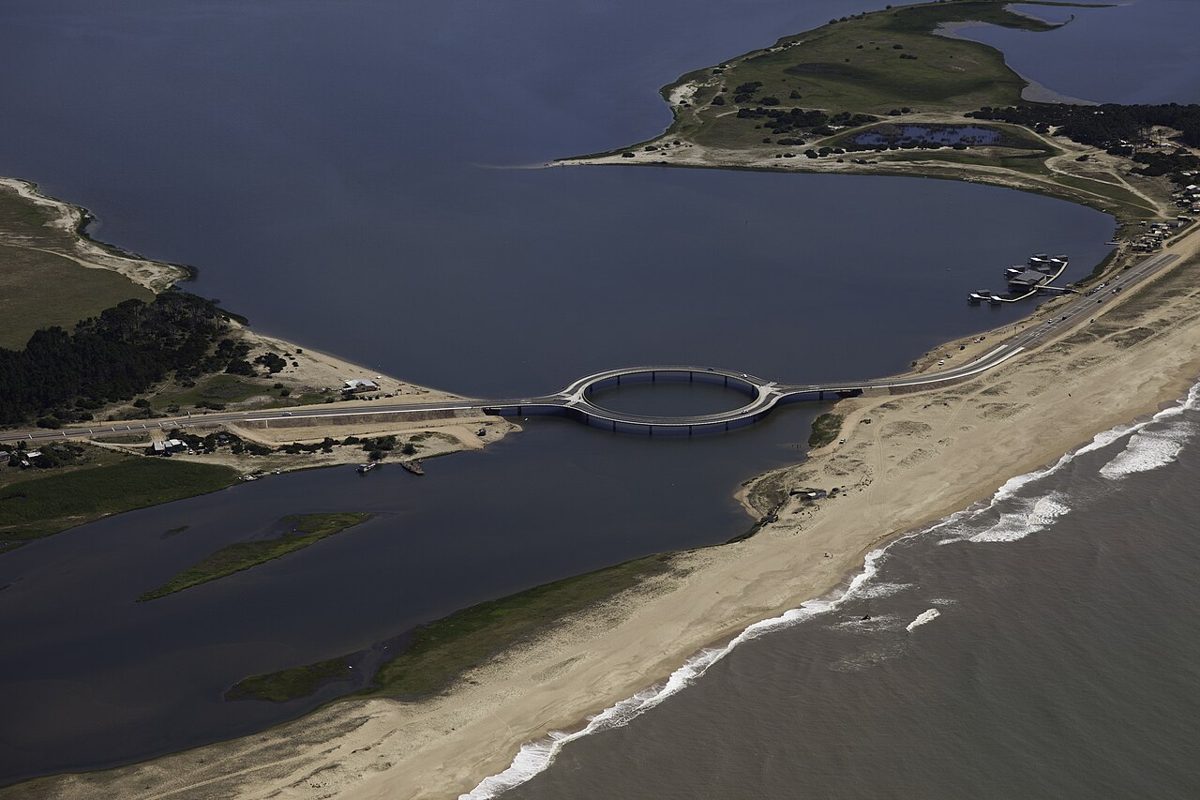
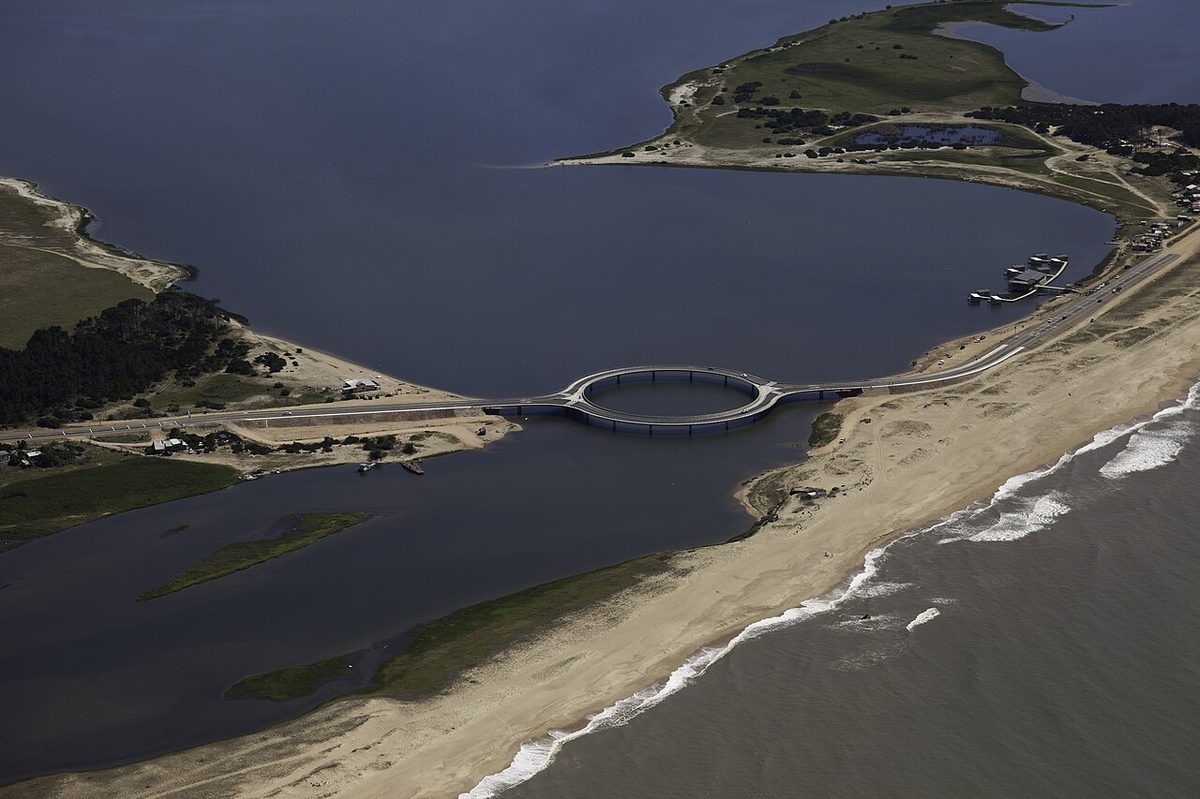
The ring-shaped Laguna Garzón bridge itself is worth a stop on the way in. Rafael Viñoly designed it as a circle deliberately – it forces drivers to slow to a crawl and look at the lagoon, and it replaced a sketchy little raft ferry that used to carry cars across. There is a parking area and you can walk the full circle on the pedestrian lane. Touristy? A bit. Still worth ten minutes.
One more thing that surprises people: Rocha is seasonal to an extreme. From Christmas to Carnival the popular towns multiply their population many times over. By April, shutters go up and many restaurants simply close until December. Neither version is wrong – January Rocha is sociable and alive, winter Rocha is moody and empty and the whales arrive – but you should know which Rocha you are buying a ticket to. My month-by-month take is in the guide to the best time to visit Uruguay.
The beach towns of Rocha, west to east
The geography is simple: one coast, one string of towns, each with its own personality. I will take them in the order you meet them driving east on Ruta 10 and Ruta 9 from Montevideo.
La Paloma: the sensible base with the serious surf
La Paloma is the biggest town on the Rocha coast – close to 4,000 people live here year-round, which by local standards makes it a metropolis. It is the only place east of the Laguna Garzón with real infrastructure: a choice of hotels and cabañas, supermarkets, pharmacies, a small cinema, banks with ATMs, even a casino. If you are traveling with kids, or you simply like knowing dinner will be available in May, this is your base.

The town sits on a stubby peninsula under the Cabo Santa María lighthouse, working since 1874 and climbable most afternoons for a small fee – the view over the bays is the best orientation lesson on the coast. Around the peninsula curl more than twenty kilometers of beaches, each facing a slightly different direction, which means somewhere is always sheltered and somewhere always has waves. Bahía Chica and Bahía Grande are the calm family swims near the center. La Balconada, a short walk west, is the surf and sunset beach – locals gather on the rocks with mate at dusk like it is a scheduled event. East toward La Aguada the sandbars produce some of Uruguay’s most consistent surf breaks, and a couple of schools rent boards and wetsuits in season.
The honest drawback: La Paloma the town is plain. It grew as a middle-class Uruguayan holiday town and looks like one – flat streets, concrete summer houses, pine trees. You come for the coast and the easy logistics, not for charm. For charm, drive ten minutes north.
La Pedrera: the pretty one on the cliff
La Pedrera has the single best setting on the Rocha coast: a village of maybe 250 permanent residents perched on a rocky balcony above two long golden beaches. Stand on the rambla at the end of the main street and the coast unrolls in both directions – south toward La Paloma, north in an unbroken sweep of sand that, if you felt ambitious, you could walk most of the way to Cabo Polonio.

The beach split is easy to remember. Playa del Barco, named for a rusting shipwreck, is the surfier, younger beach below the cliffs to the north. El Desplayado, south of the point, is calmer and more family-friendly. The village itself is one sandy main street with a disproportionate number of good restaurants and a notable population of Argentine artists and architects who migrated here when José Ignacio got expensive. In late February or early March, La Pedrera throws one of the coast’s rowdiest Carnival street parties.
The drawback is the flip side of the charm: La Pedrera knows it is lovely. In the first half of January, accommodation prices can match Punta del Este, and the one street becomes a slow-moving crowd. Come in December or March and you get the same cliffs at half the price. In July you may struggle to find an open restaurant on a weeknight – though the handful that stay open are the ones locals actually rate.
Cabo Polonio: the village off the grid
Cabo Polonio is the reason most foreign travelers have heard of Rocha at all, and it earns the reputation. Picture a knuckle of rock and grass sticking into the Atlantic, a lighthouse, a sea lion colony, and around 80 mismatched houses scattered over the cape with no streets between them. No mains electricity. No running water in most houses – wells and rainwater tanks do the job. No road in. The village sits inside a national park, and the dunes around it are the largest in the country.
Getting in is part of the experience. You leave your car (or step off the bus) at the park terminal on Ruta 10, kilometer 264, buy a ticket for the big 4×4 trucks, and ride twenty minutes over dunes and along the beach itself, spray coming off the wheels. The trucks run all day in summer and on a thinner schedule the rest of the year; the return trip costs a few hundred pesos – well under ten US dollars last I checked. You can also walk in along the beach in about an hour and a half if you pack light, which I have done once and would describe as beautiful and slightly longer than it looks.

Once there: climb the lighthouse (built in 1881, still working, small entry fee), walk five minutes past it to the rocks where hundreds of South American sea lions grunt and flop – one of the largest colonies on the continent – and then do approximately nothing, which is the local specialty. After dark the village runs on candles, gas lamps, and generators; on a clear night the Milky Way is ridiculous. In July and August you can sometimes watch southern right whales from the beach without binoculars.

Now the honest part. Cabo Polonio in high season is not a secret – the trucks pour day-trippers in every hour, and the village’s rustic charm comes with rustic plumbing, cold showers in many hostels, and food that costs more than it should because every lettuce arrives by 4×4. There are no ATMs and card machines are rare, so bring all the cash you need. Some travelers fall in love; a few take the next truck out. I am firmly in the first camp, but go with your expectations set to “beautiful campsite”, not “boutique hotel”.
Barra de Valizas: the hippie heart
An hour’s walk up the beach from Cabo Polonio – or twenty minutes by road – Barra de Valizas is the coast’s unreconstructed bohemian village: sandy lanes, hand-painted signs, artisans selling jewelry off blankets, and a stream (the arroyo Valizas) that empties into the sea right at the village beach. It stayed off the radar even as Cabo Polonio got famous, and the people who summer here like it that way.
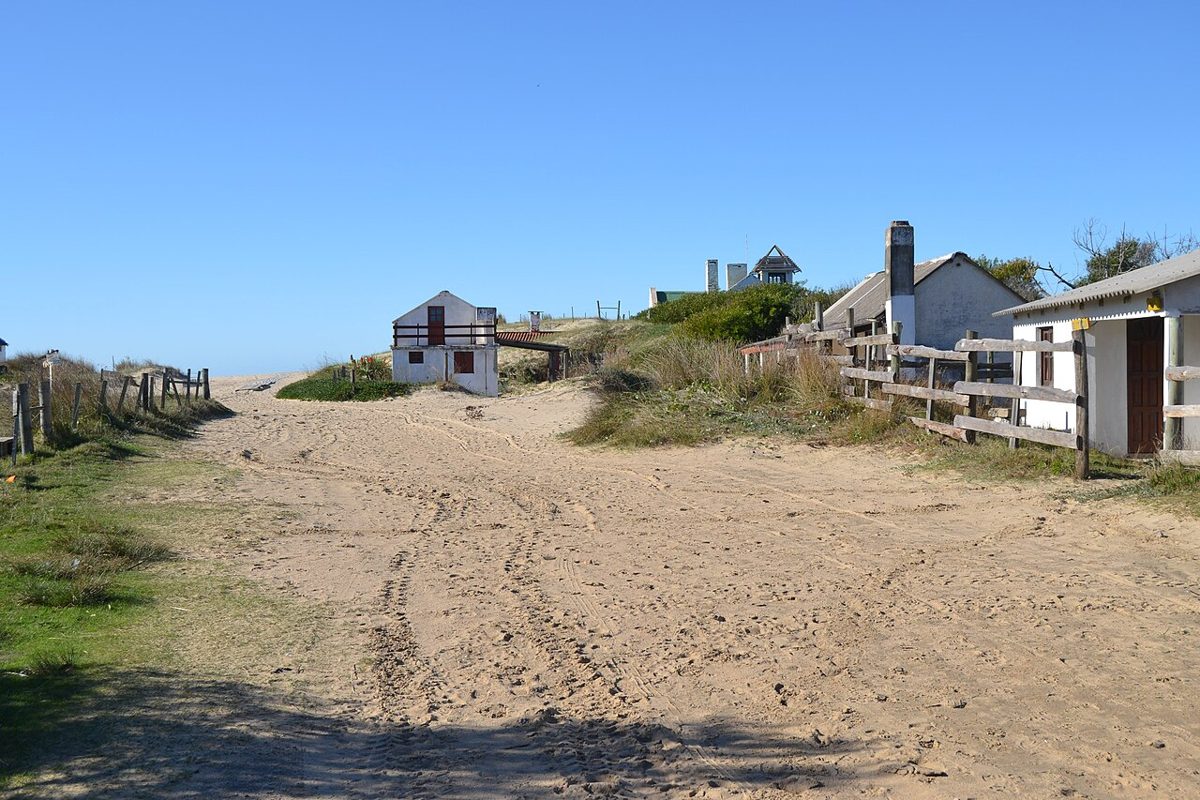
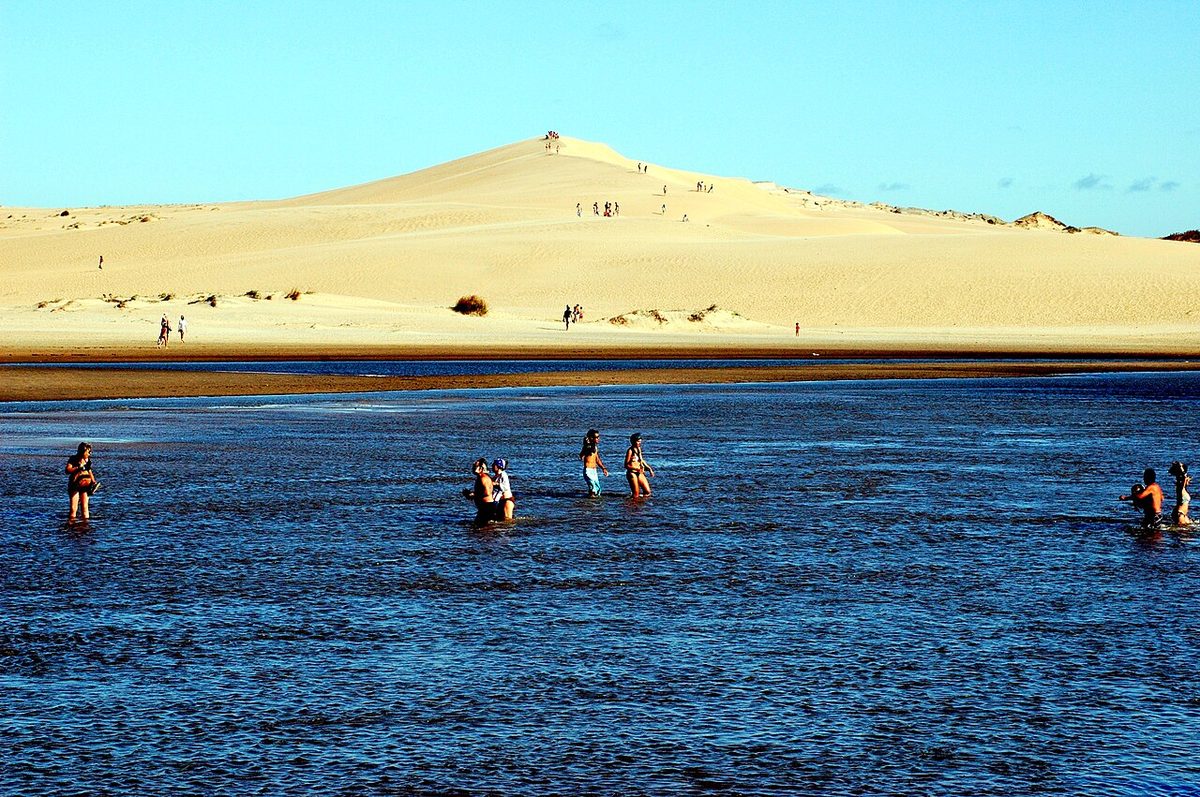
The big attraction is the walk south: cross the arroyo by rowboat in summer, climb the Cerro de la Buena Vista – at around 50 meters one of the highest dunes in South America, with a genuinely great view – and continue over the sand to Cabo Polonio in two to three hours (bring water, there is no shade whatsoever). Done as a one-way hike with the truck back out of Polonio, it is the best half-day on the wild coast.
Drawback: Valizas is scruffy by design, the summer mosquitos after rain are a plague with wings, and outside January the village can feel like a stage set with the cast gone home. Budget travelers will be happy; comfort-seekers will not.
Aguas Dulces: the one time forgot
Ten minutes from the town of Castillos, Aguas Dulces is a strip of weathered wooden shacks – some on stilts right over the sand, a leftover from the days before coastal setback rules – a couple of grocery stores, a handful of beach bars in summer, and a long brown-sugar beach that runs to the horizon in both directions. Uruguayan families have been coming here for generations and tourism has barely changed a thing.
What do you do in Aguas Dulces? You swim, you eat fried fish, you walk, you have a beer while the sun drops. That is the complete list, and the people who love this place love it for exactly that. Stay a night if slow beach villages are your thing; otherwise it is a lovely lunch stop between Valizas and Punta del Diablo.
Punta del Diablo: the famous fishing village
Punta del Diablo is what happens when a tiny shark-fishing settlement gets discovered by surfers, then backpackers, then everyone. For most of the year it is still a village of dirt roads and brightly painted timber cabins where fishermen winch their boats up Playa de los Pescadores by hand. For six weeks around New Year it becomes one of Uruguay’s busiest beach destinations, its population exploding from a few hundred to tens of thousands.
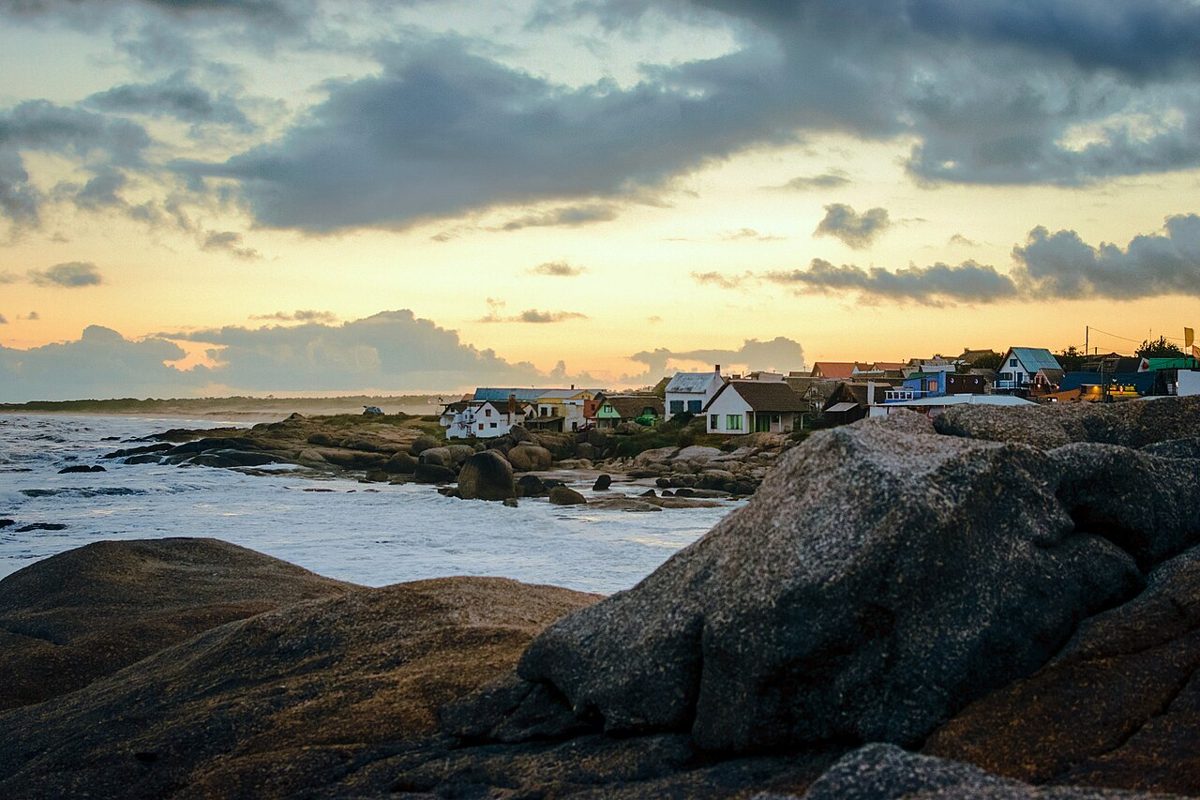
The town spreads over low hills behind three main beaches. Playa de los Pescadores, with the fishing boats and most of the restaurants, is the postcard one – the smell of grilling fish and woodsmoke at sunset here is one of my favorite sensory memories of Uruguay. Playa del Rivero, just north, is the main surf and swim beach. Playa de la Viuda, south past the point, is bigger, emptier, and named after a widow whose lonely mansion predates the road into town; surfers like its beach breaks. Walk north along the sand for forty minutes and you reach the wild beaches of Santa Teresa park – in summer a beach-bar shack or two appear along the way, selling cold beer to people who walked for it.
Eating here means seafood: the fishermen’s stalls sell the morning catch, and in season half a dozen kitchens turn it into excellent, unfussy meals. The local buñuelos de algas – seaweed fritters – sound like a dare and taste like the sea’s answer to a potato chip. I cover the wider national menu in my guide to Uruguayan food, but Punta del Diablo is the best place on this coast to eat it with sand still on your feet.
Drawbacks, because there are real ones: January is heaving, loud, and roughly double the price of December; the hilly sand streets punish flip-flops and rental-car suspensions alike; and from Easter to November the town is so quiet that “is anything open?” becomes a fair question. Aim for December or late February through March if you want life without the crush.
Santa Teresa National Park: the fortress in the forest
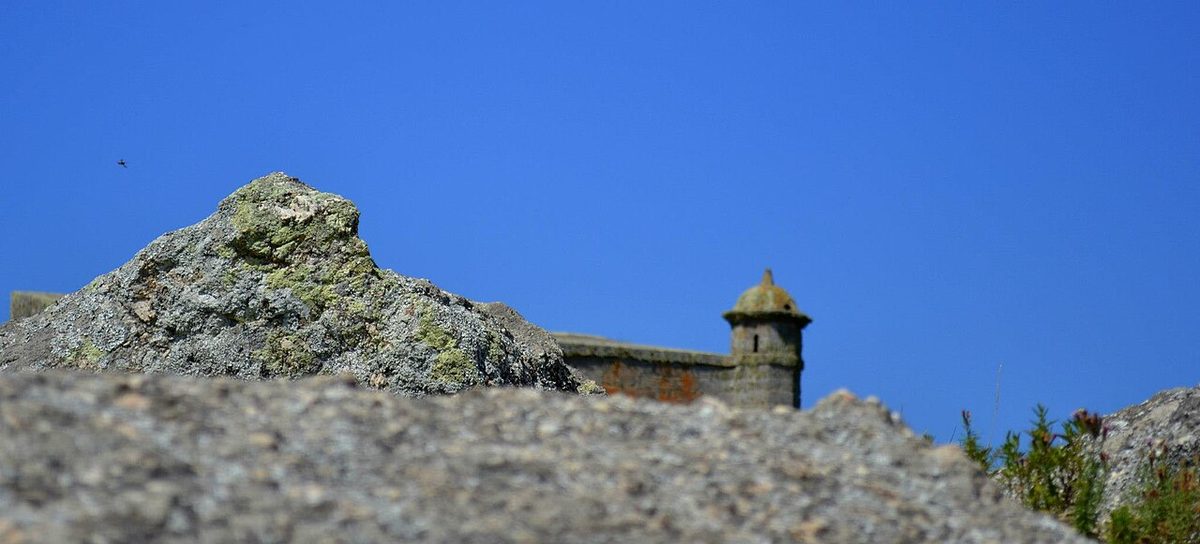
Immediately north of Punta del Diablo, Parque Nacional Santa Teresa is a 3,000-hectare slab of planted forest, gardens, and empty ocean beach run by the army – which sounds odd and works beautifully. The headline act is the Fortaleza de Santa Teresa, a genuinely imposing stone fortress begun by the Portuguese in 1762 and captured and finished by the Spanish, sitting on a hill of green lawns with cannons still aimed at an enemy who never came back. Entry costs little, the small museum is worth twenty minutes, and the ramparts are a kid’s imagination set loose.

The rest of the park is beaches and campgrounds. Playa Grande, La Moza, and Playa del Barco are as close to deserted as a beautiful beach gets outside the first weeks of January; Cerro Verde at the northern end is a protected sea-turtle area where green turtles feed in summer. The campgrounds – among the cheapest sleeps on the whole coast – have hot showers, a small store, and capybaras wandering through at dusk like they pay rent. There are also basic cabins if a tent is a step too far.
The catch: around New Year the campsites fill with thousands of Uruguayan and Brazilian families and the party runs late. Come any other time and you may have a forest clearing – and a few hundred meters of beach – entirely to yourself.
La Coronilla and Barra del Chuy: the end of the line
Past Santa Teresa the crowds give up. La Coronilla is a faded little resort town with a long empty beach that has quietly become a base for visiting Cerro Verde’s turtle waters. Barra del Chuy, the last settlement before Brazil, is beloved by Uruguayan surfcasting fishermen and almost nobody else – which, if you have read this far, you may correctly interpret as a recommendation. The beach is enormous, the water warmer than further west, and on a weekday in March yours will be the only footprints.
The border town of Chuy itself is a strange beast: one main avenue where the median strip is the international frontier, Uruguay on one sidewalk and Brazil on the other, lined with duty-free shops. It is useful (cheap electronics, Brazilian snacks, onward buses to Brazil) and completely charmless. Nearby, the small restored Fuerte San Miguel – older sibling to Santa Teresa’s fortress, dating to 1734 – and its parador make a better stop than the shopping.
Beyond the beaches: lagoons, palm groves, and hills
Most visitors see Rocha’s coast and nothing else, which is like eating the crust and leaving the pie. The department’s interior holds some of Uruguay’s best nature, and almost none of it requires a tour bus.
Laguna de Rocha: shrimp, swans, and a UNESCO biosphere
Just behind La Paloma, separated from the ocean by a sand bar that the sea occasionally breaches, Laguna de Rocha is the easiest of the big lagoons to visit and the most rewarding for the effort. It is a UNESCO biosphere reserve and a protected landscape where a small community of fishing families works the water the way their grandparents did – rowboats, hand nets, traps for the famous camarones (shrimp) that fatten in the lagoon in autumn. More than 200 bird species use the lagoon: black-necked swans, flamingos in good years, spoonbills, and enough migratory shorebirds to make a birder forget lunch.
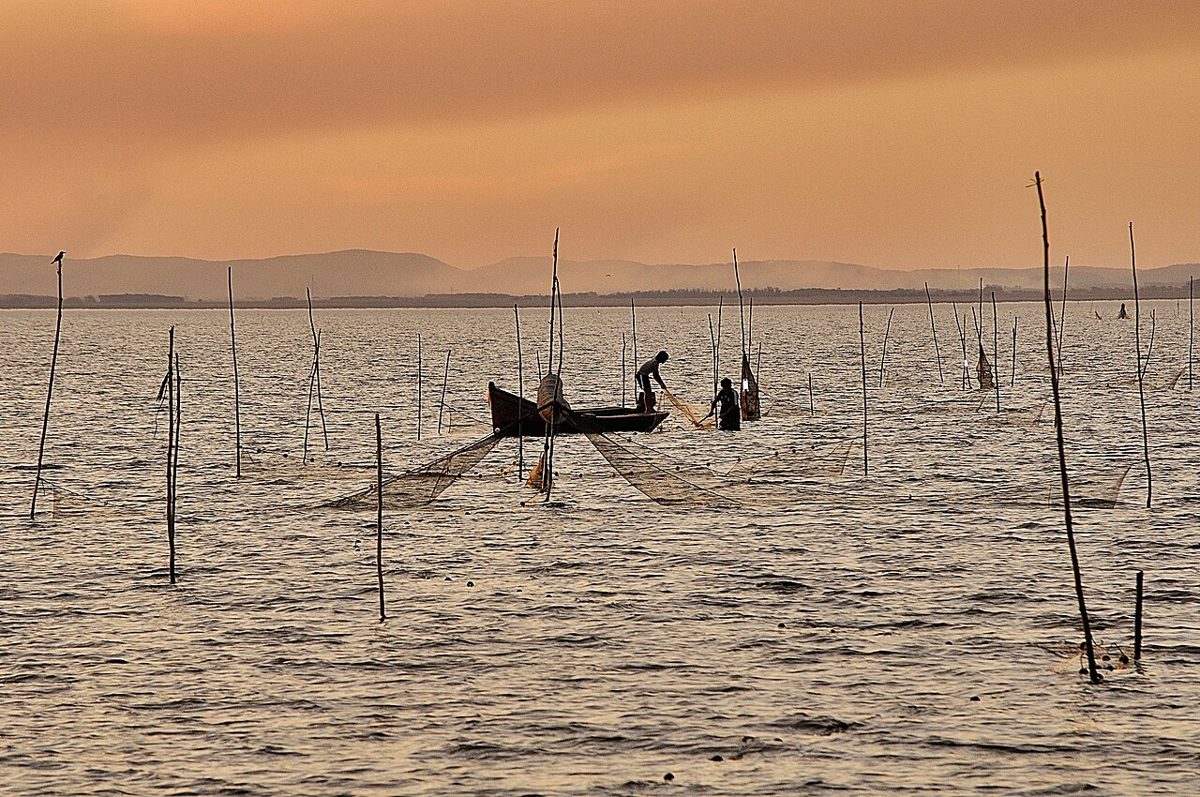
Go at sunset when the fishermen check their nets and the water turns the color of mate cocido. You can buy shrimp and fresh fish directly from the families at the barra in season – bring pesos and a cooler bag. There is no visitor center to speak of; that is part of the appeal.
Laguna de Castillos and the ombú forest
North of Valizas, Laguna de Castillos hides Rocha’s most unexpected sight: the Monte de Ombúes, one of the world’s only true forests of ombú – a giant, swollen-trunked plant that is technically an overgrown herb and normally grows alone on the pampas. Local families run boat trips up the arroyo Valizas from the bridge on Ruta 10, drifting past caimans and kingfishers to walk among centuries-old specimens with trunks like melted candles. Capybaras graze the banks; serious birders rate this lagoon even above Laguna de Rocha. Trips run mainly in season and on demand – around two to three hours, reasonably priced, and worth every peso.
Palm groves, Castillos, and a glass of butiá
Inland Rocha grows the country’s densest groves of butiá palms – low, shaggy, improbably photogenic trees that carpet the flats around the town of Castillos and turn gold at sunset. Rochenses harvest the orange fruit every summer and turn it into jams, ice cream, and licor de butiá, a sweet liqueur you will be offered everywhere and should accept at least twice. Castillos itself is a workaday town, but it is the supply stop for Valizas, Aguas Dulces, and Polonio – and its bakeries are better than they need to be.
The sierras: horses and silence
West of the lagoons the land crumples into low hills – the Sierras de Rocha – all rock outcrops, streams, and cattle. A handful of small ranches here run horseback days and farm stays, including some long-established places beloved of travelers looking for the gaucho experience without a five-hour drive into the interior. It is the same landscape that estancia tourism sells elsewhere in Uruguay, twenty minutes from the beach. If the wild coast is act one of Rocha, an evening ride in the sierras is the encore most people never see.
Things to do in Rocha beyond lying on the sand
The beach is the headline, but Rocha rewards people who like their nature with a pulse.
Surfing. Rocha has Uruguay’s most consistent surf. La Paloma’s many aspects mean a rideable wave somewhere almost every day; El Desplayado at La Pedrera, Playa del Rivero and La Viuda at Punta del Diablo, and the empty beach breaks of Santa Teresa fill out the map. Water is wetsuit territory most of the year – a 3/2 in summer, more rubber from May. Boards rent easily in La Paloma and Punta del Diablo in season; elsewhere, bring your own.
Whale watching, free, from the sand. Southern right whales migrate along this coast from roughly July to October, often inside the line of the breakers, breaching close enough to hear. The lighthouse at La Paloma, the cliffs of La Pedrera, and the rocks at Cabo Polonio and Punta del Diablo are all reliable lookouts in August and September. No boat, no ticket – just patience and something warm to drink.
Wildlife. The Cabo Polonio sea lion colony performs year-round. Cerro Verde’s green turtles feed close to shore in summer. Between the four big lagoons you have one of South America’s richest waterbird corridors, and capybaras are a daily sight around Castillos and Santa Teresa. Bring binoculars; you will use them more than sunscreen outside summer.
Hiking. The Valizas-to-Cabo Polonio dune walk is the classic. The full beach walk from La Pedrera toward Cabo Polonio is a longer, flatter cousin. Santa Teresa’s forest tracks and the hills behind the lagoons round it out. Nothing here requires gear beyond water, a hat, and respect for the sun bouncing off all that sand.
Fishing. Surfcasting is close to religion on this coast, peaking at Barra del Chuy and La Coronilla. In the lagoons, the artisanal shrimp harvest runs in autumn – and eating the result at a fisherman’s table beats any restaurant version.
About Rocha city (a quick honest word)
The department’s capital, also called Rocha, sits inland on Ruta 9 – a tidy agricultural town of about 25,000 people with a pleasant plaza, some handsome century-old buildings, cheap set-menu lunches, and no tourist attractions to speak of. You will likely pass through its bus terminal when connecting between coastal towns, and that is the correct amount of time to spend there. I say this with affection: rochenses themselves will tell you the same, then point you to the beach.
Getting to Rocha and getting around
First, orientation: Rocha’s coast starts about 180 km east of Montevideo and runs to the Brazilian border at Chuy, 340 km out. Two roads matter – Ruta 9, the fast inland highway, and Ruta 10, the slow coastal road that hops from beach town to beach town until it peters out near Valizas. If you are starting from abroad, my guide on getting to Uruguay covers flights and the Buenos Aires ferries, and my Montevideo guide is worth a read if you have a night in the capital first; from Montevideo onward it works like this.
By bus. Comfortable coaches leave Montevideo’s Tres Cruces terminal many times daily. Rutas del Sol and COT are the main companies; both are reliable and tickets are easy to buy at the terminal or online. Reckon on roughly 3.5 to 4 hours to La Paloma or La Pedrera, about 4.5 hours to the Cabo Polonio terminal on Ruta 10, and around 5 hours to Punta del Diablo, for something in the range of US$15-25 one way last I checked. In high season buses fill up – book a day or two ahead. Off-season the coastal services thin out, and reaching the smaller villages can involve a change in Rocha city or a local minibus.
By car. A rental is the difference between seeing one town and seeing the coast. Ruta 9 is in good shape; Ruta 10 varies from smooth to washboard gravel east of La Pedrera but needs no 4×4. Distances are short – La Paloma to Punta del Diablo is about 90 minutes – and an itinerary that strings together three or four towns suddenly becomes easy, lagoon stops included. Watch for capybaras and the absence of streetlights after dark, fill the tank in Rocha city or Castillos, and remember you cannot drive into Cabo Polonio at all: you park at the terminal (paid, guarded) and take the truck.
The Cabo Polonio trucks. Because everyone asks: the 4×4 trucks are the official park transport, they leave from the terminal at km 264 on Ruta 10, run roughly hourly through the day in summer (less often in winter), take about twenty minutes each way, and cost a few hundred pesos return. Buy the ticket at the terminal window. Walking in along the beach (about 7 km) is allowed and lovely; doing it with luggage is a workout you only choose once.
Onward to Brazil. Buses run from Punta del Diablo and along Ruta 9 to Chuy, where you can connect to Brazilian services toward Porto Alegre. Remember to handle both countries’ immigration stamps – the offices are outside the town center on each side, and the bus does not always wait while you figure that out.
When to go to Rocha
My short answer: the first half of December, or late February through March. You get open restaurants, warm sea, working buses, and rooms at sane prices – without the January density.
High season (Christmas to early February). Everything is open, the towns are at their most social, and prices double or worse, with January 1-15 the absolute peak. Cabo Polonio and Punta del Diablo are a party. Book weeks ahead.
Shoulder (November-mid December, late February-April). The sweet spot. Water is warmest in February and March. Carnival brings a fun, rowdy spike – La Pedrera especially.
Winter (May-October). The wild coast earns its name: storms, empty beaches, many places closed. But this is whale season, the light is extraordinary, and a fireplace cabin in a near-empty Punta del Diablo is its own kind of holiday. Pack proper layers – the damp Atlantic cold sneaks up on people. The full seasonal picture is in my month-by-month Uruguay guide.
Rocha by traveler type
First trip to Uruguay, want one base: La Paloma. Infrastructure, beaches for every mood, day trips in both directions. Add a night in Cabo Polonio so you do not go home wondering.
Couples: La Pedrera in December or March – clifftop sunsets, the best food on the coast, and walkable everything. Splurge nights exist; so do simple posadas.
Backpackers: Punta del Diablo and Valizas are the classic pair, with Cabo Polonio in between. Hostels in all three; the Valizas-Polonio dune walk is the rite of passage.
Families: La Paloma’s Bahía Chica for small kids, Santa Teresa’s campgrounds and fortress for the older ones. Capybaras at dusk beat any screen.
Surfers: Base in La Paloma or Punta del Diablo, chase the forecast between them, and accept the wetsuit.
Nature and birds: A car, the four lagoons, the ombú forest boat trip, Cerro Verde, and your binoculars. October-November and March-April are prime.
Avoiding crowds at all costs: Aguas Dulces, La Coronilla, or Barra del Chuy, any month except January.
Where to stay in Rocha
Rocha does not do international hotel chains – anywhere. Accommodation means cabañas (self-catering cabins, the local default and great value for groups), small posadas and guesthouses, hostels in the backpacker towns, and campgrounds, with Santa Teresa’s the standout. A few style-forward small hotels cluster in La Pedrera and around Punta del Diablo.
Three practical notes. First, in January, minimum-stay requirements of a week are common for cabañas – the towns rent by the season, not the night. Second, outside high season many places close entirely; book somewhere that confirms it is actually open rather than just accepting reservations. Third, in Cabo Polonio “rustic” is a fact, not a marketing word – check if your hostel has hot water and decide how much you care. Wherever you stay, book directly when you can; most owners answer WhatsApp faster than email and often discount for it.
Suggested Rocha itineraries
Three days (the taster): Day one, bus or drive to La Paloma, lighthouse climb, sunset at La Balconada. Day two, morning at La Pedrera, afternoon truck into Cabo Polonio, candlelit night. Day three, sea lions at dawn, truck out, home. Doable without a car.
Five days (the proper visit): Add a night in Punta del Diablo with a morning at Santa Teresa’s fortress, and slot in the Laguna de Rocha sunset on the La Paloma day.
A week or more (the full coast): All of the above plus the Valizas dune walk, the ombú forest boat trip, a sierras horseback afternoon, and a lazy day at Aguas Dulces. This pairs naturally with the eastern half of my two-week Uruguay itinerary, which strings Rocha together with Punta del Este and Montevideo.
Practical tips for the wild coast
Cash. ATMs exist in La Paloma, Rocha city, Castillos, and Chuy – and nowhere else that you can count on. Cabo Polonio, Valizas, Aguas Dulces, and much of Punta del Diablo run on cash. Carry more pesos than feels necessary.
Connectivity. Signal is decent in the towns, patchy in the park and dunes, and Cabo Polonio’s is famously moody. Download offline maps before you leave Montevideo.
Sun and sea. The UV here is fierce – the sand and water double it – and several beaches have strong rips and no lifeguards outside summer. Swim where the locals swim. If the red flag is up, believe it.
Mosquitos. After summer rain, the lagoons breed clouds of them, with Valizas the traditional capital. Repellent is not optional from December to March.
Safety. Rocha is rural Uruguay: petty theft in the January crush is the realistic worry, violent crime is rare. The bigger hazards are sunburn, rips, and night driving on unlit roads. My general Uruguay travel tips cover money, SIM cards, and the mate etiquette you will need everywhere.
Spanish. English gets thinner the further east you go. A few phrases, Google Translate, and good humor cover the gap – rochenses are patient with visitors who try.
FAQ: Rocha, Uruguay
Is Rocha, Uruguay worth visiting?
Emphatically yes, if your idea of a beach holiday involves nature, character, and space rather than resorts and nightlife. Rocha holds Uruguay’s wildest beaches, its only off-grid village, a UNESCO biosphere lagoon, and an 18th-century fortress – all within a two-hour stretch of coast. If you want polish and beach clubs, stay west in Punta del Este.
What is Rocha known for?
Wild Atlantic beaches and the absence of development. Its headline names are Cabo Polonio (the off-grid village in the dunes), Punta del Diablo (the fishing-village-turned-surf-town), La Paloma and La Pedrera, plus protected lagoons full of birdlife, butiá palm groves, and the fortress of Santa Teresa near the Brazilian border.
How do you get to Cabo Polonio?
Take a Rutas del Sol bus from Montevideo’s Tres Cruces terminal (about 4.5 hours) or drive to the park terminal at km 264 on Ruta 10. From there, official 4×4 trucks cross 7 km of dunes to the village in about twenty minutes for a few hundred pesos return. You can also walk in along the beach in around 90 minutes.
Can you drive to Cabo Polonio?
No. Private vehicles are banned inside the national park. You leave your car at the guarded paid lot at the Ruta 10 terminal and ride the park’s 4×4 trucks, walk, or – in summer – ride in on horseback with a local guide. The vehicle ban is precisely why the village still looks the way it does.
Which is better, La Paloma or La Pedrera?
La Paloma for practicality: more beaches, more services, easier with kids, better surf variety, and it stays alive year-round. La Pedrera for looks: the clifftop setting, sunset views, and the coast’s best restaurant scene, at higher January prices. They are 10 km apart, so honestly – base in one, have dinner in the other.
When can you see whales in Rocha?
Southern right whales pass along the Rocha coast from about July through October, with August and September the most reliable months. You watch them free from shore – the La Paloma lighthouse, La Pedrera’s cliffs, and the rocks at Cabo Polonio and Punta del Diablo are the classic lookouts. Mornings with calm sea offer the best spotting.
Do you need a car in Rocha?
No, but it helps. Buses connect Montevideo with every major town, and local services link them in summer. A car earns its cost if you want the lagoons, the ombú forest, several towns in one trip, or any of it outside high season, when bus frequencies drop sharply.
Is Punta del Diablo safe?
Yes, by any regional standard. The village’s main risks are opportunistic theft during the packed January weeks – do not leave valuables on the beach – plus rip currents on the surf beaches and unlit sandy streets at night. Off-season it is one of the sleepiest, safest-feeling places on the Uruguayan coast.
Final thoughts
Uruguay gets described as South America’s quiet achiever, and Rocha is the quietest, best part of that story. Nowhere else on this side of the continent can you watch whales from an 1881 lighthouse, sleep in a village with no electricity, walk a dune the height of a ten-story building, and eat shrimp bought from the family that netted it – all in the same week, none of it expensive. Go before everyone you know does. And if Rocha is your reason for the trip, build the rest of it around the east: start with my guide to the best beaches in Uruguay and you will see how much of that list lives on this one stretch of coast.
Last updated: June 2026. Prices and timetables move – treat numbers here as ballpark and check current details before you travel.
Credits & sources
Sources & further reading
- Turismo Rocha – the department’s official tourism site (Spanish-first, with basic English)
- Uruguay Ministry of Environment – details on the national protected areas system, including Cabo Polonio and Laguna de Rocha
- Guru’Guay: beaches of Rocha – a long-running local English-language site with good Rocha coverage
Photo credits
All photos via Wikimedia Commons, used under their respective licenses: Cabo Polonio beach by Pablo Castañero (CC BY 3.0); Cabo Polonio lighthouse by Rarrillaga86 (CC BY-SA 3.0); sea lions by Okta30 (CC BY-SA 4.0); Punta del Diablo by Franco Frizzo (CC BY 3.0); La Paloma lighthouse by Marcelo Campi (CC BY-SA 2.0); La Pedrera by eurimaco (CC BY-SA 3.0); Barra de Valizas by Casaseneleste (CC BY-SA 4.0); Fortaleza de Santa Teresa by rodoluca (CC BY-SA 3.0); Laguna de Rocha by Pablofor (CC BY-SA 3.0); Laguna Garzón bridge by Jimmy Baikovicius (CC BY-SA 2.0).
1 comment