Piriapolis: Uruguay’s Original Beach Resort (2026)
The first time I drove into Piriápolis, I almost missed the turn because I was staring at a hill with a giant cross on top instead of watching the road. That’s the thing about this town: the geography does half the work before you’ve even parked the car. I’ve been back four or five times since, and I’ve come to think of it as the most quietly likeable beach town in Uruguay.
Piriapolis Uruguay is the country’s oldest purpose-built seaside resort, a planned town created by an eccentric Italian-Uruguayan businessman in the early 1900s, sitting on the coast of Maldonado department about 100 km east of Montevideo. It pairs a long curved promenade and calm swimming beaches with green hills, a grand old hotel, a working fishing port and a famous chairlift.
This guide is the deep dive on Piriápolis the town: its strange and wonderful history, the landmarks Francisco Piria left behind, the beaches in and around the center, the two hills everyone climbs, the port, and the honest practicalities of getting here and deciding whether it’s your kind of place. For the wider coast I’ll point you to siblings as we go.
| Piriápolis at a glance | The short version |
|---|---|
| Where it is | Maldonado department, Atlantic coast, ~100 km east of Montevideo |
| Getting there | ~1h40–2h by bus or car from Montevideo; ~45 km (under an hour) from Punta del Este |
| Founded | Early 1900s by Francisco Piria; first land auction 1912 |
| Best for | Families, budget travelers, slow beach days, walkers and history nerds |
| Signature sights | Rambla de los Argentinos, Cerro San Antonio chairlift, Castillo de Piria, Hotel Argentino, Cerro Pan de Azúcar |
| Beaches | Calm central bay plus Playa Hermosa, Playa de los Ingleses, Punta Colorada and Punta Negra nearby |
| When to go | December–February for full swing; March or November for warm days and elbow room |
| Daily budget | Around US$60–70 per person, last I checked — noticeably cheaper than Punta del Este |
A town one man dreamed up: the Francisco Piria story
You can’t understand Piriápolis without understanding the man it’s named after. Francisco Piria (1847–1933) was the child of Italian immigrants, raised partly in Montevideo and schooled in Italy. He came back a property developer, a writer, a sometime politician, and — this is the part everyone repeats — an alchemist obsessed with esoteric symbolism.
In 1890 he bought up a long stretch of empty coast with one idea: build a European-style seaside resort from scratch. He’d seen the French Riviera and wanted his own version on the River Plate. So he laid out streets, planted hills with trees, built a rail link, and started constructing the grand buildings that would lure wealthy montevideanos and porteños across the water.
His first big building was the castle. By 1905 he’d opened a grand hotel, and around 1910 he began the promenade. In 1912 he held the first auction of building lots, and the town was officially born. Piria essentially willed an entire resort into existence, which is why locals sometimes call him “the alchemist who turned hills into gold.”
Here’s the fun rabbit hole. Piria was a Freemason and a reader of esoteric texts, and people have spent decades arguing that he encoded alchemical and Masonic symbols into the layout of the town — the alignment of the castle, the fountains, the hills. Some of it is probably real intent and some is later myth-making. Either way, it gives a wander around town a faint treasure-hunt feeling that no other Uruguayan beach town has.
Castillo de Piria, his fairy-tale residence
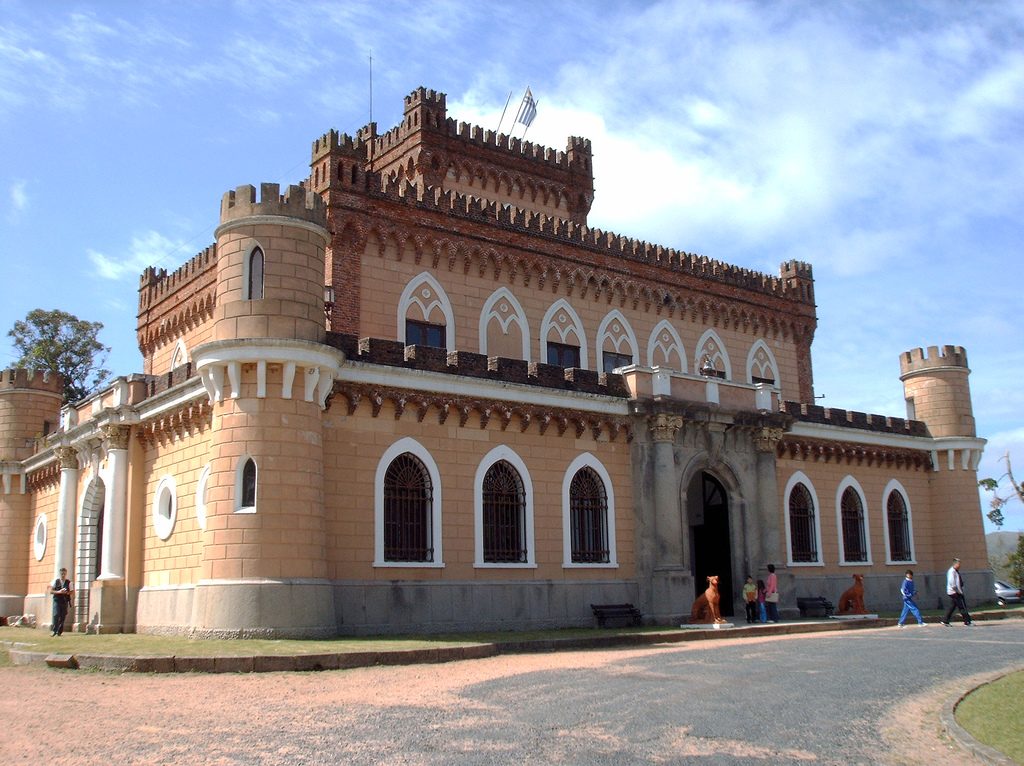
The Castillo de Piria sits a few kilometers inland at the foot of Cerro Pan de Azúcar, built between 1894 and 1897 to designs Piria sketched himself, executed by the Italian architect Aquiles Monzani. It was his summer home, a Renaissance-inspired pile surrounded by terracotta statues and formal gardens, and today it’s a museum you can walk through inside and out.
I find the grounds more memorable than the rooms, honestly — the statue-dotted gardens and the backdrop of the hill do a lot of heavy lifting. Entry was free or close to it last I checked, which makes it an easy add-on. The one drawback is that it’s not in town, so without a car you’re relying on a local bus or taxi to reach it, and the connections aren’t frequent.
The Hotel Argentino, a grand dame on the rambla
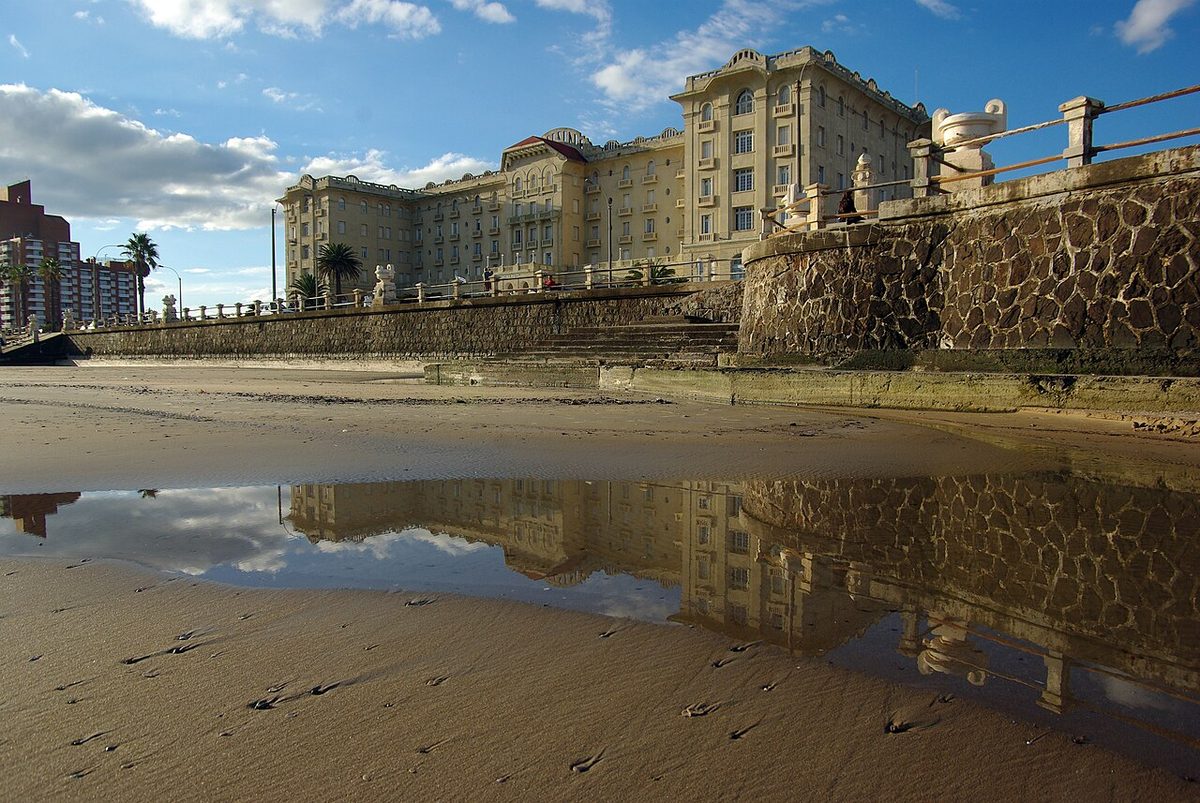
Dominating the seafront is the Hotel Argentino, opened in 1930 and, at the time, billed as one of the largest hotels in South America. It’s a vast belle-époque block with hundreds of rooms, a thermal spa, and a frontage that defines the whole promenade. Even if you don’t stay, walk past it at dusk when the facade lights up.
Staying there is a particular experience — equal parts faded grandeur and genuine old-world charm, with a spa fed by mineral water and corridors that feel like a film set. Just temper expectations: it’s a historic giant, not a slick modern resort, so some rooms show their age and service can be unhurried in the very Uruguayan sense of the word. If you want polish over patina, you may prefer the glossier options around Punta del Este.
The Rambla de los Argentinos: the heart of town
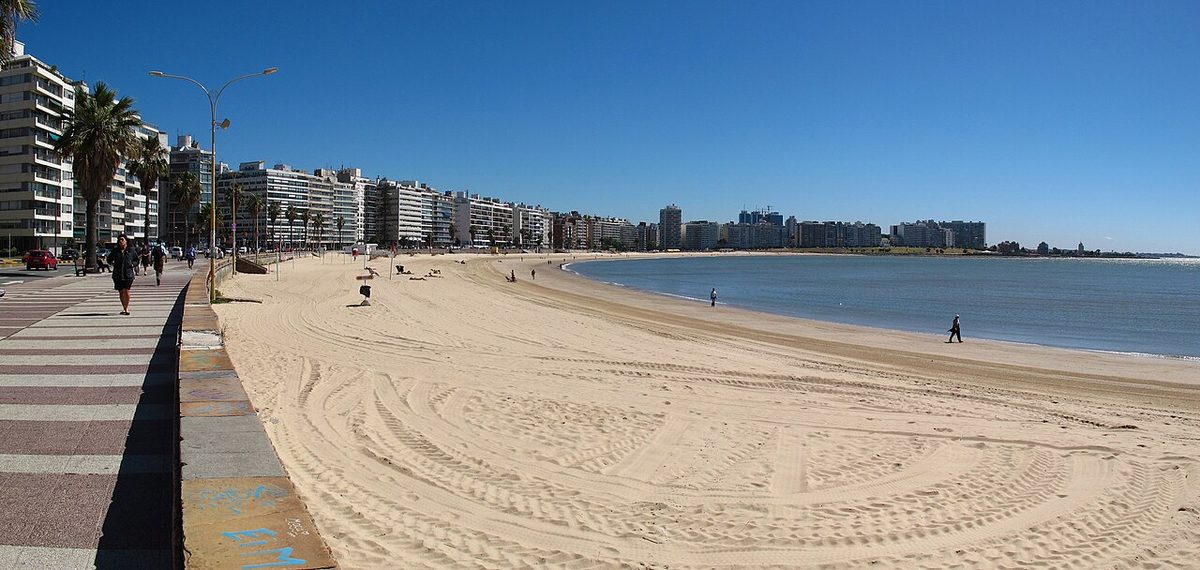
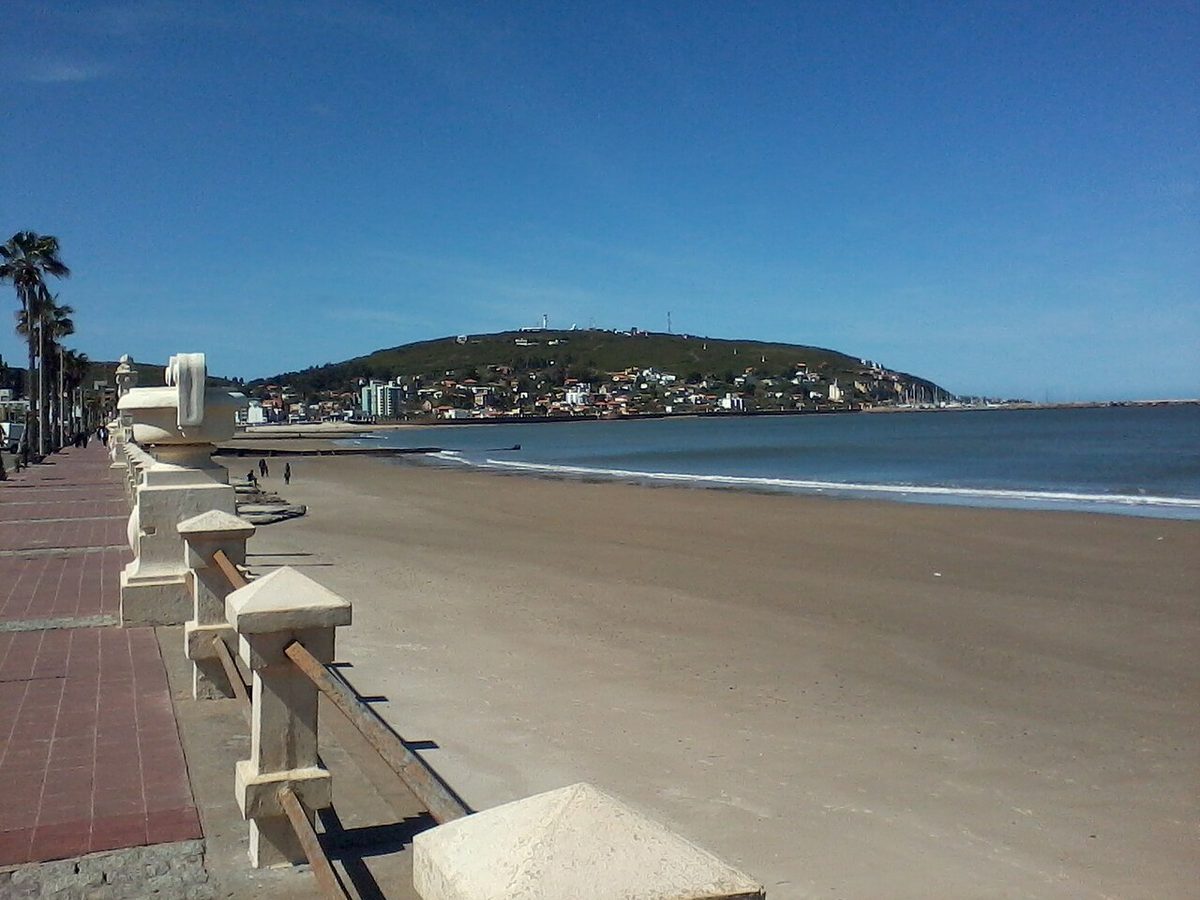
Every Uruguayan coastal town has a rambla — a waterfront promenade that doubles as the social spine of the place — and Piriápolis has one of the best. The Rambla de los Argentinos runs the length of the central bay, a wide curve of pavement, palm trees and low-rise hotels that Piria laid out more than a century ago.
Mornings here are for joggers and dog-walkers and old men setting up fishing rods. Late afternoons are for families drifting between the beach and the ice-cream shops. And the evening paseo — the slow walk locals take after the heat drops — is the whole town’s unofficial ritual, mate flask (the bitter herbal tea Uruguayans carry everywhere) tucked under one arm.
I like that the rambla feels lived-in rather than staged. There are old-fashioned heladerías, a few parrillas (grill restaurants serving Uruguay’s beloved wood-fired beef), souvenir stalls, and the artisan fair near the Paseo de la Pasiva where you can pick up leather and silver and the inevitable mate gourds. It’s not a luxury strip and it doesn’t pretend to be.
The honest drawback: in deep winter the rambla can feel half-asleep, with shuttered shops and a wind off the water that cuts right through you. Piriápolis is a summer creature at heart, and a grey Tuesday in July shows you a very quiet version of it. If you want guaranteed buzz, time your visit for the warm months — our guide to the best time to visit Uruguay breaks down the seasons.
Piriapolis Uruguay beaches: where to swim
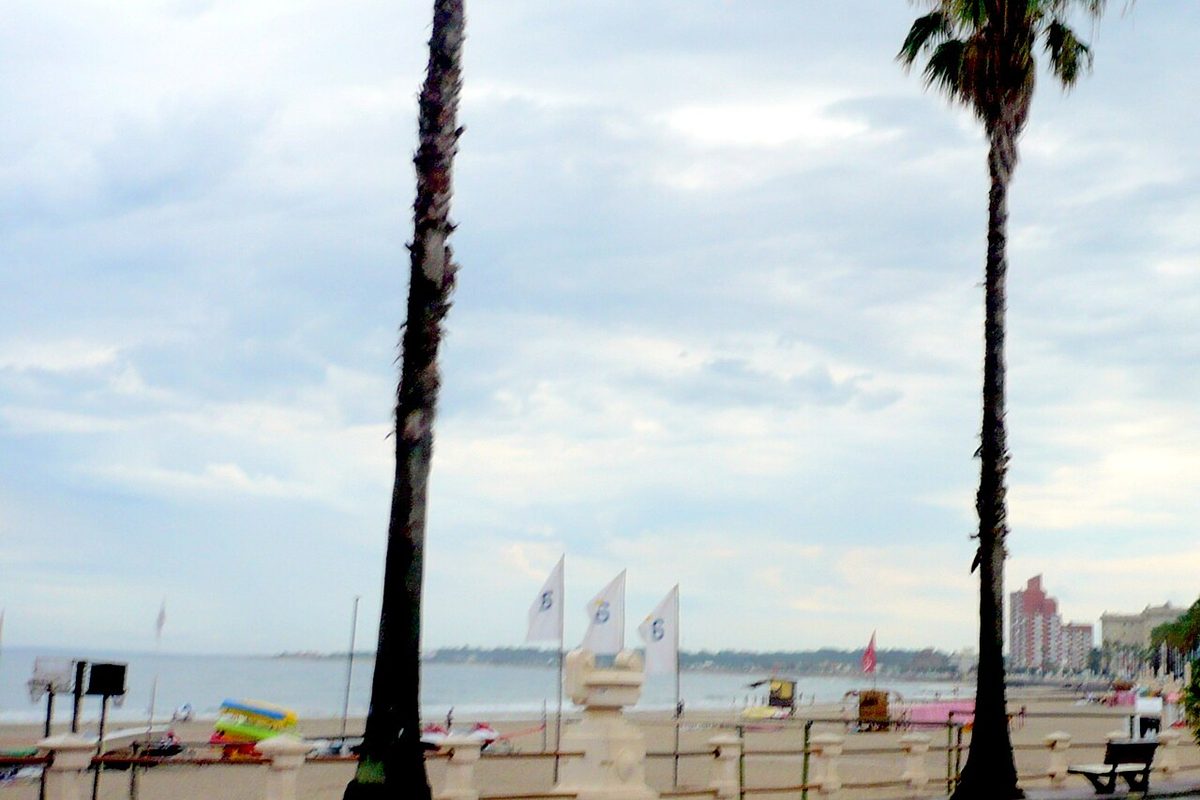
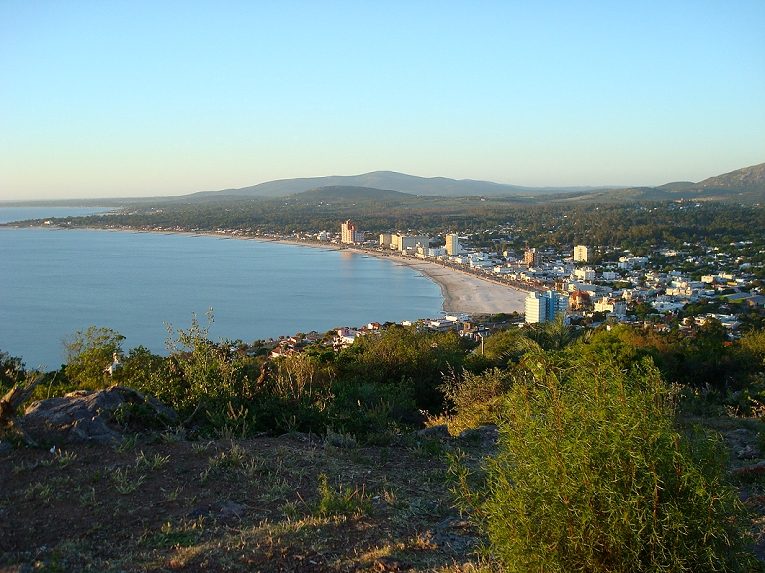
Let’s talk sand, because that’s what most people come for. The defining feature of the central beach is that it’s calm. Piriápolis faces a sheltered bay on the River Plate estuary rather than the open Atlantic, so the water is gentler and the gradient is shallow — which is exactly why it became a family resort in the first place.
The main town beach, Playa Piriápolis, is the long arc right in front of the rambla. It’s wide, easy to reach, lined with services, and busy in season. For my money it’s the best base if you’ve got kids or you just want to roll out of your hotel and onto the sand. The flip side of all that convenience is that on a January weekend you’ll be sharing it with half of Montevideo.
The smaller beaches around town
Walk or drive a little and the coast opens up. Playa de los Ingleses, just east toward Punta Fría, is a smaller, prettier cove that catches good sunsets — lovely, though its size means it fills fast on hot days. Keep going and you reach Punta Colorada and Punta Negra, rockier headlands with little beaches tucked between them, quieter and more scenic but with fewer facilities.
West of the center, Playa Hermosa lives up to its name: more than a kilometer of fine sand sheltered by the Cerro de los Burros, with calm water that’s genuinely good for small children. It’s part of a string of balnearios (small seaside resort settlements) that runs along this coast. For the full lay of the land, our guide to the best beaches in Uruguay sets Piriápolis in context against the rest of the country’s coast.
The hills: Cerro San Antonio, Cerro Pan de Azúcar and the chairlift
What makes Piriápolis look different from every other flat Uruguayan beach town is the ring of green hills behind it. Two of them are the reason I keep coming back, and climbing them is the best free entertainment in the area.
Cerro San Antonio and the only chairlift in Uruguay
Cerro San Antonio rises straight up behind the eastern end of the bay, about 130 meters above the sea. You can drive up, walk up, or — and this is the one everyone does — ride the aerosilla, a 1950s-era chairlift that is, as far as I know, the only one in the entire country.
It’s a wonderfully old-fashioned contraption: open two-person chairs that swing you slowly up the hillside while the whole town unspools below — the port, the lighthouse, the curve of the rambla, the sea going on forever. Partway up you pass the Virgen de los Pescadores, a statue of the Madonna with her arms open to the sea, placed to watch over the fishermen, near the foundation stone of the town.
At the top there’s a small chapel dedicated to Saint Anthony, a café, and the kind of panorama that makes people propose up here (locals will tell you it’s a classic engagement spot). The ticket was cheap last I checked and worth every peso. One honest caveat: the chairlift runs on the season and the weather, so outside summer or on a windy day it may simply not be operating — check before you build your afternoon around it, or be ready to drive the road up instead.
Cerro Pan de Azúcar, the big one
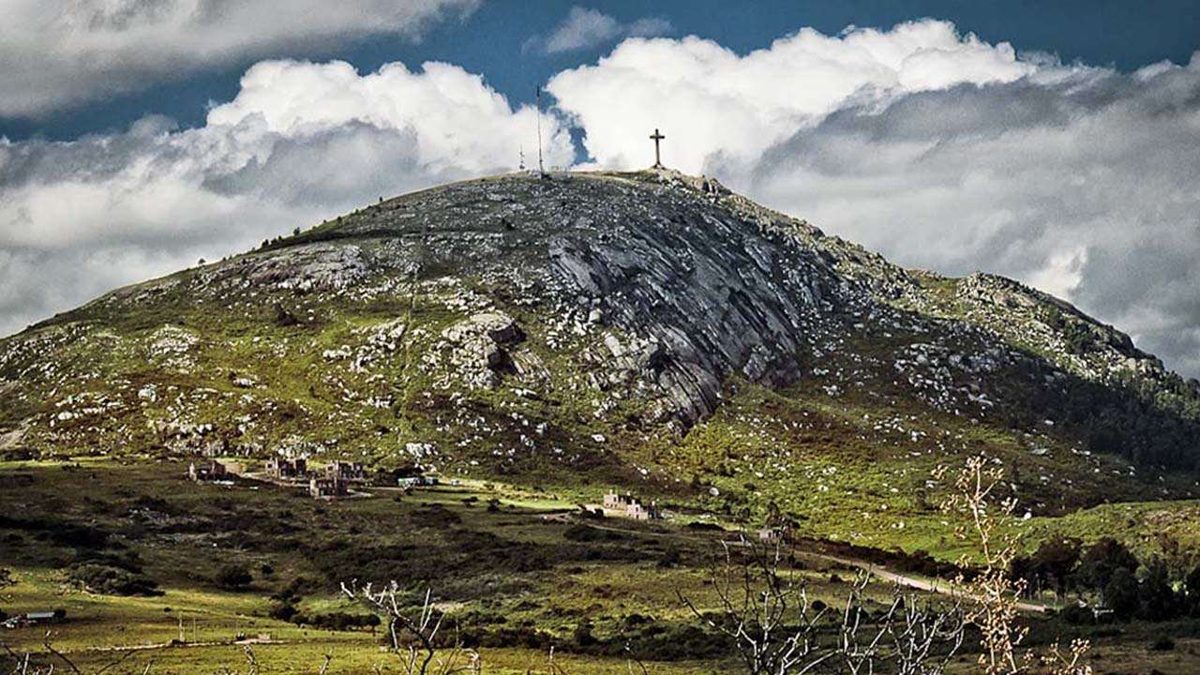
That hill with the giant cross I nearly crashed staring at? That’s Cerro Pan de Azúcar (Sugarloaf Hill), one of the highest points in Uruguay at around 423 meters. It sits a few kilometers inland near the town of Pan de Azúcar, and on its summit stands a 35-meter concrete cross you can actually climb inside, via a spiral staircase, to peer out through slots near the top.
The hike to the summit is the real draw — a steep, rocky scramble marked with paint blazes that takes most people somewhere over an hour each way. It’s the closest thing this coast has to a proper mountain walk, and the view from the top, with the Atlantic on one side and rolling country on the other, is the best in the region. Wear real shoes; this is not a sandals climb.
At the base is the Reserva de Fauna y Parque Cerro Pan de Azúcar, a small wildlife reserve and native-animal breeding station with picnic grounds. It’s a decent stop with kids, though I’ll be honest: the enclosures are modest and a little dated, so go for the park and the trailhead rather than expecting a polished zoo. It pairs naturally with Uruguay’s wider wild spaces, which I cover in the national parks guide.
Cerro del Toro and the iron bull
Less famous but worth a mention is Cerro del Toro, behind the town, where a fountain shaped like a giant iron bull spouts water from a hillside spring. It’s a short, pleasant walk up to it, popular with families, and occasionally a venue for outdoor concerts in summer. A quick one if you’ve already done the bigger hills and want a low-effort leg-stretch.
The port and other things to do in Piriápolis
Down at the western end of the bay sits the port, and it’s one of my favorite corners of town precisely because it’s not really a tourist attraction — it’s a working fishing and yacht harbor that tourists happen to enjoy. Boats come and go, the catch gets unloaded, and a handful of seafood spots sell whatever was pulled in that morning.
You can usually arrange a fishing trip here, from relaxed inshore outings to deep-sea charters, and in season there are short boat rides around the bay. Eating fresh fish at a no-frills place by the water, watching the masts clink, is the kind of low-key pleasure Piriápolis does better than its glamorous neighbor. Prices for charters vary a lot, so ask around the dock rather than booking the first thing you see online.
Beyond the obvious, the town rewards aimless wandering. There’s the artisan market, the old Fuente de Venus and other Piria-era fountains scattered about, a small rambla-side fairground feel in high summer, and easy day trips inland to the towns of Pan de Azúcar and Minas. If you’re collecting ideas for the whole country, our roundup of things to do in Uruguay casts a wider net.
Where Piriápolis sits, and how to get there
Geography is the key to understanding this town’s appeal. Piriápolis sits on the coast of Maldonado department, roughly 100 km east of Montevideo and about 45 km west of Punta del Este. That puts it squarely on the route between Uruguay’s capital and its glitziest resort — close enough to both to be an easy stop, far enough to feel like its own world.
From Montevideo it’s about a 1h40 to 2h drive along the coastal Ruta Interbalnearia, or a similar bus ride; frequent services run from the Tres Cruces terminal and most take under two hours. That drive runs past the pine-backed balnearios of the Costa de Oro, and Atlántida makes a good halfway stop if you want to break the trip with a swim. The same route makes Piriápolis a natural pause on the classic Montevideo to Punta del Este run, and it’s an easy half-day or overnight if you’re short on time.
Coming the other way, from Punta del Este it’s well under an hour by car or bus, which is why a lot of people staying in Punta pop over for a half-day. For the bigger picture on flights, ferries from Buenos Aires and border crossings, see our overview of getting to Uruguay. And if you’re sketching out a longer route, Piriápolis slots neatly into a coastal Uruguay itinerary between the capital and the eastern beaches.
One practical note on getting around once you arrive: the town center is flat and walkable, but the castle, Cerro Pan de Azúcar and the outlying beaches really do want a car. Without one you can still see plenty on foot and by local bus, but you’ll trade some flexibility for the savings.
Who Piriápolis is for (and who should skip it)
Honesty time, because not every beach town suits every traveler. Piriápolis is, to my mind, the best-value family resort on the Uruguayan coast and a lovely slow-paced base for anyone who values atmosphere over status. But it’s not trying to be Punta del Este, and if you arrive expecting that, you’ll be disappointed.
You’ll love it if you have kids — the calm bay, the chairlift, the wildlife park and the cheap ice cream are a ready-made itinerary, and I cover more of this in our Uruguay with kids guide. You’ll love it if you’re on a budget, since rooms and meals run noticeably cheaper than the eastern resorts. And you’ll love it if you like to walk, climb hills, and poke at history.
Skip it, though, if your idea of a beach holiday involves beach clubs, designer shopping and a party scene that runs till dawn. That’s Punta del Este’s department, not this one. And if the choice you’re really weighing is the polished coast against the wild beaches further east, I go through how Punta del Este and Rocha compare in a separate guide. Piriápolis is also genuinely sleepy out of season, so a winter visitor chasing nightlife will find the shutters down.
How long to stay and where to base yourself
For most people a full day or an overnight covers the headline sights — chairlift, rambla, a beach, maybe the castle. Give it two or three nights and you can fold in the Cerro Pan de Azúcar hike, the quieter outlying beaches and a fishing trip without rushing. It also works beautifully as a calm first or last stop bookending a louder Punta del Este leg.
On where to sleep, the Hotel Argentino is the atmospheric splurge, but there’s a good spread of mid-range hotels and apartments along and just behind the rambla, plus the balnearios to the west for something quieter. Our broader where to stay in Uruguay guide can help you weigh the options. If you’re traveling in the peak December-to-February window, book ahead — the town is small and fills up.
Piriapolis Uruguay: your questions answered
Is Piriápolis worth visiting?
Yes, especially if you want the Uruguayan coast without the price tag or the posing. It’s the country’s original resort, with a grand old hotel, a beautiful promenade, calm family beaches and a one-of-a-kind chairlift, all set against green hills. Treat it as a charming, slower alternative to Punta del Este rather than a substitute for it.
How far is Piriápolis from Montevideo?
It’s roughly 100 km east of Montevideo, which works out to about a 1h40 to 2h drive along the coastal Ruta Interbalnearia. Frequent buses run from the Tres Cruces terminal and take a similar time. That proximity makes Piriápolis one of the easiest beach day trips from the capital, though an overnight lets you see far more.
What is Piriápolis known for?
Piriápolis is known as Uruguay’s first planned beach resort, created by the eccentric businessman Francisco Piria in the early 1900s. People come for the Rambla de los Argentinos, the historic Hotel Argentino, the Castillo de Piria, the calm swimming beaches, and the famous aerosilla chairlift up Cerro San Antonio. The surrounding hills add scenery no other Uruguayan beach town has.
How do you get up Cerro San Antonio?
You have three options: drive up the access road, walk up on foot, or ride the aerosilla, an old open-chair lift that’s the only one of its kind in Uruguay. The chairlift is the most fun and gives the best views over the port and bay. Just check it’s running, since it depends on the season and the wind.
Is Piriápolis good for families?
Very. The central bay is sheltered and shallow, which makes it safe for small children, and the chairlift, the Cerro del Toro fountain and the wildlife park near Cerro Pan de Azúcar give kids plenty to do. Add cheap ice cream and a walkable center and it’s one of the most family-friendly spots on the whole Uruguayan coast.
Piriápolis or Punta del Este?
Choose Piriápolis for value, history, calm beaches and a relaxed pace; choose Punta del Este for nightlife, dining, shopping and glamour. They sit about 45 km apart, so you don’t strictly have to pick — many people base in one and day-trip to the other. If you only want one, ask yourself a simple question: hills and quiet, or beach clubs and noise?
Final thoughts
Piriápolis won’t dazzle you the way Punta del Este tries to. What it does instead is grow on you — the old chairlift creaking up the hill, the evening crowd drifting along the rambla, the slightly mad story of the alchemist who built the whole place from nothing.
Go for a slow couple of days, climb at least one hill, eat fish by the port, and let the town’s gentle, unhurried rhythm do its work. Of all the beach towns I’ve sent friends to in Uruguay, this is the one that gets the most surprised thank-you messages afterward.
Credits & sources
Sources & further reading
- Francisco Piria — Wikipedia on the founder’s life, esoteric leanings and the creation of the town.
- Cerro San Antonio — Wikipedia for the hill, the chairlift and the Virgen de los Pescadores.
- Intendencia de Maldonado, the regional government’s official page on Piriápolis and its coast.
Photo credits
All images via Wikimedia Commons: Rambla De Piriapolis Uruguay by Andrés Franchi Ugart… (CC BY-SA 3.0); Castillo De Piria Piriapolis by https://www.flickr.com/photos/21685589@N00/ (CC BY 2.0); Hotel Argentino Piriapolis Rambla by Ismael Cordero (CC BY-SA 3.0); Playa Piriapolis Uruguay by Roxyuru (CC BY-SA 3.0); Cerro San Antonio Piriapolis Chairlift by Hoverfish (CC BY-SA 3.0); Cerro Pan De Azucar Uruguay by Re Uruguayo (CC BY-SA 4.0).