The Best Beaches in Uruguay: A Coast-by-Coast Guide (2026)

Last updated: June 2026
Uruguay’s coastline can confuse a first-time visitor. If you expect turquoise water, a Montevideo beach comes as a surprise: the river lapping at your feet is the color of milky tea. Head east, though, and this coast starts to make sense.
So here’s the direct answer. The best beaches in Uruguay are split between two coasts: the glamorous resort sands of Punta del Este and José Ignacio, and the wild Atlantic beaches of Rocha — Cabo Polonio, La Pedrera, and Punta del Diablo — where dunes replace condo towers. City swimmers get Montevideo’s Pocitos; families do well at Piriápolis and Atlántida.
This guide walks the entire coast west to east, the same direction you’d travel it, covering about 670 km of shoreline. I’ll tell you which beaches genuinely deserve your limited vacation days, which are overhyped, what the water is actually like (temperature included, because nobody warns you), and how to reach the awkward ones without a car.
The Best Beaches in Uruguay at a Glance
If you only remember one thing from this table, make it the “Coast” column. Río de la Plata beaches have calm, silt-tinted river water; Atlantic beaches have blue-green ocean, surf, and cooler swims. Neither is “better” — they’re different trips.
| Beach / town | Coast | Vibe | Best for | Water |
|---|---|---|---|---|
| Playa Pocitos, Montevideo | Río de la Plata | Urban, lively | City stays, volleyball, people-watching | Calm, brownish river water |
| Atlántida & Costa de Oro | Río de la Plata | Local, low-key | Families, budget weekends | Calm to gentle waves |
| Piriápolis | Río de la Plata | Faded-grandeur resort | Families, old-school charm | Sheltered, good swimming |
| Playa Mansa, Punta del Este | Río de la Plata (estuary mouth) | Resort classic | Easy swims, sunsets, watersports | Calm, clearer than upriver |
| Playa Brava, Punta del Este | Atlantic | Famous, energetic | The La Mano photo, bodysurfing | Open ocean, real waves |
| Bikini / Manantiales | Atlantic | See-and-be-seen | Beach clubs, young crowd | Waves, strong rips at times |
| Playa Brava, José Ignacio | Atlantic | Barefoot luxury | Long walks, food, style | Ocean, often swimmable |
| La Paloma (La Balconada) | Atlantic | Practical surf town | Surf lessons, sunsets, amenities | Ocean, multiple aspects |
| La Pedrera (Playa del Barco) | Atlantic | Boho-chic village | Couples, surfers, January scene | Ocean, shipwreck beach |
| Cabo Polonio | Atlantic | Off-grid hamlet | Unplugging, sea lions, stargazing | Ocean, wild and exposed |
| Barra de Valizas / Aguas Dulces | Atlantic | Rustic, backpacker | Budget trips, dune hikes | Ocean, unsupervised stretches |
| Punta del Diablo (Playa de la Viuda) | Atlantic | Fishing-village surf town | Surfers, backpackers, summer parties | Ocean, year-round swell |
| Playa Grande, Santa Teresa | Atlantic | National park forest beach | Camping, nature, space | Ocean, pristine |
First, Understand Uruguay’s Two Coasts (and the Brown Water Question)
Uruguay’s shoreline fronts two different bodies of water, and this single fact explains almost every beach decision you’ll make.
From Colonia del Sacramento past Montevideo to roughly Punta del Este, the coast faces the Río de la Plata — not technically the sea but a broad estuary (classed as a river, it is the world’s widest), draining parts of Brazil and Paraguay. All that drainage carries silt, which is why the water runs tea-brown to khaki most days. It’s not pollution and it’s not dirty; it’s sediment. Locals swim happily all summer. But if you arrive expecting postcard blue, you’ll be disappointed, so calibrate now: river beaches are for easy swimming, sunsets, and city convenience, not water color.
East of Punta del Este, the Atlantic takes over and everything changes — blue-green water, surf, dunes, and progressively fewer buildings until you hit Brazil. The trade-off is cooler water and rougher conditions.
On temperature: the sea off Montevideo averages about 24°C (76°F) in January and 23°C (74°F) in February — pleasant, not bathwater — and drops to a frankly punishing 11°C by July. The realistic swimming season runs December through March, stretching to April in a warm year. I cover the broader weather picture in my month-by-month guide to the best time to visit Uruguay, but for beaches specifically: January is peak crowds and peak prices, February is nearly as warm with slightly thinner crowds, and early December and March are the sweet spots.
Montevideo’s City Beaches: Better Than They Have Any Right to Be
A capital city where you can leave a museum, cross one road, and be on sand twenty minutes later is rarer than it should be. Montevideo’s rambla — the coastal promenade that runs unbroken for over 20 km — strings together a dozen beaches, and while none will headline your trip, they’re a real perk of basing yourself here. My complete Montevideo guide covers the city itself, and my rundown of the city beaches goes along the rambla one beach at a time, with bus lines and water-quality notes; these are the beaches worth your towel.
Playa Pocitos
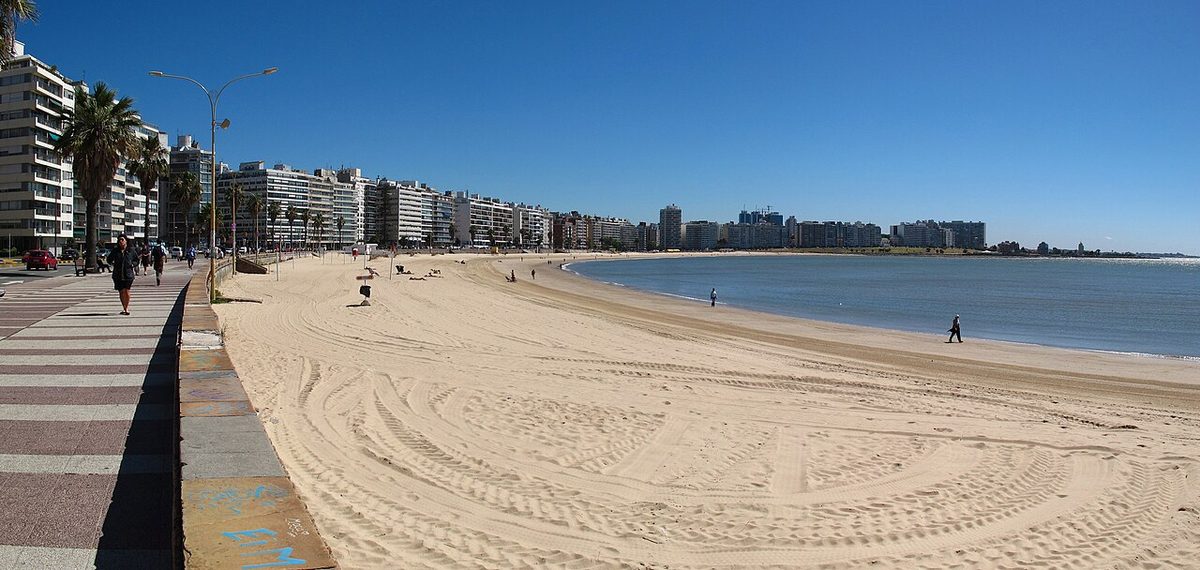
The classic. A long, gently curved crescent backed by apartment towers, busy with volleyball nets, mate-sipping locals, and runners on the rambla. The sand is genuinely good — fine and golden — and the city cleans it on a schedule in season. Swim here in January and you’ll share warm, calm, brown-tinted water with half the neighborhood. It reminds me a little of Rio’s Flamengo, minus the hassle. One honest drawback: the urban backdrop means you’re never quite “away.”
Playa Ramírez
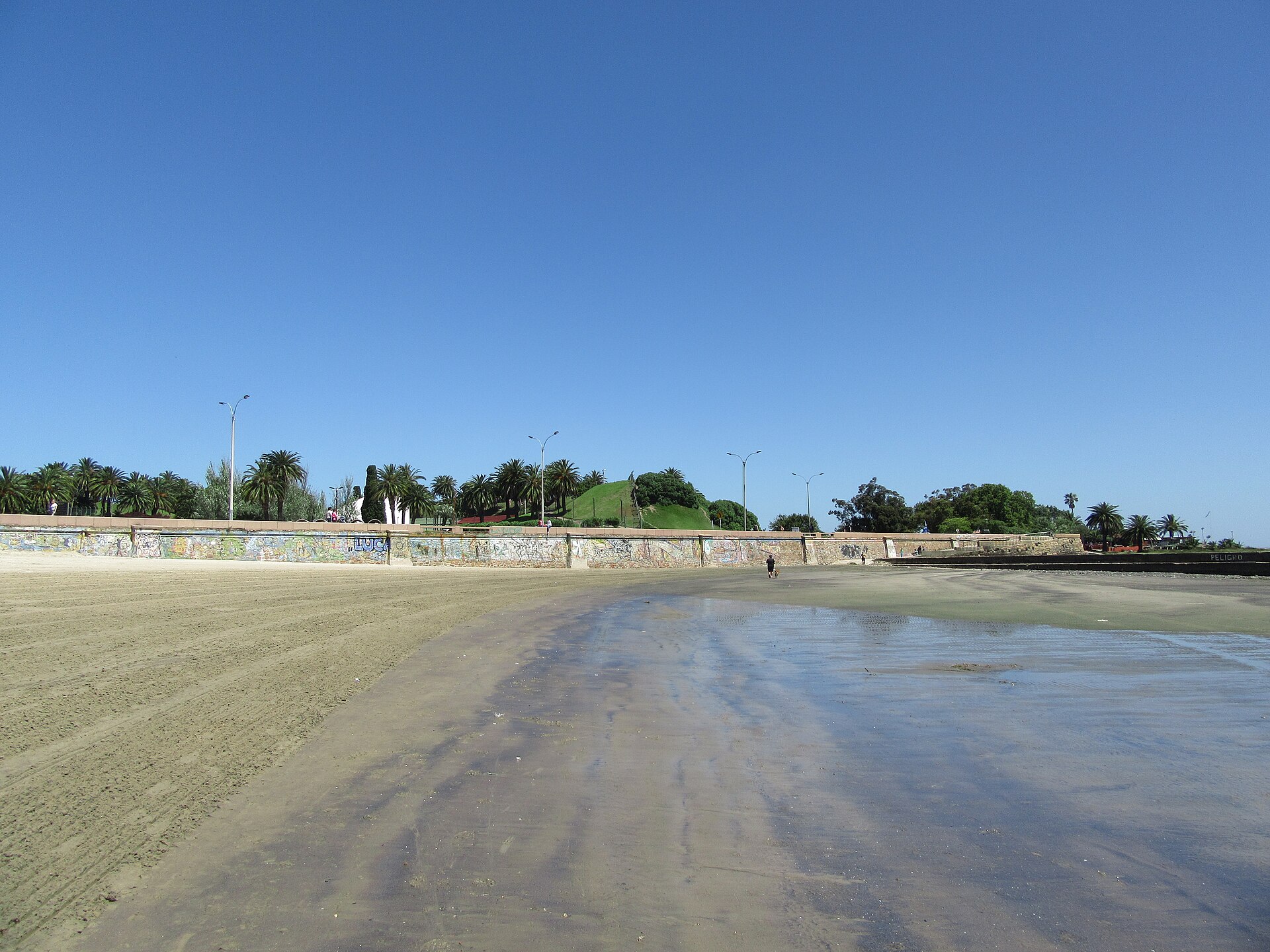
Smaller and more charming, a crescent fronting Parque Rodó with its funfair and weekend artisan stalls. You get a park instead of tower blocks behind you, group exercise classes on the sand, and the summer amphitheater nearby. I’d pick Ramírez over Pocitos for atmosphere, Pocitos for the better swim.
Playa de los Ingleses, Buceo and Carrasco
Heading east, Buceo sits by the port and yacht club (handy with kids — calm and shallow), while Carrasco anchors the city’s most elegant neighborhood, all wide sand and a quieter, residential feel with windsurfers and kitesurfers offshore on breezy days. If you’ve rented a bike, riding the rambla from Pocitos to Carrasco and beach-hopping along the way is one of my favorite free afternoons in the capital.
The Costa de Oro: Where Montevideo Actually Goes to the Beach
A short drive east of the capital along the old Interbalnearia highway brings you to a chain of pine-backed beach towns: Atlántida, Parque del Plata, La Floresta, Costa Azul. They lack Punta del Este’s fame, and that’s precisely the appeal. This is where middle-class Uruguayan families have summered for generations, in modest houses under maritime pines, and prices reflect local wallets rather than Argentine tourist budgets.
Atlántida
The hub of the strip, with two distinct beaches split by a small headland: Playa Mansa (calm side) and Playa Brava (wavier side) — a naming convention you’ll see repeated in Punta del Este. The town has proper services, a tree-shaded center that smells of pine and grilled chorizo, and two genuine architectural oddities worth a detour: the stone landmark of El Águila brooding over the dunes, and Eladio Dieste’s swooping brick Iglesia del Cristo Obrero, which made UNESCO’s World Heritage list in 2021. The honest drawback: the water is pure Río de la Plata — warm, calm, brown — and the sand is narrower than the Atlantic beaches further east. Come for an easy, cheap, very Uruguayan beach day, not drama.
The quieter towns
La Floresta and Costa Azul are sleepier versions of the same formula, and out of season they’re nearly abandoned in a melancholy, cinematic way. If you’re driving the coast and want a swim plus a milanesa lunch for half of what Punta del Este charges, pull off anywhere along here. You won’t need more than an afternoon.
Piriápolis: The Grand Old Lady of Uruguayan Beach Resorts
Piriápolis was founded in 1890 by an eccentric alchemist-entrepreneur named Francisco Piria, inspired by the grand European resorts of the Belle Époque, and it still carries itself like a seaside town that never fully updated — which I mean as a compliment. The centerpiece Argentino Hotel, a colossal 1930 pile modeled on European spa hotels, dominates a long rambla lined with palms.
The main beach, Playa Piriápolis, curves for over a kilometer in front of town: sheltered, family-friendly, with calm water that warms nicely by January. Follow the coast around Punta Fría headland to Playa San Francisco, or drive a little farther east to Punta Colorada’s reddish rocks and little surf break.
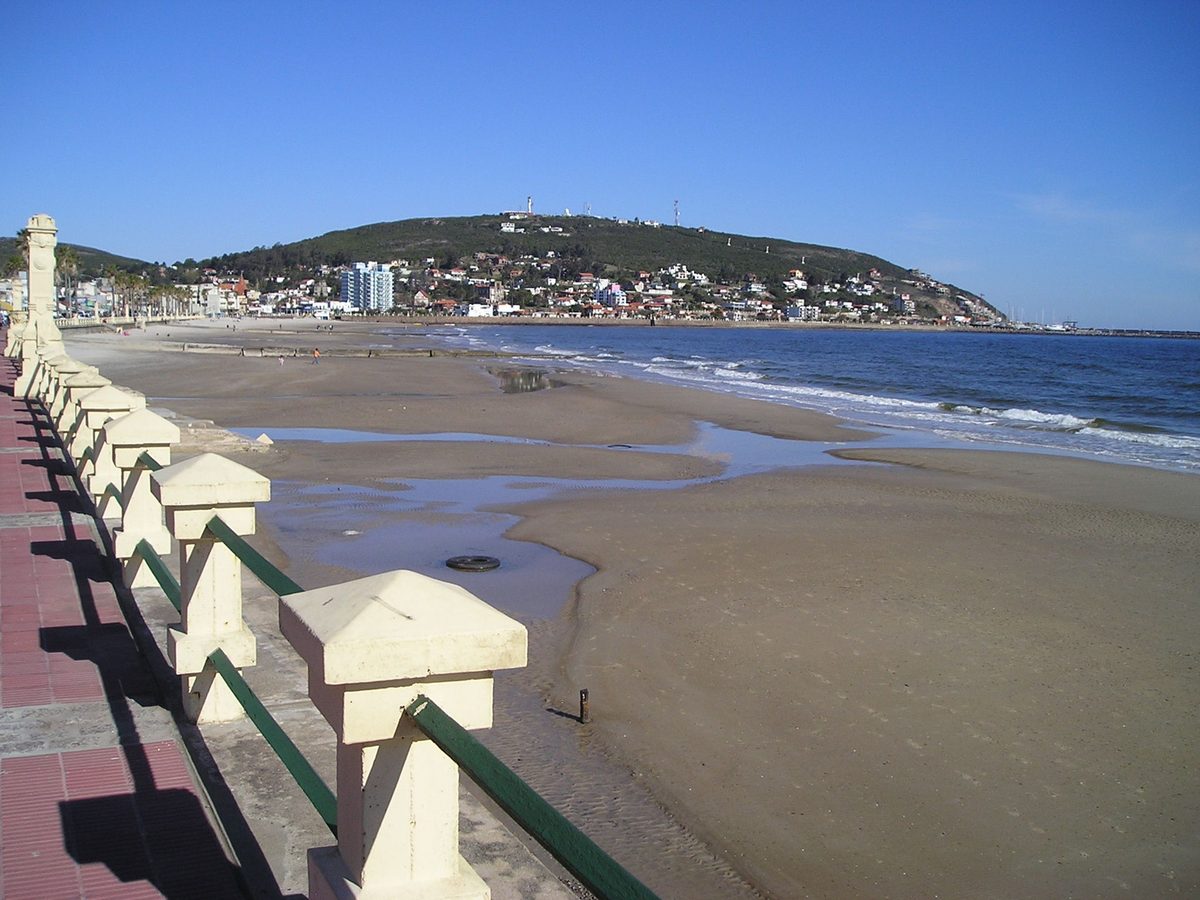
What sells Piriápolis for me is everything behind the beach. Cerro San Antonio has views toward Punta del Este (ask locally whether its chairlift is running before you plan on it), you can hike Cerro Pan de Azúcar, topped by a 35-meter cross, and Piria’s bizarre castle inland is open as a museum. It’s the best one-two of beach plus actual sightseeing on the whole river coast — I’ve ranked several of these in my guide to the best things to do in Uruguay. The drawback: nightlife is essentially zero, and the town feels dated if you’re after style. Families and anyone allergic to scene-y beaches will love it; the Instagram crowd should push on east.
Punta del Este: Mansa or Brava — Know Which Side You’re On
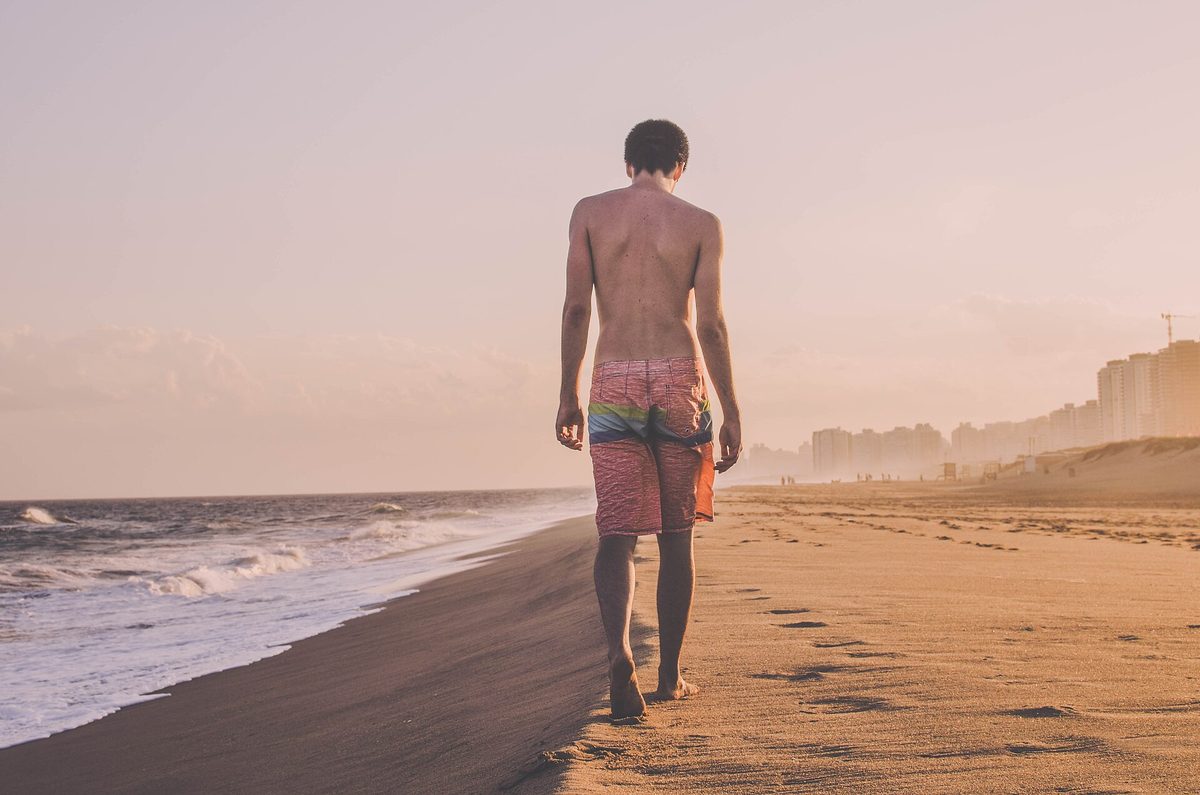
Punta del Este gets called the Monaco, Miami, and Saint-Tropez of South America, usually in the same paragraph. Strip away the branding and you’re left with something more useful: a narrow peninsula marking the conventional point where the Río de la Plata meets the Atlantic Ocean, with long stretches of legitimately excellent sand running away from it in both directions. I’ve written a full Punta del Este travel guide covering hotels, restaurants and the day trips; here I’ll stick to the sand.
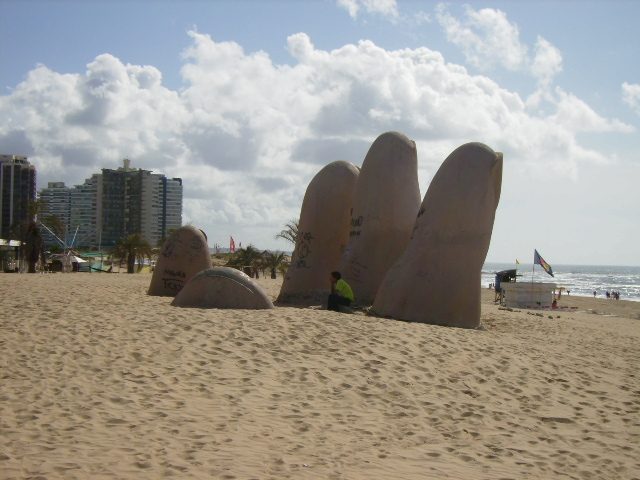
The geography is beautifully simple. West of the peninsula = Playa Mansa (“tame beach”), facing the estuary: calm water, gentle entry, sunset views, families, paddleboards. East = Playa Brava (“wild beach”), facing the open Atlantic: waves, currents, surfers, and the famous fingers of La Mano sculpture rising from the sand at Parada 1. Beaches on both sides are numbered by their bus stop — parada — so “Parada 9 Mansa” is a precise address. It’s the most organized beach system in the country.
Playa Mansa
The first few paradas, nearest the peninsula and marina, are the social heart: beach yoga at sunrise, jet skis, kayak rentals, and easy walks to restaurants. The water is noticeably clearer here than at Montevideo — you’re at the river’s mouth — though still not tropical blue. By Parada 16 and beyond toward Punta Ballena, things quieten down considerably. Mansa sunsets, with the sun dropping straight into the water, are the best free show in town.
Playa Brava
Cross the peninsula — a ten-minute walk — and the temperature of everything changes. Brava’s surf is real: good fun for bodysurfing, but rip currents are no joke on rough days, so respect the flag system and the lifeguards (on duty roughly December through Easter). Everyone does the La Mano photo; go at sunrise to get it without strangers’ elbows in frame.
La Barra, Bikini and Manantiales
Northeast across the wavy bridge at La Barra, the beaches turn younger and shinier. Playa Bikini at Manantiales is the see-and-be-seen strip — beach clubs, DJs by late afternoon, models in January, eye-watering drink prices. The sand and water are honestly excellent; whether you enjoy it depends entirely on your tolerance for paying around $10 for a beer near someone filming content. In January I find it exhausting by 6pm; in March, with the crowds gone, Bikini is quietly one of the prettiest beaches on this stretch of coast.
José Ignacio: Barefoot Luxury Done Properly
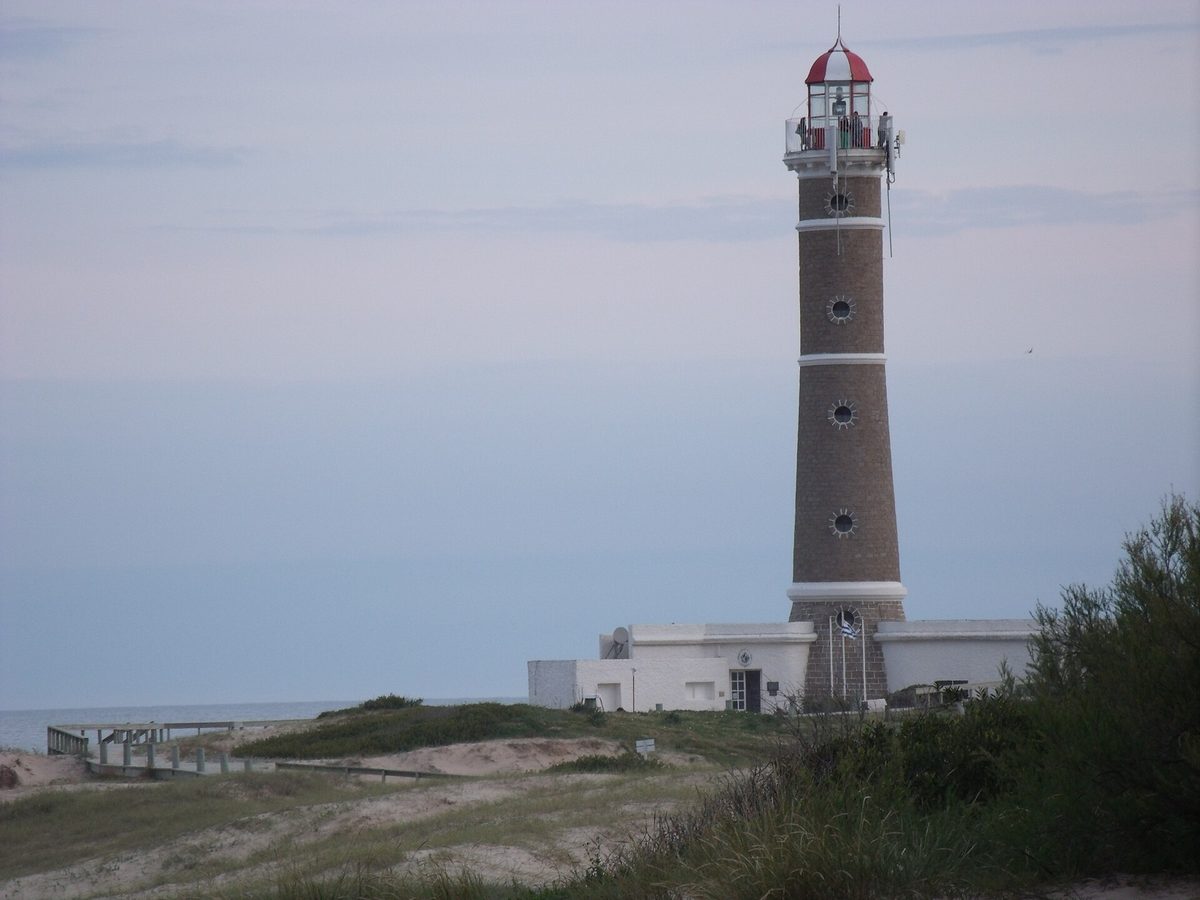
Farther east along the coast from Punta del Este, José Ignacio is a former fishing village that somehow became a fashionable beach destination — and, against the odds, stayed lovely. Local rules banning tall buildings, nightclubs and amplified music did the heavy lifting: the money arrived, but the village skyline didn’t change. Think sandy lanes, a working lighthouse, thatched-roof houses worth millions, and Porsches parked next to fishermen’s pickups.
The village sits on its own tiny peninsula, so it repeats the national pattern in miniature: Playa Mansa on the west side (calmer, sunset-facing, lagoon kitesurfers in the distance) and Playa Brava on the east (wilder, wider, running up to the lighthouse rocks). Brava is the showpiece — a long, dune-backed sweep where the crowd is somehow both barefoot and impeccably dressed.
The food scene outpunches the village’s size absurdly. Parador La Huella, set directly on the sand of Playa Brava, regularly ranks among the best restaurants in Latin America — grilled fish, clay-oven everything, and a reservation you should make well ahead in summer. It’s expensive (think around $60–90 a head with wine, last I checked) and worth it once.
The honest drawback is cost-of-everything: summer rentals here run to figures that make Punta del Este look reasonable, and there’s no real budget accommodation. My advice for most travelers: stay elsewhere, come for a long beach day and an early dinner, and leave before your wallet notices. If you’re road-tripping, the Ruta 10 drive onward across the circular Laguna Garzón bridge is a small joy in itself.
Rocha: Uruguay’s Wild Atlantic Coast (the Best Beaches in the Country)
Everything east of Laguna Garzón belongs to Rocha department, and I’ll put my cards on the table: this is where Uruguay’s truly great beaches live. The coast here is long Atlantic sweeps broken by rocky points, backed by extensive coastal dunes (Cabo Polonio’s mobile dunes can top 20 meters), with small towns that empty to near-nothing outside summer. If Punta del Este is about being seen, Rocha is about disappearing. Most people only have time to commit to one of the two, so I have set out choosing between Punta del Este and Rocha on cost, crowds and how you get around.
La Paloma
The most practical base in Rocha: an actual town with a bank, pharmacies, supermarkets and a bus terminal, set on a cape with beaches facing three directions — which means whatever the wind is doing, one of them is working. La Balconada is the famous one, angled so the sun sets over the water (rare on an east-facing coast), and the evening crowd on the rocks with mate and beers is a nightly ritual. La Aguada and Anaconda pull surfers; Bahía Grande, in the lee of the cape, is calm enough for kids and kayaks and has wheelchair access — genuinely uncommon on this coast. La Paloma won’t make you gasp like Cabo Polonio, but as a base for surf lessons and day trips it’s the sensible pick.
La Pedrera
Seven kilometers up the road, La Pedrera is the boho-chic one: a single main street running to a clifftop balcony over two long beaches, dusty lanes, good little restaurants, and a January scene beloved by Montevideo’s creative class. Playa del Barco, with the rusted bones of a shipwreck on the sand, is the surfers’ beach; El Desplayado, below the cliff, suits families. I think La Pedrera at dusk from that headland — beaches curving away in both directions — is one of the finest coastal views in the country. Drawback: in the first half of January it’s packed and pricey for what is, ultimately, a very small village; come in December or late February instead.
Cabo Polonio
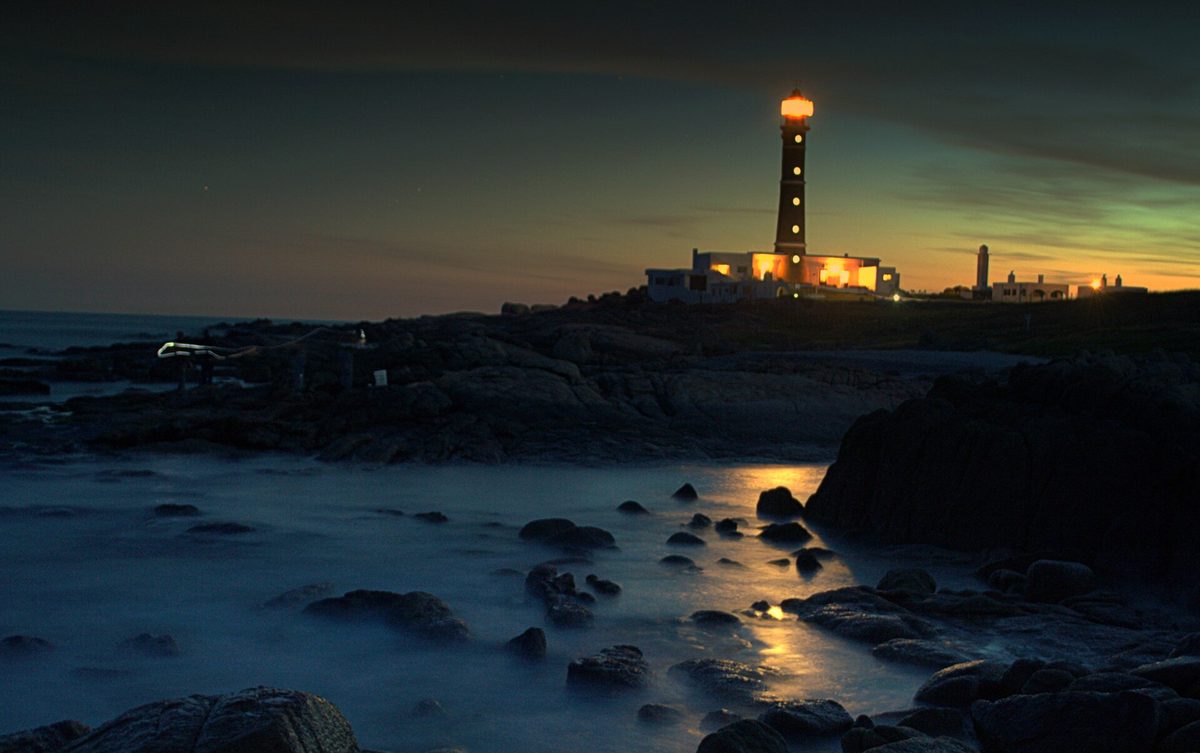
No roads in and no grid electricity: Cabo Polonio is a scatter of brightly painted shacks on a dune-backed cape inside a national park, reachable only by authorized 4×4 trucks that lurch over the dunes from the highway terminal, or on foot (a long, gorgeous beach hike from Barra de Valizas). Cabo Polonio and its offshore islands support important fur-seal and sea-lion colonies, with the historic lighthouse standing over the cape.
The beaches themselves — Playa Sur toward the lighthouse and Playa Norte, called La Calavera, toward the dunes — are wide, wild and beautiful, though the swimming is exposed and unsupervised; treat the ocean with respect. Spend at least one night. Day-trippers see a quirky village; overnighters, once the trucks stop running and candles come out, get the actual magic. Honest warnings: showers may be a bucket of well water, summer weekends get surprisingly crowded for an “off-grid” place, and if you need constant connectivity you will suffer.
Barra de Valizas and Aguas Dulces
The budget secret. Valizas is a ramshackle fishing-and-backpacker village just north of the Cabo Polonio dunes, and you can walk from here to the Cabo over the giant Cerro Buena Vista dune (a haul over beach and sand mountains; carry water). Aguas Dulces, a little further on, is even sleepier: stilted shacks above the tide line, fried-fish stands, almost zero tourism infrastructure. Neither has “amenities” worth the name, which is exactly why prices stay low and the vibe stays 1995.
Punta del Diablo
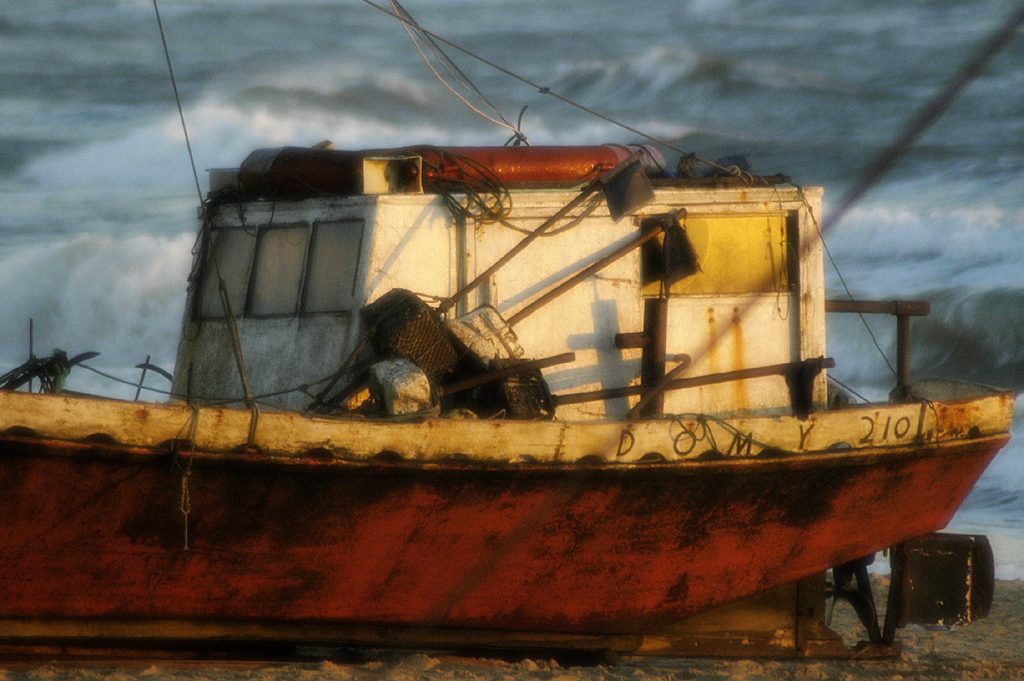
About 45 km from the Brazilian border at Chuy, Punta del Diablo is a surf-minded fishing village of dirt streets and timber cabins, home to 2,014 residents in the 2023 census and far busier in summer. Playa de los Pescadores, with its painted wooden fishing boats hauled up the sand, is the postcard; Playa de la Viuda is the surf beach; Playa del Rivero, the long sweep north of the point, suits swimmers and families, and beyond it the separate Playa Grande stretches toward Santa Teresa.
I love this town in December and February — bonfires on the beach, fishermen selling the morning’s catch, surf that works nearly year-round. In peak January it becomes a heaving student party, which is either the dream or the dealbreaker depending on who you are. Plan accordingly.
Playa Grande and Santa Teresa National Park
Walk north from Punta del Diablo (or drive into the park) and you reach Playa Grande, a beach inside Santa Teresa National Park where pine and eucalyptus forest runs nearly to the tide line and buildings simply stop. The park — administered by the army, oddly, around a restored 18th-century star fortress — has affordable camping under the trees, a wildlife refuge, and kilometers of sand. La Moza and the beaches near the fortress are wilder still. If your ideal beach has more birds than people, this corner of Uruguay is your answer.
La Coronilla and Barra del Chuy
The last stretch before Brazil. La Coronilla is a faded resort town slowly being rediscovered for one reason: it’s the gateway to Cerro Verde, a protected coastal area and Uruguay’s most important sea turtle habitat (the NGO Karumbé runs a small rescue center; green turtles feed here November through April). Barra del Chuy has endless hard-packed sand where locals drive onto the beach, and a frontier oddity factor — you can stand with one foot in each country at the border stones. For most first-timers these are skippable; for coast completists and wildlife people, quietly rewarding.
Which Uruguay Beach Is Right for You?
Thirteen-plus beaches is a lot to process, so here’s how I’d actually match them to travelers. These are opinions, not algorithms — argue with me by email if you like.
For families
Piriápolis first: calm, shallow water, a rambla made for evening ice-cream walks, the chairlift and castle when the kids mutiny against sand. Playa Mansa in Punta del Este (higher paradas, around 16–22) and Bahía Grande in La Paloma are the runners-up. The river coast generally beats the Atlantic for small children — warmer, calmer water and lifeguarded town beaches.
For surfers
Punta del Diablo’s La Viuda for its surf, La Paloma’s La Aguada and Anaconda for variety, Playa del Barco at La Pedrera for the scene. The Atlantic works more or less year-round if you bring rubber: a 4/3 wetsuit outside summer, and honestly even summer mornings can want a spring suit. Ask locally about board rental and lessons; La Paloma’s surf beaches run along nearly 10 kilometers of coast, with waves for every taste.
For seclusion and nature
Cabo Polonio overnight, Playa Grande and the Santa Teresa park beaches, Aguas Dulces midweek, and Cerro Verde near La Coronilla. In March you can have kilometers of any of these almost to yourself, sharing the sand with oystercatchers instead of umbrellas.
For nightlife and a social scene
Punta del Este (La Barra and Bikini in January) is the obvious answer and the right one — nowhere else on the coast comes close. Second tier: Punta del Diablo’s young summer crowd and La Pedrera’s first-week-of-January street party, which is fun and chaotic but very Uruguayan-twenty-something.
For luxury
José Ignacio, no contest — the hotels, the food, the crowd. Manantiales is the busier, flashier version. If your budget is high but you want quiet, look at the small inns around Laguna Garzón.
For budget travelers
Barra de Valizas and Aguas Dulces for rock-bottom beach time; Punta del Diablo and Cabo Polonio hostels shoulder-season; the Costa de Oro if you’re based in Montevideo. Santa Teresa’s campsites are around $10–15 a night under pine trees; the 2025–26 tariff was UYU 250 per person per day for ordinary plots and UYU 300 for serviced ones, with a three-night minimum, so confirm the coming season’s rates with the army’s park service.
If you only have time for one stretch
Rocha. Base in La Paloma or Punta del Diablo, day-trip to Cabo Polonio, and you’ll see the best of Uruguayan coast in three days. My Uruguay itinerary guide has a full route that threads Montevideo, Punta del Este and Rocha together in a week to ten days.
Planning Your Uruguay Beach Trip: The Practical Stuff
When to go
Beach season is December through March, full stop. January is the national holiday month: everything open, everything booked, prices doubled, beaches busy — energizing in Punta del Este, overwhelming in tiny La Pedrera. February keeps the warmth (the sea off Montevideo still averages about 23°C) with slightly saner crowds. Early December and March are my picks: warm enough to swim most days, accommodation 30–50% cheaper than January, and the towns still feel alive. April can deliver gorgeous lonely beach days if you’ll settle for walking over swimming. May through September, coastal towns largely hibernate — Cabo Polonio and Punta del Diablo in winter are atmospheric but most restaurants shut.
Getting there and around
You can do this entire coast by bus, which surprises people. From Montevideo’s Tres Cruces terminal, COT’s timetable lists Piriápolis (examples at 1h35–1h50), Punta del Este (2h10 and 2h20, slower via Piriápolis), La Paloma (3h30–3h35), La Pedrera (3h45–3h50), Punta del Diablo (4h10–4h25) and Chuy (4h55–5h10); check it for your travel date. For Cabo Polonio, the access terminal is on Ruta 10 at km 264.5, so confirm that your bus serves it. The official 4×4 trucks take over from there (UYU 470 return per person, roughly US$11–12). Fares are reasonable — COT lists Montevideo to Punta del Diablo at UYU 1,015 one way (about US$25–26).
That said, a rental car transforms Rocha: beaches like Playa Grande, the Laguna Garzón bridge, and the quieter stretches between towns become trivially easy, and Ruta 10 along the coast is a lovely drive. Roads are good and traffic outside January is light. Just don’t drive onto soft sand without 4×4 — tow-out stories are a Rocha tradition. Day-trippers from Buenos Aires also combine the ferry to Colonia with the coast; see my Colonia del Sacramento guide if you’re starting from that side (Colonia’s little river beaches are pleasant for a stroll, but don’t plan your swimming there).
Costs
Uruguay is the most expensive country in South America, and the coast in January is its priciest corner. Rough January numbers I’d plan around: a beach-town double from $80–120 in Rocha towns and $150–300+ in Punta del Este; double that energy for José Ignacio. A parrilla dinner for two with wine: around $50–70 in most towns, more in Punta. Shoulder season cuts accommodation by a third or more. Budget travelers can still do Valizas or camping at Santa Teresa on $40–50 a day. Bring a card — Uruguay is heavily cashless and paying by card cuts the IVA on restaurant bills by 9 points through 30 April 2027 (from 15 November 2026 to 30 April 2027 a foreign card takes the IVA off entirely for non-residents, so check your receipt), but small beach kiosks still like pesos.
Safety and sea sense
Uruguay’s beaches are safe by regional standards; petty theft of unattended bags is the main risk, and even that is modest outside crowded January strips. The ocean deserves more respect than the crime pages: Atlantic rip currents are common, town beaches fly colored flags (red = no swimming) with lifeguards in season, but park and village beaches like Cabo Polonio and Aguas Dulces are unsupervised. If you’re caught in a rip, swim parallel to shore until you’re out of it. And the UV index here is brutal in summer — the ozone hole years left their mark on local skin-cancer statistics — so sunscreen is non-negotiable even on hazy days.
What to book ahead
For January: accommodation everywhere (by October if you can), La Huella and the top Punta del Este restaurants, and any beachfront cabin in Punta del Diablo or La Pedrera. For February–March: a few days ahead is usually fine outside weekends. Cabo Polonio’s nicer posadas fill early year-round because there are so few of them.
Uruguayan Beach Culture: Small Things That Make the Coast Make Sense
A few cultural notes will make your beach days noticeably smoother. First, the thermos-and-mate rule: roughly half the people on any Uruguayan beach are cradling a gourd of yerba mate and a thermos of hot water, year-round, even at 35°C. Nobody will offer you any (sharing rounds is for friends), but bringing your own instantly marks you as someone who gets it. Second, beach days run late. Locals arrive at 4 or 5pm when the sun softens, and prime sand at noon in January is often just tourists slowly roasting; the evening beach — mate, bizcochos, guitar somewhere down the sand — is the cultural main event.
Third, food: beach kiosks and paradores sell chivitos and milanesa sandwiches, but the coastal specialty worth seeking out is fresh fish — corvina, brótola, pejerrey — grilled at fishing-village shacks in Punta del Diablo and Valizas for a fraction of restaurant prices. January brings churro carts and medialuna vendors working the towels. And everywhere, the asado smell starts around 9pm; if you rent a cabin with a parrillero grill, using it is practically a civic duty. I go deeper on all of this in my things to do in Uruguay rundown, but the short version: eat where the fishing boats are.
What I’d Skip (So You Don’t Have To)
Every guide should tell you what not to prioritize, so here’s mine. Skip swimming at Colonia del Sacramento — the old town is wonderful and absolutely worth a day, but its small river beaches are murky and underwhelming as a destination in themselves. Skip Bikini Beach in the first two weeks of January unless the beach-club scene IS your trip; the same sand is far more pleasant in March. Skip the Montevideo beaches west of the Old City (Ramírez westward toward the port) for swimming — water quality is at its weakest there after rain; the city posts advisories, so check flags. And I’d skip building a whole itinerary around Barra del Chuy unless border curiosities and beach-driving genuinely excite you — it’s a long way to go for hard-packed sand. None of these are bad places; they’re just the wrong first choices when Rocha is sitting right there.
Uruguay Beaches FAQ
Does Uruguay have nice beaches?
Yes — genuinely excellent ones, especially along the Atlantic coast of Rocha department. Expect long golden-sand beaches backed by dunes and pine forest rather than palm-fringed turquoise coves. The Punta del Este area delivers polished resort beaches; Cabo Polonio, La Pedrera and Punta del Diablo deliver wild, uncrowded ocean. By South American standards, only Brazil clearly outclasses them.
Can you swim in the sea in Uruguay?
Absolutely, from roughly December to March, when the water off Montevideo averages about 22–24°C (71–76°F). River-coast beaches like Montevideo and Playa Mansa are calm and family-friendly; Atlantic beaches have real waves and rip currents, so use lifeguarded stretches and watch the flags. Winter swimming, at 11–13°C, is strictly for wetsuits and the brave.
Why is the water brown at Uruguay’s beaches?
From Montevideo to about Punta del Este you’re swimming in the Río de la Plata, a giant estuary that carries silt from rivers draining half a continent. The brown-khaki tint is sediment, not pollution. East of Punta del Este the Atlantic takes over and the water turns blue-green — clearest in Rocha.
What is the nicest beach town in Uruguay?
Depends on your definition. For style and food, José Ignacio. For character and surf, Punta del Diablo. For sheer uniqueness, Cabo Polonio — no roads, no grid power, sea lions under the lighthouse. For a balanced family base with services, La Paloma or Piriápolis. My personal pick for atmosphere is La Pedrera in early December.
When is beach season in Uruguay?
Summer runs December through early March, with January the crowded national-holiday peak. Sea temperature off Montevideo tops out around 24°C in January. Early December and March offer warm water, lower prices and breathing room. From May to September most coastal towns largely close down.
Is Punta del Este worth visiting?
For a first trip, yes — the Mansa/Brava double coastline, La Mano, Casapueblo nearby and the restaurant scene justify two or three days, and beaches are excellent. Skip it if high-rises and January prices put you off; in that case go straight to Rocha. Off-season Punta is strikingly quiet — pleasant for some, ghostly for others.
Is Uruguay good for surfing?
Better than its reputation. The Atlantic coast picks up swell, and Punta del Diablo, La Paloma and La Pedrera are all surf destinations. Waves are friendly-to-fun rather than world-class, water is cool (wetsuits most of the year), and lineups are blissfully uncrowded compared with Brazil.
How do you get to Cabo Polonio?
Take a bus that serves the Cabo Polonio terminal on Ruta 10 at km 264.5 (check first that yours stops there), then ride an authorized truck over the dunes — around 20–30 bumpy, wonderful minutes. Alternatively, walk along the beach from Barra de Valizas over the Cerro Buena Vista dune. Private cars cannot enter the national park.
Final Thoughts: My Honest Take on Uruguay’s Coast
Uruguay’s beaches reward you most once you stop comparing them to the Caribbean and start taking them on their own terms: big skies, big dunes, water that’s river-brown in the west and Atlantic-green in the east, towns that range from champagne to driftwood. The fact that you can go from the capital to an off-grid cape with sea lions in a single day, by bus and then by truck over the dunes, still strikes me as absurdly underrated.
If I had to write the one-line version of this entire guide: spend a night or two on the river coast for the cities and the sunsets, then give every remaining day to Rocha. Walk the dunes from Valizas to Cabo Polonio, eat fried fish at Punta del Diablo with sand still on your feet, watch the sun drop from La Balconada — that’s the Uruguay coast I keep coming back for. The towers of Punta del Este are fun; the empty beaches east of them are the point.
Credits & sources
Sources & Further Reading
- Uruguay Ministry of Tourism — official destination and seasonal-events information
- Uruguay Ministry of Environment (SNAP protected areas) — Cabo Polonio and Cerro Verde protected-area details
- UNESCO World Heritage: Church of Atlántida — Eladio Dieste’s listed church near the Costa de Oro beaches
- Sea temperature data for Uruguay — monthly water-temperature averages
Photo Credits
- Playa Brava in Punta del Este, one of the best beaches in Uruguay — NaBUru38, CC BY-SA 4.0, via Wikimedia Commons
- The fingers of the La Mano sculpture rising from the sand of Playa Brava, Punta del Este — Wikimedia Commons contributor, Public domain, via Wikimedia Commons
- The main beach and old rambla balustrade at Piriapolis, with Cerro San Antonio behind — Wikimedia Commons contributor, Public domain, via Wikimedia Commons
- Evening light over the surf and high-rises at a Punta del Este beach — Paz Arando pazarando, CC0, via Wikimedia Commons
- The Jose Ignacio lighthouse above dunes and beach grass at the tip of the village — Fatima Cáneba, CC BY-SA 3.0, via Wikimedia Commons
- The lighthouse and off-grid houses of Cabo Polonio at dusk above the rocky Atlantic shore — Julio Clavijo Ferraro, CC BY-SA 4.0, via Wikimedia Commons
- A weathered wooden fishing boat hauled onto the sand at Punta del Diablo — Vince Alongi from Delta, B.C., Canada, CC BY 2.0, via Wikimedia Commons
- Playa Ramírez: 2016 extremo sur de la Playa Ramírez en la Rambla del Presidente Wilson. Punta Carretas, sur Montevideo by Felipe Restrepo Acosta, CC BY-SA 4.0, via Wikimedia Commons.